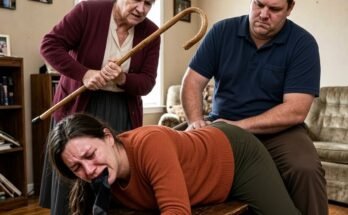
“If your daughter wakes up the whole house again tonight, you and she can both get out, Madison.”
My mother-in-law, Shelby, said it in front of everyone while my five-year-old daughter, Natasha, clung to my waist with swollen eyes from crying so much.
We lived in a three-story house in the Maplewood neighborhood of Columbus. My in-laws occupied the first floor, my husband Chandler, Natasha, and I lived on the second, and the third was packed with old furniture. During the day, my daughter was cheerful, polite, and endlessly talkative. But the moment the lights went out, she became a different child. She screamed, trembled, and begged us not to leave her alone.
Chandler and I had gone weeks without proper sleep. I had read that we needed to teach her independence, so I tried to stay firm. Chandler, exhausted from his job as an engineer, usually ended up carrying her through the hallway until he fell asleep sitting upright. Every night, our arguments grew worse.
The only person who never complained was my father-in-law, Walter. He was sixty-nine, with rough, calloused hands and a patience that never seemed to run out. He repaired Natasha’s toys and picked her up from kindergarten on his electric bicycle.
Whenever she asked why leaves fell from the trees, he would smile and tell her that even trees needed to rest.
Shelby was full of contradictions. One moment she would scold Natasha for leaving crumbs on the table, and five minutes later she would secretly tuck a sweet pastry away for her afternoon snack. She claimed her knees hurt too much to carry her granddaughter, yet every morning before dawn, Natasha’s school uniform was neatly ironed.
I noticed those small acts of kindness, but her harsh words always outweighed them. Walter, on the other hand, seemed to notice what everyone else missed. Every time an argument broke out, Natasha gripped an adult’s arm so tightly that her knuckles turned white.
The tension became even worse when Chandler’s younger brother, Kenneth, moved in with his wife Naomi and their daughter Paisley. They had closed their small electronics business and sold their apartment to pay off debts. They claimed they would only stay for three months, but they arrived with mattresses, boxes, a washing machine, and even a refrigerator.
Shelby immediately began counting every light left on and every glass of milk poured. She demanded that Naomi contribute toward groceries, electricity, and water. She constantly reminded me that I had been living “under her roof” for years.
Yet when her daughter Stephanie arrived in tears because her husband Brandon supposedly needed money for a construction contract, Shelby opened her drawer and handed over cash without asking a single question.
During dinner one evening, Naomi complained that not everyone was being treated by the same standard. Shelby sl:amm:ed her hand on the table.
“Bl00d is bl00d. A daughter will always be a daughter. Daughters-in-law, no matter how good they seem, will always be outsiders.”
My face burned with embarrassment. Chandler lowered his eyes. Kenneth tried to calm everyone down. Brandon quietly said that money could always be divided, but dignity could not.
The next morning, a scream sent all of us running into Shelby ‘s bedroom. Her closet stood wide open, clothes were scattered across the floor, and she was clutching an empty envelope.
“One hundred and eighty thousand dollars are gone!” she shouted.
Then she pointed directly at Naomi.
“You came in here yesterday to get Paisley’s medicine. Empty your suitcases right now.”
Naomi turned pale. Kenneth stepped in front of her protectively, but Shelby had already started throwing her clothes across the floor.
While Natasha watched silently from the staircase, my mother-in-law announced that she was calling the police on her own daughter-in-law.
None of us could have imagined what was about to happen next…
“Then call them.”
Naomi’s voice was so quiet that Shelby stopped with a sweater still clutched in her fist.
Kenneth turned toward his wife.
“Naomi—”
“No.” She wiped her face with the back of her hand. “Let her call. I want someone in this house to ask questions before deciding I’m guilty.”
Shelby dropped the sweater.
“You think being bold makes you innocent?”
“No,” Naomi said. “But being poor doesn’t make me a thief.”
From the staircase, Natasha made a small sound.
I turned.
She had both hands pressed over her ears.
Walter reached her before I did. He lowered himself onto the step beneath her and waited until she looked at him.
“Come help me water the plants, little bird.”
Natasha shook her head.
Her eyes were fixed on Shelby’s empty envelope.
Walter followed her gaze.
Then he looked back at her.
He did not ask a question in front of everyone.
He simply held out his hand.
This time, she took it.
The officers arrived forty minutes later.
Shelby met them at the door and began talking before they had introduced themselves.
The money.
The empty envelope.
Naomi’s visit to her bedroom.
Their debts.
Their failed business.
One officer listened while the other asked everyone to sit separately.
“Was the money yours alone?” he asked Shelby.
“My husband and I have been saving it for years.”
“Why was that amount kept in cash?”
Shelby’s mouth tightened.
“Walter withdrew it when a property purchase fell through. I hadn’t put it back yet.”
“When did you last count it?”
“Last Sunday.”
It was Thursday.
Four days.
Dozens of trips through the house.
Yet she had needed less than a minute to select Naomi.
The officer asked who knew where the money was kept.
Shelby glanced at Walter, who had returned from the porch.
“He did. Our children.”
“All three of your children?”
“Yes.”
“And their spouses?”
“I don’t know what they tell each other.”
The officer wrote that down.
Then he looked toward Stephanie and Brandon, who had arrived after Shelby called them.
Stephanie was crying.
Brandon rested a hand on her shoulder.
“Let’s not make this worse by accusing everyone,” he said.
The officer looked up.
“Then we’ll ask everyone the same questions.”
For the first time that morning, Brandon stopped looking comfortable.
No money was found in Naomi’s belongings.
No arrest was made.
The officers photographed the disturbed room, took statements, and asked Shelby not to move anything else.
She seemed offended that they were leaving without someone in handcuffs.
After the front door closed, she turned toward Naomi.
“You’ve embarrassed this family.”
Kenneth stepped forward.
“She asked you to call because you were tearing through her clothes.”
“If she hadn’t gone into my room—”
“You told her to get the medicine,” Walter said.
Everyone looked at him.
He stood beside the dining table, one hand resting on the back of a chair.
“Paisley had a fever. You told Naomi where the bottle was.”
Shelby stared at him.
“That doesn’t mean—”
“It means you left that part out.”
His voice was calm.
Somehow that made it harder to ignore.
Naomi bent to gather the clothes Shelby had left on the floor.
Kenneth helped her.
Nobody else moved.
I still remember that.
How easily a room full of people can watch someone being humiliated and mistake their own silence for staying out of it.
That night, Natasha began crying before I even reached for the light.
“Please leave the door open.”
“I will.”
“All the way.”
“All the way.”
“And don’t go downstairs.”
I sat beside her.
“Sweetheart, I’m only going to the kitchen.”
She grabbed my wrist.
“No.”
Chandler stood in the doorway with the exhausted expression I had begun to dread.
“Natasha, Mommy will be right back.”
Her breathing became quick and shallow.
“No. No, please.”
From downstairs, Shelby shouted, “Not again.”
Natasha flinched.
Walter appeared behind Chandler.
“Let her stay with me tonight.”
We all looked at him.
“Dad, you need your sleep,” Chandler said.
“So does she.”
He had been using the small first-floor guest room because Shelby said his snoring kept her awake. There was an old armchair beside the bed and a low reading lamp that Natasha loved.
Walter crouched carefully.
“What do you say, little bird? You can have the bed. I’ll take the chair.”
Natasha looked at me.
“Mommy won’t leave?”
“I’ll be upstairs.”
Walter waited.
Finally, she nodded.
I carried down her blanket and stuffed rabbit.
When I left the room, he was telling her why the moon sometimes appeared in the daytime.
For the first time in weeks, she did not call me back.
At ten-thirty, I passed the guest room.
The door was open.
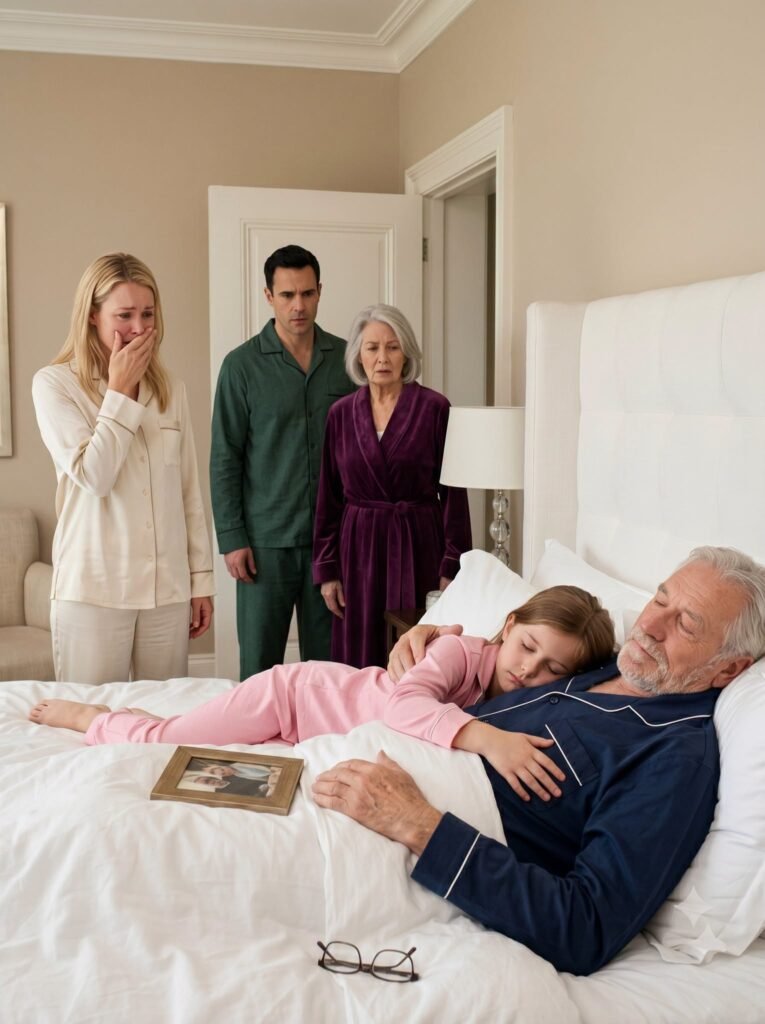
Natasha was asleep.
Really asleep.
Her hands were loose beside her face. Her forehead was smooth. The rabbit lay underneath one arm instead of being crushed against her chest.
Walter sat in the armchair, watching her.
He raised one finger to his lips.
I stepped inside and whispered, “How did you do that?”
He looked at me for a long moment.
“Tomorrow, Madison. We need to talk.”
“About what?”
He glanced toward Natasha.
“About what she’s afraid of.”
Something tightened in my stomach.
“Did she tell you something?”
“A little.”
I moved closer.
“Walter—”
“She needs to sleep.” His voice stayed gentle. “And when we talk to her, we need to listen without putting words in her mouth.”
He looked tired.
More tired than usual.
“Are you feeling all right?”
“Just worn out.”
On the small table beside him lay his glasses, a glass of water, and a little brass key.
I thought nothing of it.
I wish I could say I understood that night was different.
I didn’t.
I went upstairs believing morning was guaranteed.
Natasha woke me just after seven.
She stood beside my bed holding her rabbit.
“Grandpa’s still sleeping.”
I brushed the hair away from her face.
“Did you sleep well?”
She nodded.
“All night?”
Another nod.
Relief washed over me so strongly that I almost cried.
We went downstairs together.
I gently pushed the guest-room door farther open.
“Dad, we’re awake.”
Walter did not answer.
His head rested against the chair. His glasses were folded on his lap.
At first, he looked peaceful.
Then I noticed how still he was.
I touched his shoulder.
“Walter?”
Nothing.
I checked for a response, then turned to Natasha.
“Go upstairs and get Daddy, sweetheart.”
Something in my voice made her obey immediately.
I called 911.
I did not scream.
The dispatcher gave me instructions. As I tried to help him, I noticed the little brass key held loosely inside his curled hand.
I set it on the table so it would not fall.
Chandler reached the doorway.
He said, “Dad?”
Then again.
Louder.
“Dad.”
The paramedics could not bring him back.
Later, we were told his death appeared to be a sudden cardiac event during the night.
At the time, all I knew was that the man who had finally helped my daughter sleep would never tell her another story.
Shelby stood in the hallway in her robe.
“No,” she said.
Nobody answered.
“No. He was talking yesterday.”
As though death had made an administrative mistake.
As though someone could correct it if she explained clearly enough.
When they took Walter away, she reached for his sleeve.
Not his hand.
His sleeve.
“Your sweater,” she whispered. “You’ll be cold.”
That broke Chandler.
He folded against the wall and covered his face.
I held Natasha while she asked why Grandpa had gone without his shoes.
It was almost noon when I remembered the key.
I found it where I had placed it.
There was only one small lock in the guest room: the lock on Walter’s old metal filing case beneath the bedside table.
He kept appliance warranties in it.
Bicycle receipts.
Letters from former coworkers.
Ordinary things.
I called Chandler into the room before opening it.
“I think he wanted to talk to us about Natasha.”
Chandler looked hollow.
“What?”
“Last night. He said she’d told him something.”
We knelt beside the case.
The key turned.
On top of the files was an envelope.
Walter had written two names across it.
Madison and Chandler.
Beneath that:
Please listen before you ask her anything.
Inside was a handwritten note and a small digital recorder.
Chandler stared at them.
I unfolded the paper.
Natasha told me something this afternoon while we watered the plants. I asked if she wanted me to help tell her parents. She said yes, but she was afraid she would forget the words.
I recorded what she wanted you to hear. I did not know all of this before today.
There are other papers underneath. I should have spoken sooner about those.
My hands began shaking.
Chandler pressed play.
Walter’s voice filled the room.
Soft.
Familiar.
“Whenever you’re ready, little bird.”
A pause.
Then Natasha.
“If I tell Mommy, does she have to go away?”
I stopped breathing.
Walter answered, “You haven’t done anything wrong.”
“Aunt Stephanie said she would.”
Chandler looked at me.
The recording continued.
Natasha spoke in pieces.
The way young children do.
A hallway.
A light under a door.
Her getting up because she needed the bathroom.
“Aunt Stephanie had Grandma’s big envelope.”
“When was that?” Walter asked.
“Before Paisley’s medicine day.”
Then:
“She saw me.”
There was a rustling sound.
Walter moving closer, perhaps.
“What happened next?”
“She said Mommy and me would have to leave if I talked. And Daddy would stay here.”
My husband made a strangled sound.
Natasha kept speaking.
“Uncle Brandon said Grandma wouldn’t want us anymore.”
I pressed my hand over my mouth.
“He said I should stay in bed when it’s dark.”
There it was.
The hallway.
The darkness.
The frantic grip whenever I tried to leave.
We had been teaching our daughter to sleep alone while she was trying to keep me from disappearing.
The recorder captured Walter taking a slow breath.
Then his voice again.
“Thank you for telling me.”
“Are you mad?”
“No, sweetheart.”
“Is Grandma?”
“I’ll help explain it to the grown-ups.”
“Will Mommy stay?”
“I’m going to talk to Mommy and Daddy with you tomorrow.”
The recording ended shortly afterward.
No dramatic confession.
No perfect timeline.
Just a frightened five-year-old trying to explain the shape of her fear.
Chandler bent forward until his forehead touched his knees.
“I carried her through that hallway,” he whispered.
I could barely hear him.
“Every night. I told her there was nothing to be scared of.”
I looked at the recorder in his hand.
“So did I.”
We did not go upstairs and confront Stephanie.
We called the detective handling the missing money.
We told her about Walter’s death, the recording, and the papers.
She asked us to preserve everything and avoid repeatedly questioning Natasha.
A trained interviewer could speak with her in an appropriate setting.
For once, we listened before trying to solve the problem ourselves.
Then we examined the rest of Walter’s file.
Bank withdrawals.
Dates.
Amounts.
Copies of checks.
Messages printed from his phone.
Over the previous eighteen months, Shelby had given Stephanie and Brandon far more than any of us knew.
Money for a construction deposit.
Money to release equipment.
Money to cover payroll until a client paid.
The explanations changed.
The urgency did not.
Walter had started keeping records after noticing that the same supposed contract required a new emergency payment every few weeks.
On one page, he had written:
Asked Brandon for invoices. Still waiting.
On another:
Shelby says asking means I don’t trust our daughter.
The last document was a message from Stephanie to Walter.
Don’t tell Mom about the other money. She’ll never forgive me.
Chandler read it twice.
“Other money?”
Beneath it was Walter’s reply.
Come tomorrow morning. Bring the statements. No more explanations without records.
Tomorrow morning.
The morning that never happened for him.
The detective came that afternoon.
We gave her the original recording and the file.
We told Shelby only after the evidence had been handed over.
At first, she refused to believe us.
“Natasha misunderstood.”
Chandler looked up.
“She described Stephanie taking your envelope.”
“She’s five.”
“Yes,” he said. “She is.”
His voice broke.
“She’s five, Mom. And somebody told her she’d lose her mother.”
Shelby looked toward the doorway.
Natasha was upstairs with Naomi and Paisley.
For a moment, I thought she was about to shout.
Instead, she sat down.
Very slowly.
“Stephanie wouldn’t.”
I put Walter’s handwritten note in front of her.
She recognized his handwriting immediately.
Her fingers touched the page.
Then stopped.
The investigation did not depend on Natasha carrying the whole truth.
Her interview gave the detective a place to start.
The adults’ records did the rest.
Messages between Stephanie and Brandon discussed the cash before it disappeared.
Their accounts showed deposits and payments shortly afterward.
Some of the money had gone toward overdue personal debts.
Some had covered losses Brandon had hidden behind stories about construction work.
Part of it remained.
The contract that supposedly required the latest emergency payment did not exist in the form they had described.
When questioned separately, their explanations diverged.
Stephanie said Brandon had assured her they could replace the money quickly.
Brandon said Stephanie had told him her mother had agreed to help.
Then the detective showed them the messages.
Including one sent after Natasha saw the envelope.
She was in the hall.
And the answer:
Make sure she keeps quiet.
Stephanie came to the house once before her arrest.
Chandler met her on the porch.
I stood behind him.
She looked past us.
“Where’s Mom?”
“What do you want?” he asked.
“To explain.”
“Then explain why my daughter was afraid to sleep.”
Her mouth opened.
Nothing came out.
Finally, she said, “I never thought she’d take it that seriously.”
I stepped forward.
“You told her I would be sent away.”
“I was panicking.”
“She didn’t know that. She thought you were telling her how the world worked.”
Stephanie began crying.
“I was going to put it back.”
Chandler gripped the porch railing.
“And Naomi?”
Stephanie looked down.
“You watched Mom tear through her clothes,” he said. “You watched Kenneth defend her. You let the police question her.”
“I didn’t know how to stop it.”
“You tell the truth.”
He spoke so quietly that she had to look up.
“That was how.”
The funeral came before the legal case was resolved.
Walter’s electric bicycle stood in the garage.
Natasha’s broken music box remained on his workbench, its tiny screws arranged in a saucer.
I found a packet of replacement parts beside it.
He had ordered them three days before he died.
There are things grief does to you that nothing prepares you for.
I could accept that his chair was empty for a few seconds at a time.
I could not bear that he had expected to repair something on Saturday.
At the service, Natasha held a leaf she had found outside.
“Can I leave this with Grandpa?”
“Yes.”
“Because trees need to rest?”
I knelt beside her.
“Yes, sweetheart.”
She studied my face.
“Did he die because I told?”
The question went through me.
I held both her hands.
“No.”
I made sure she was looking at me.
“Nothing you said made Grandpa die. His heart stopped working. You did not cause it.”
She began to cry.
I stayed on the floor with her until she was ready to stand.
Shelby apologized to Naomi after the funeral.
We were in the kitchen.
Nobody had planned it.
Naomi was washing the cups people had left behind when Shelby said her name.
“I accused you because you needed help.”
Naomi turned off the water.
Shelby stared at the counter.
“I thought that made you capable of taking from me.”
“It made me someone who needed somewhere to live,” Naomi said.
“I know.”
“No. You know now.”
Shelby nodded.
There was no embrace.
No immediate forgiveness.
Naomi dried her hands and went upstairs.
But the next morning, Shelby corrected the relatives she had told about the missing money.
She called them herself.
She said Naomi had not stolen it.
She named the accusation as her mistake.
For the first time, she did some of the uncomfortable work instead of expecting kindness afterward to erase what she had said.
Stephanie and Brandon eventually faced criminal consequences for their roles in the theft.
The messages, financial records, and their own accounts established what had happened.
Restitution was ordered.
Some money was recovered.
Some had already disappeared into debts and spending.
Shelby had to accept that an order to repay was not the same as having her savings restored.
She also had to accept something worse.
Her daughter had allowed her to destroy another woman’s dignity to protect herself.
One evening, Shelby sat at the dining table with Walter’s file open.
“I gave her money because she was my daughter.”
Chandler remained standing.
“And you treated Madison and Naomi like they had to earn their place every morning.”
Shelby closed her eyes.
“I thought I was protecting my family.”
“You needed to count everyone in it.”
We moved out six weeks later.
Not across the country.
Not somewhere grand.
A small rental twenty minutes away, with a kitchen barely large enough for three chairs.
Chandler packed after work.
I sorted Natasha’s books.
We argued sometimes.
About what we should have noticed.
About how often he had stayed quiet when Shelby threatened to make us leave.
Once, he began to say his mother had never really meant it.
Then he stopped himself.
Natasha had believed her.
That was what mattered.
We found a child therapist and followed her guidance. Bedtime became slower. Predictable.
A story.
A small lamp.
The door open.
Someone nearby.
We stopped treating fear as disobedience.
Progress came unevenly.
Some nights Natasha slept until morning.
Other nights she appeared beside our bed, trembling.
We let recovery take longer than our impatience wanted it to.
Kenneth and Naomi found an apartment of their own.
Paisley came to play on Sundays.
Shelby visited occasionally, after calling first.
She still brought pastries.
But now, if Natasha spilled milk, she reached for a cloth.
One afternoon, she looked at my daughter and said, “I was wrong to say you and Mommy would have to leave.”
Natasha watched her carefully.
“I won’t say that again,” Shelby added.
Natasha did not run into her arms.
She nodded and returned to her crayons.
Shelby looked hurt.
Then she picked up the spilled pencils and helped put them back in the box.
It was a beginning.
It needed to be enough.
Several months after Walter died, Chandler repaired the music box.
He worked from his father’s notes.
When he wound it, the little tune filled our kitchen.
Natasha stared.
“Grandpa fixed it?”
Chandler swallowed.
“He started it. I finished.”
She held it with both hands.
That night, she asked to put it beside her bed.
I sat with her until the music slowed.
“Mommy?”
“Yes?”
“Grandpa believed me.”
I brushed her hair away from her cheek.
“Yes. He did.”
“He didn’t say I was being difficult.”
I had to wait before answering.
“No.”
She looked down at her rabbit.
“Do you believe me now?”
I took her small hand.
“Yes, Natasha. And I’m sorry I didn’t understand sooner.”
The room stayed quiet.
Then she shifted her pillow and lay down.
I waited beside her, listening as her breathing settled.
Just before she fell asleep, she whispered, “You can go get your tea.”
It was such an ordinary sentence.
A child letting her mother step into the next room.
I sat there with tears running down my face.
Then I stood, left the door open, and went to put the kettle on.