The box changed hands before anyone had a chance to pretend everything was still a celebration. Megan’s new husband carried it back across the porch, placed it in front of her, and asked her to open what had been brought as a wedding gift. What she found inside was not a traditional present, but a record of everything that had happened after a promise was broken.
The lake house had never been just a building to me. It was the place my grandmother had spent years filling with ordinary moments that mattered. Family dinners, quiet mornings by the water, and weekends where nobody needed an invitation because everyone understood they were welcome. When she left it to me, I knew I had inherited more than property. I had inherited the responsibility of protecting something she loved.
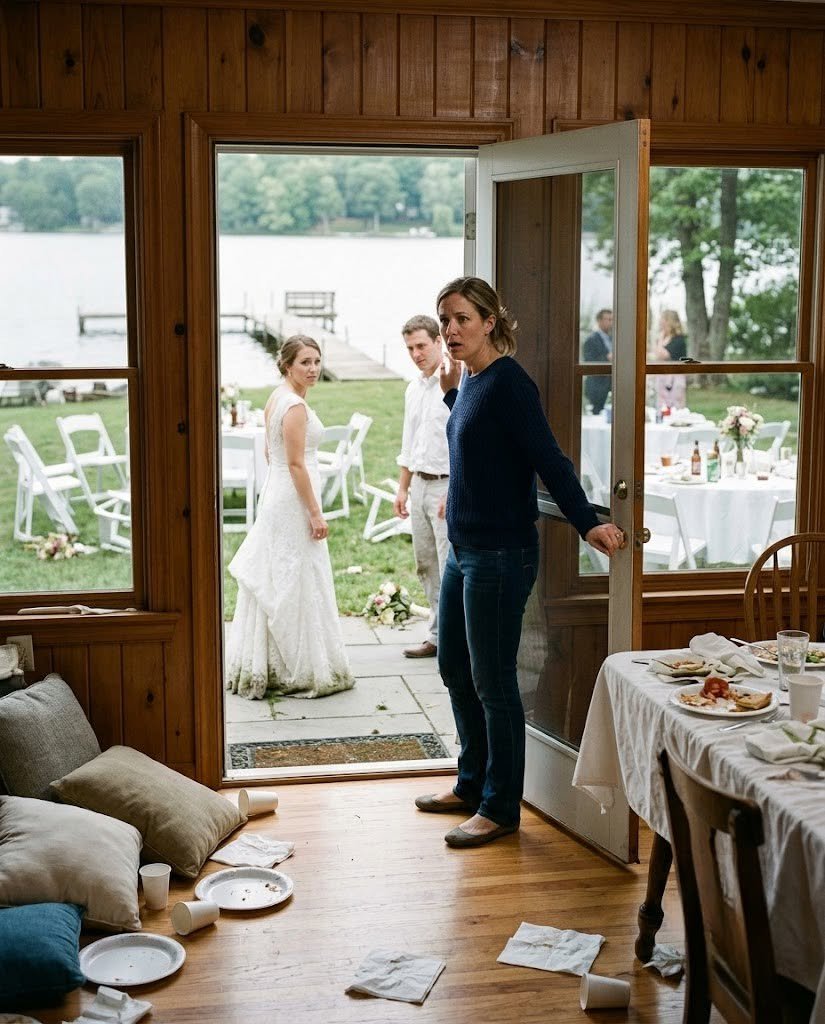
That was why I hesitated when Megan asked if she could hold her wedding there.
She was my husband Daniel’s sister, and she made the request sound simple. She described a small lakeside ceremony, something relaxed and meaningful. Daniel told me it would mean a lot to his family. He reminded me how much my grandmother enjoyed having people around the house.
I understood that part. I wanted the house to continue being a place where people made memories. But memories did not mean ignoring boundaries.
Before the wedding, I sent one clear message to everyone involved. The lawn and downstairs areas could be used. The upstairs bedrooms were private. Furniture stayed where it was. The house needed to be cleaned before everyone left.
Megan responded immediately.
“Of course. I promise.”
At the time, I believed her.
The first signs that something was wrong appeared before the reception was even over. The yard, which my grandmother had cared about so much, started showing damage. Chairs had been dragged across wet grass, leaving deep tracks behind. It was not a small mark that would disappear after a little rain. It was the kind of damage that happened when people stopped seeing the space as someone’s home and started seeing it as a venue they had rented for the night.
Inside, the situation was worse.
Catering boxes were stacked through the hallway. Drinks had somehow made their way upstairs despite the clear instructions. Wet towels were left outside bedrooms that were supposed to be private. Then I saw something that hurt more than the scratches or the mess.
One of my grandmother’s quilts was crumpled on the floor beneath garment bags.
That quilt had been part of the house long before anyone at that wedding arrived. It represented years of care, family history, and the kind of quiet love that does not need attention to matter.
I found Daniel near the back porch and showed him what I had found.
I expected him to understand immediately.
Instead, he rubbed his forehead and said, “Please don’t make this a thing tonight. It’s her wedding.”
That sentence stayed with me.
Not because I wanted to ruin his sister’s wedding. I did not want to stop the music, embarrass anyone, or pull attention away from the couple. I wanted my husband to recognize that something important to me was being treated like it belonged to nobody.
The problem was never just the torn screen or the dirty carpet. The problem was watching someone I trusted act as if my connection to the house mattered less because the people causing the damage were family.
Eventually, I found Megan and asked her to look at what was happening.
She barely glanced toward the house.
“It’s one night,” she said. “Stop acting like my landlord. Grandma left it to you on paper, but we all grew up coming here.”
That response told me everything.
She saw the history. She saw the memories. But she did not see the responsibility attached to them.
“You asked to use it,” I told her. “You didn’t ask to take it over.”
She rolled her eyes and returned to her guests.
I left the wedding feeling like I had somehow become the unreasonable person for wanting basic respect.
The next morning, I came back with trash bags and cleaning supplies.
The lake was calm. The trees reflected across the water. Under different circumstances, it would have been beautiful. Instead, the peaceful view made the condition of the property harder to ignore.
Plastic cups covered the lawn. Mud had been tracked across the entryway. The porch screen was hanging loose. Upstairs, the carpet had stains from people who ignored the one area they were told not to enter.
Then I saw something on the kitchen counter that changed the entire situation.
It was not just carelessness anymore.
Under a stack of disposable plates was a vendor schedule for another gathering planned at the lake house that morning. It listed brunch, full-house access, additional furniture setup, and pickup the following day.
The contact name was Megan’s.
The part that made my stomach drop was the property authorization line.
“Owner approval confirmed.”
I had never approved another event.
Megan had not misunderstood my instructions. She had planned beyond them.
The wedding was not the end of her use of the house. It was only the beginning of what she assumed she could do.
I called the vendor listed on the paperwork. I explained that I was the property owner and that I had never authorized the additional gathering. I did not yell. I did not threaten anyone. I simply corrected information that had never been true.
Then I changed the keypad code.
After that, I documented everything. The damaged screen. The scratched dining table. The stained carpet. The yard that needed attention. The estimate for cleaning and repairs came back at $4,783.
I kept every photo.
I kept the paperwork.
And I kept the wedding gift box.
Later that day, Megan arrived with her new husband and relatives expecting brunch at the lake house. She walked up like nothing had happened. She entered the code she had been given for the wedding.
It did not work.
She tried again.
Then she looked at me.
“You changed it?”
“Yes,” I said. “Your permission ended after the wedding.”
Her expression changed immediately.
“You can’t lock family out of a family house.”
That was when I showed her the vendor schedule.
I asked why she had told people she had the owner’s approval when she did not.
At first, she tried to explain it away. She said maybe the vendor had used the wrong wording. She acted like the problem was a misunderstanding instead of a decision she had made.
But her husband was standing there now.
And for the first time, he was not looking at me like I was the person causing trouble.
He was looking at the paperwork.
Then he was looking at her.
The difference mattered.
For days, I had felt like I was fighting against a family story where I was supposed to be the difficult one. Megan was the bride. Daniel was protecting his sister. Everyone wanted the celebration to continue without anyone asking what it cost someone else.
But the paperwork changed the conversation.
Facts have a way of doing that.
The plain white box I had been holding suddenly felt heavier.
I told Megan I had brought her the wedding gift I should have given her the day before.
Her husband took it first.
He carried it over and handed it to her.
Inside was the repair estimate.
Below it were printed photos showing exactly what had been damaged. The torn screen. The stained carpet. The scratched table. The damaged yard. The quilt that had been left on the floor.
At the bottom was a written boundary stating that nobody in Daniel’s family would have unsupervised access to the lake house again without my direct permission.
Megan stared at the papers.
Then she blamed me.
She said I could not put everything on her. She claimed Daniel had told her she could use the entire house.
That was when everyone looked at Daniel.
And Daniel had nowhere to hide.
He admitted he had said she could use the house. But he had not told her to ignore the rules. He had not told her to damage anything.
The problem was that Megan knew exactly where to push next.
She looked at him and said he had told her I would complain anyway, so she should not bother asking about every little thing.
That changed the room.
Because the issue was no longer just the wedding.
It was the conversation that happened before it.
The permission she believed she had was built on the idea that my concerns did not matter. The boundaries were treated as obstacles instead of information from the person responsible for the home.
For the first time that morning, Daniel stopped defending his sister.
Megan reached into her purse.
She unlocked her phone.
She opened their message thread.
Then she placed it in my hand.
And whatever was written there would decide whether this was a misunderstanding between family members or proof that the lake house had never been respected the way it should have been.