My cousin’s father leaned over me and lifted the photograph from my fingers.
He didn’t say anything at first.
His newborn son was still pressed against his chest, crying hard enough that every breath sounded broken apart, and the photograph looked strangely small in his free hand.
He looked at the baby’s face in the picture.
He looked at the hospital wristband on the floor.
He looked at the second blanket spread across my knees.
Then his eyes returned to the photograph.
“This isn’t him,” he said.
“I know.”
My elbow had started throbbing in time with my heartbeat, but I barely noticed it anymore.
What I noticed was the wristband.
When I had first pulled it from beneath the blanket, all I had registered was what it was.
Now I actually looked at it.
The plastic wasn’t clear and new like something that had come home with my cousin.
It was cloudy with age.
One edge had yellowed slightly, and the surface was flattened where it had apparently been stored beneath something heavy for a long time.
The second blanket was old too.
Not dirty in the same fresh, greasy way as the one my cousin had been lying in.
This one smelled like fabric that had spent years shut away somewhere—dust, detergent, and something faintly stale beneath both.
The photograph had the same feeling.
Its corners were soft from handling.
This wasn’t a collection somebody had assembled that morning.
It had history.
His father crouched beside me without putting his son down and turned the wristband until the printed side faced him.
His breathing changed.
I saw it happen before he spoke.
His shoulders stiffened first.
Then his thumb stopped moving against the edge of the band.
Finally, he whispered his sister’s full name.
I stared at him.
“What?”
He held the band closer.
The name printed on it belonged to the woman he had just forced out of the house.
But the date on it was from years before his son had been born.
Years before I had any memory of her being around a newborn at all.
For several seconds, neither of us moved.
The baby did.
He kicked beneath the blanket, gave another furious cry, and his father immediately adjusted his hold so the baby’s head stayed supported against his chest.
That ordinary movement pulled both of us back to what mattered first.
Whatever was under that sink could wait a few minutes.
The newborn couldn’t.
His father carried him out of the kitchen and called for medical help while I stayed near the cabinet, holding pressure against my elbow with a clean towel.
He wouldn’t let his sister back inside.
He wouldn’t go outside to argue with her either.
He locked the door and kept his son with him.
That mattered later, because once the adrenaline started wearing off, both of us kept trying to replay the kitchen as though there had been some decision we could have made differently.
There probably were a hundred smaller choices.
There wasn’t a different choice about getting the baby out of the sink.
The blanket wrapped around him had a damp patch near one side and fresh grease along a fold.
The pans beside him had not been washed.
The cabinet beneath him had been open.
And when I removed him, his aunt had fought me hard enough to split my elbow against the counter before tearing him back out of my arms.
Those facts did not disappear just because something older had been hidden below them.
By the time medical help arrived, the house felt completely different.
The kitchen was no longer just the place where the fight had happened.
It had become a scene none of us understood.
The first blanket was set aside.
The old blanket stayed where I had placed it.
The wristband and photograph remained together.
Nobody dug deeper through the cabinet.
Nobody wanted to disturb anything else until we understood what we were looking at.
My cousin was examined first.
That was his father’s only concern.
The baby had been screaming, moving, and reacting throughout the struggle, but his father still wanted someone qualified to check him after everything that had happened.
I needed attention for my elbow.
His sister needed attention for the injury near her hairline too.
The anger hadn’t vanished.
It had simply been forced to share space with something else.
Fear.
Not fear of what she might do next, because she was no longer near the baby.
Fear of what had already been happening inside her head before I walked through the door.
The first person his father called after making sure his son was being cared for was their mother.
He didn’t tell her the whole story over the phone.
He only said he had found an old infant photograph, a baby blanket, and a hospital wristband with his sister’s name on it.
There was a long pause on the other end.
Then their mother asked him one question.
“Where did you find them?”
“Under my kitchen sink.”
Another pause.
Longer this time.
“I need to come over,” she said.
Her reaction told him more than an explanation would have.
She knew the objects.
She knew the baby in the picture.
And for reasons neither of us understood yet, she had apparently hoped never to see those things again.
When she arrived, the violence was already over.
That made what came next quieter, but not easier.
She walked into the kitchen, stopped beside the table, and looked down at the photograph.
Her hand went to the back of a chair.
She didn’t sit.
She just held it.
His father placed the wristband beside the picture.
Their mother closed her eyes for a moment.
“That’s hers,” she said.
He answered immediately.
“I know the band is hers. Who is the baby?”
Their mother looked at him.
“Her daughter.”
He stared at her as if she had spoken in another language.
I did too.
His sister had once had a baby.
Not a pregnancy people vaguely remembered.
Not a family rumor.
A daughter who had been born alive, photographed, wrapped in that blanket, and given the hospital band now lying on his kitchen table.
The little girl had died when she was only days old.
The loss had happened long before I was old enough to understand family conversations, and the adults had gradually stopped talking about it because every mention seemed to tear the same wound open again.
His father remembered his sister being gone for a while when they were younger.
He remembered adults whispering.
He remembered being told she had lost the baby.
But he had never seen the photograph.
He had never held the blanket.
And he had never known those items had survived.
Their mother said she had packed the keepsakes away years earlier after his sister told her she could no longer bear seeing them.
The box had eventually been returned to his sister.
After that, their mother believed the belongings were either stored somewhere private or gone.
She had no idea they had been brought into her son’s house.
That changed the question.
Until then, I had been asking why there was another baby’s blanket under the sink.
Now we were asking why his sister had secretly brought her dead daughter’s belongings into a home with a newborn boy.
And why she had opened that cabinet while he was lying directly above it.
His father didn’t speculate aloud.
He was too angry for guesses and too scared of what those guesses might become.
Instead, he asked his mother when she had last seen the blanket.
Years ago.
When had she last seen the photograph?
The same time.
Did his sister ever mention wanting the items back?
Not recently.
Had she ever confused another baby with her daughter before?
Their mother hesitated.
That hesitation was the first answer.
The second came more slowly.
There had been difficult anniversaries.
There had been years when his sister avoided babies entirely.
There had also been times when she became intensely attached to pregnancies and newborns in the extended family, offering help people hadn’t asked for and becoming hurt when boundaries were set.
But nothing like this had happened before.
Nothing anyone knew about.
His father sat down.
For most of his life, he had defended his sister.
She could be difficult, he said, but she was family.
She had gone through something terrible.
She had helped him during bad stretches of his own life, and when his son was born, he had believed her eagerness to be around the baby came from love.
That trust was why she had been welcome in the house.
That trust was why nobody had treated her interest in the newborn as a warning by itself.
It was also why the photograph hurt him in a way the fight hadn’t yet managed to.
He had trusted her with access.
She had used that access to bring a hidden piece of another baby’s life into his home without telling him.
Still, there was one thing we did not know.
Intent.
We knew what she had done.
We didn’t yet know what she believed she was doing.
That distinction didn’t make the baby less endangered.
It did matter for what happened next.
His sister was not allowed back near the newborn that day.
There was no argument about that.
His father made the boundary before anyone asked him to.
He also made it clear that the family was not going to turn the afternoon into a screaming confrontation about a dead child.
She needed help.
The baby needed protection.
Both could be true at once.
Later, once the immediate injuries had been addressed and she was no longer in the middle of the crisis, his sister finally explained the cabinet.
The answer was simpler than the theories we had built in our heads.
And somehow worse.
She had hidden the keepsakes there herself.
She had brought the blanket, the photograph, and the wristband into the house days earlier.
She didn’t want her brother to see them because she knew he would ask why she had them around his newborn.
That afternoon, while holding the baby, she had decided she wanted to wrap him in her daughter’s blanket.
Just once.
That was how she described it.
Just once.
She had opened the cabinet to reach for the old blanket.
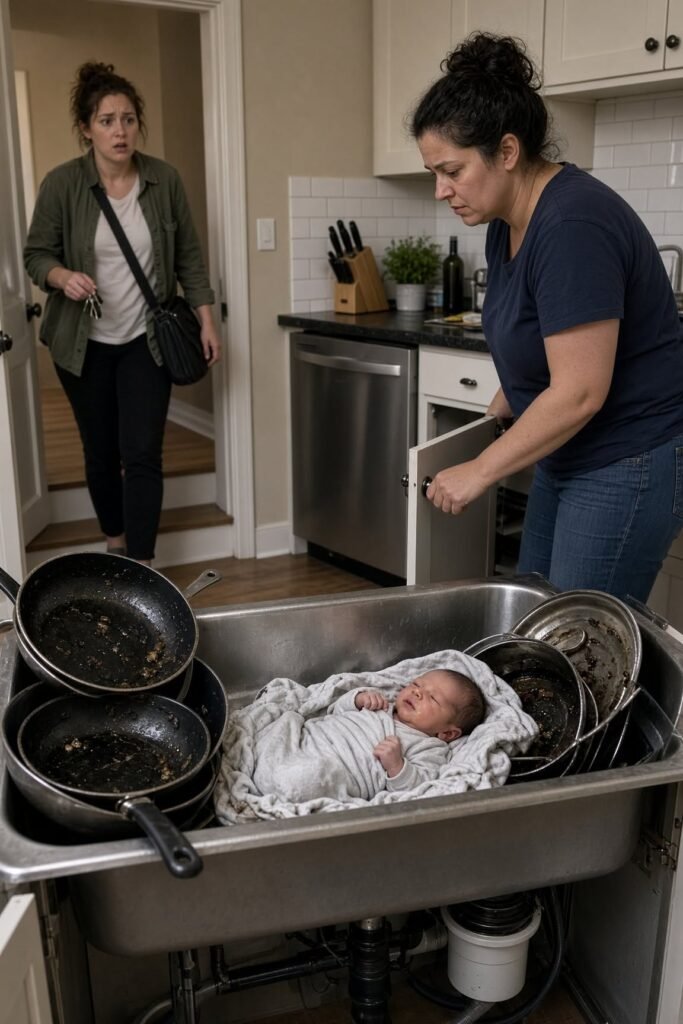
Instead of placing the newborn somewhere safe first, she had laid him in the kitchen sink because it was directly above the cabinet and left both of her hands free.
She claimed she only meant to leave him there for a moment.
The greasy pans were already beside him.
She had not cleared them.
She had not put down a clean towel.
She had not called anyone to hold him.
She had simply set a newborn among dirty cookware so she could reach into a cabinet for a dead baby’s blanket.
And then I walked in.
That explained the open door.
It explained the second blanket.
It explained why she had reacted so violently when I picked him up.
But the part that stayed with me was what she said about that moment.
When I lifted my cousin out of the sink, she said, she knew whose baby he was.
She knew he was her brother’s son.
But she had spent so much time imagining him in the old blanket that seeing me carry him away triggered the same panic she associated with losing her own child.
“I thought you were taking her away again,” she said.
Not him.
Her.
His father went quiet when he heard that.
He did not forgive what happened because of it.
Neither did I.
Understanding a dangerous act is not the same thing as making it harmless.
She had grabbed at a newborn during a struggle.
She had pulled him from my arms.
She had kept coming after him even after being knocked down.
No explanation could turn those moments into something safe.
But the explanation changed the shape of our anger.
Before, I had seen a woman fighting to take a baby she wanted to hurt.
Afterward, I saw a woman who had let an old loss distort what she was doing to a living child in front of her.
The danger had been real either way.
The response had to be real too.
His father refused to let guilt weaken the boundary.
There would be no unsupervised contact with his son.
There would be no dropping by because she was having a better day.
There would be no family pressure about how she had suffered enough and should be allowed to move on as if the kitchen had never happened.
If she wanted any relationship with her nephew in the future, it would come only after sustained professional help and only under conditions his parents believed were safe.
His sister didn’t like hearing that.
At first she called it punishment.
Her brother corrected her.
“It’s protection.”
Two words.
Nothing more.
He didn’t threaten her.
He didn’t insult her.
He didn’t use her daughter’s death against her.
He simply held his son and refused to negotiate about access to him.
That was the first moment after the fight when I saw his sister stop arguing.
Not because she agreed.
Because there was nothing left to argue with.
The baby was not a symbol.
He was not a replacement.
He was not an object she could borrow to revisit the worst day of her life.
He was a newborn who needed clean blankets, supported arms, safe surfaces, and adults capable of remembering that his needs came before their pain.
I had my own part of the afternoon to deal with.
For days, every time I bent my elbow, the injury reminded me of the counter.
The ceramic jar bothered me more.
I remembered reaching for it.
I remembered the sound when it connected.
I remembered seeing blood at her hairline and thinking, for one awful instant, that I had made everything worse.
Then I remembered her getting up and coming for the baby again.
I couldn’t make the sequence gentler by replaying it.
His father never told me I had done the perfect thing.
He told me something more useful.
“You got him out of the sink.”
That was the trust signal I needed from him.
Not praise for the fight.
Not permission to feel righteous about hurting somebody.
Just recognition that the first decision—the one that mattered most—had been to remove a newborn from danger.
His sister eventually admitted the same thing in her own way.
She did not apologize to me immediately.
At first, she could barely discuss the kitchen without defending some piece of it.
The sink had only been for a second.
The pans weren’t touching him.
She only wanted the blanket.
She never meant for anyone to get hurt.
Each explanation tried to shrink what happened.
Over time, that changed.
She stopped saying “only.”
She stopped explaining the duration.
She stopped arguing that intention mattered more than the risk she created.
The first apology that felt real was not dramatic.
She said, “You picked him up because I had put him somewhere unsafe. I should never have fought you for him.”
That was all.
Nobody hugged.
Nobody declared the family healed.
Some things improve without returning to what they were.
Her brother kept the same boundaries.
Their mother stopped protecting the old family secret as though silence had somehow protected her daughter.
And I stopped trying to decide whether the aunt I had known before that day and the woman who fought me in the kitchen were two different people.
They weren’t.
That was the harder truth.
A person can love her family and still become dangerous inside an unresolved obsession.
A person can deserve compassion and still lose access to someone vulnerable.
A terrible loss can explain why a boundary is painful without giving anyone permission to cross it.
Months later, I went back into that kitchen.
The cabinet beneath the sink was closed.
The old blanket was gone from the house.
So were the wristband and photograph.
Their mother had taken the keepsakes and, with his sister’s agreement, moved them somewhere they could be handled as memories of the child they actually belonged to instead of being hidden beside another baby’s things.
The greasy pans were long gone too.
The coffee jar had never been replaced.
I noticed the empty spot beside the faucet immediately.
Then I noticed my cousin’s father standing at the sink.
He was washing a bottle with one hand while his son rested securely against his chest in a soft carrier, small fingers curled into the fabric of his shirt.
The baby was bigger now.
Alert.
Safe.
His father rinsed the bottle, set it on a clean towel, and rested his palm briefly against the back of his son’s head.
Nothing about the moment was dramatic.
That was why it stayed with me.
The same kitchen that had once been full of shouting, grease, blood, dirty cookware, and a cabinet nobody could stop staring at had become ordinary again.
Not forgotten.
Ordinary.
There is a difference.
We never pretended the sink hadn’t happened.
We never pretended the photograph made it acceptable.
We simply stopped allowing the worst moment in that room to control every moment that came after it.
His father kept washing bottles.
His sister kept getting help without being promised access she had not yet earned.
Their mother finally spoke openly about the baby in the photograph instead of treating her short life like a secret too painful to name.
And my cousin kept growing without ever needing to understand why, during his first weeks of life, another baby’s blanket had been waiting beneath a kitchen sink.
The photograph had looked like evidence of something monstrous when we first pulled it from the cabinet.
In the end, it was evidence of something sadder and more complicated: a child who had existed, a mother who had never learned how to carry that loss safely, and a family that had mistaken silence for healing.
But the final lesson in that house did not belong to the old photograph.
It belonged to the living baby.
He was not responsible for repairing anybody’s grief.
He never had to be.