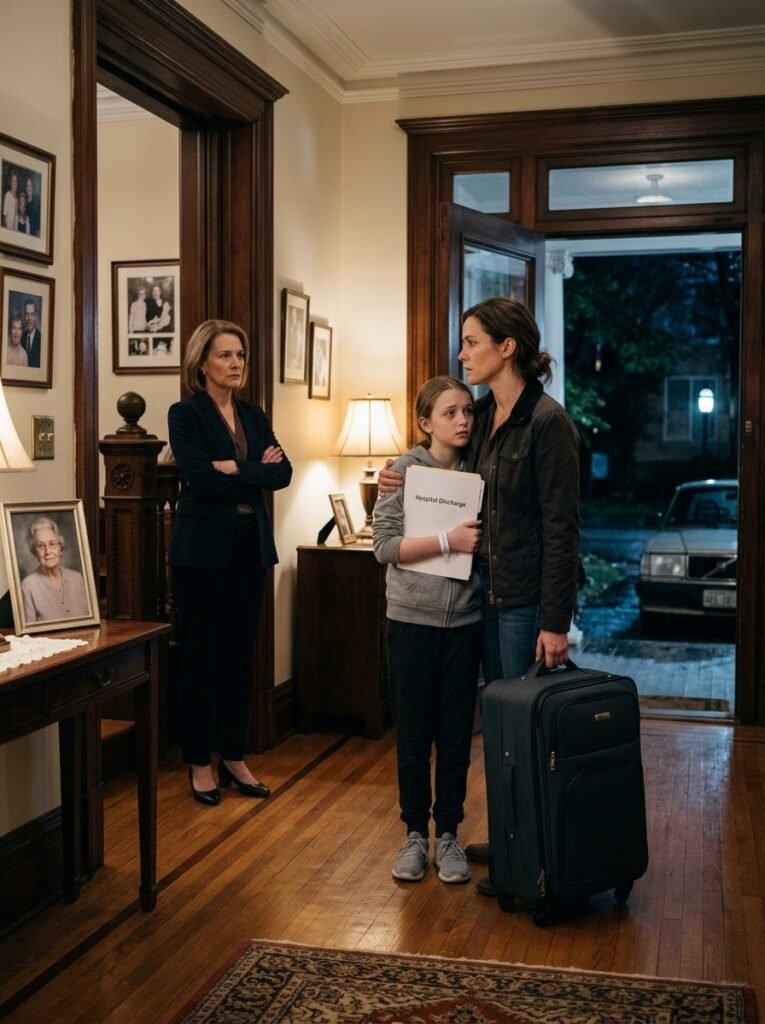
The house had been my grandmother’s before it was ever theirs. She’d left it to my mother with one condition scrawled into a handwritten codicil: that it never be used to pressure or exclude family members from support they were entitled to. I didn’t fully understand what that meant when I was twenty-two and grieving. I understood it now.
“You have until tonight,” my mother said, nodding toward the suitcase in the hallway. “Two thousand dollars for Vanessa’s rent, or you and Lily can figure out somewhere else to sleep.”
Lily’s hand tightened around the strap of her hospital discharge folder. She was twelve. She shouldn’t have had to hear any of this, let alone on the same day she’d fainted at school and spent six hours hooked to a monitor while doctors ran her blood work.
“I just paid your rent last month,” I said. “And the month before that.”
“And you’ll keep paying it,” Vanessa said around a mouthful of takeout, “because that’s what family does.”
“Family doesn’t throw a sick child’s belongings on the lawn.”
My father crossed his arms. “You want to talk about sick? You want to talk about who’s actually struggling in this family? Vanessa doesn’t have your job. She doesn’t have your income.”
“She doesn’t have a job at all,” I said. “Because you keep bailing her out every time she quits one.”
The silence that followed had teeth in it.
“Get out,” my mother said, quieter now, which was somehow worse than the screaming. “If you’re not going to help this family, you don’t get to live under its roof.”
I looked at Lily. She was watching me with the same expression she’d had in the ER — braced, waiting to see whether the adults in the room were going to make things better or worse.
I picked up the suitcase.
“Okay,” I said.
My mother blinked, clearly expecting more of a fight.
“Okay?” she repeated.
“Okay,” I said again. “We’ll go.”
What none of them knew was that I had already spoken to a lawyer three weeks earlier — after the fourth demand for “emergency” money in two months — about exactly what that codicil in Grandma’s will actually meant, and what it would take to enforce it.
What the Codicil Actually Said
I drove Lily to a motel that night — clean enough, cheap enough, with a vending machine down the hall that she found weirdly comforting. She fell asleep within twenty minutes of putting her head down, worn out from the hospital and the shouting and the cold parking lot where we’d loaded the suitcase into my trunk while my mother stood on the porch, arms crossed, watching us go like we were the ones who’d done something wrong.
I sat up for another hour, going through the folder I’d kept in my glove compartment since the meeting with my lawyer three weeks earlier.
Her name was Denise Okonkwo, and she’d been blunt with me from the start.
“Your grandmother’s will has a support clause,” she’d told me, sliding a photocopy across her desk. “It says the house — and any income derived from renting rooms in it, which is what’s effectively been happening with your sister living there rent-free while your mother demands money from you to cover her — must be used to support all grandchildren equally. Not just Vanessa.”
“I didn’t know that existed.”
“Most families don’t read the fine print until someone makes them,” Denise said. “Has your mother ever asked you for money specifically tied to the house? Rent, utilities, repairs?”
“Constantly.”
“Do you have records?”
I did. Three years of bank transfers, texts, even a voicemail where my mother had said, verbatim, “If you don’t help cover Vanessa’s rent, don’t bother coming to your grandmother’s grave, because you clearly don’t understand what family meant to her.”
Denise had smiled at that one — not kindly. “That’s going to be useful.”
Now, sitting in a motel room with my sleeping daughter beside me, I opened the folder again and reread the letter Denise had drafted, ready to be sent the moment I gave the word. It laid out, in careful legal language, that under the terms of Eleanor Hart’s estate, my mother had a fiduciary obligation to use house-related funds equitably among all grandchildren — and that three years of one-sided financial demands, documented in writing, constituted a breach worth bringing before the same probate court that had already ruled once in my favor over the inheritance.
I hadn’t wanted to use it. I’d hoped, foolishly maybe, that things would just get better on their own — that eventually my parents would notice they had two daughters, not one.
Tonight had ended that hope for good.
I picked up my phone and texted Denise: Send it.
Then I turned off the lamp and lay down next to Lily, who murmured something in her sleep and shifted closer, the hospital wristband still looped loosely around her wrist.
Three days later, my mother called nine times in a row.
I let all nine go to voicemail. Then I listened to them, one after another, in the parking lot of Lily’s school.
The first was furious. The fifth was pleading. The ninth, recorded at 11:47 that night, was quiet in a way I hadn’t heard from my mother in years.
“Claire,” she said. “The lawyer said… he said this could go to court. He said I could lose the house.”
I didn’t call back that day. But I saved the voicemail, right next to the others, in a folder Denise had told me to keep building.
What Family Was Supposed to Mean
The hearing was smaller than I expected. No dramatic courtroom, no gallery of relatives — just a conference room at the courthouse, a mediator named Judge Patricia Álvarez who handled probate disputes, my lawyer Denise, my mother, and her attorney, a tired-looking man named Grant who kept glancing at his watch like he already knew how this would go.
My mother wore the same string of pearls she’d worn to my grandmother’s funeral. I wondered if she’d done that on purpose.
Denise laid out the documentation first — three years of bank transfers, the texts, the voicemails, the codicil itself, highlighted in yellow where it specified “equitable support among all surviving grandchildren.” Judge Álvarez read through it slowly, occasionally making a note.
“Mrs. Hart-Whitfield,” she said eventually, looking at my mother over her glasses, “can you explain why Vanessa received housing and financial support from estate-related funds while Claire was asked to independently subsidize that support, on top of raising her own child?”
My mother’s attorney started to answer for her. Judge Álvarez held up a hand.
“I’d like to hear from Mrs. Hart-Whitfield.”
My mother’s hands were folded tightly in her lap. “Vanessa needed more help,” she said finally. “She’s always needed more help.”
“And Claire didn’t?”
Silence.
“Claire has a daughter,” my mother said. “She’s stable. She has a job.”
“She had a daughter in the emergency room the same night you demanded two thousand dollars from her and removed her belongings from the property when she couldn’t produce it immediately,” Judge Álvarez said, reading directly from Denise’s brief. “Is that accurate?”
My mother didn’t answer.
It didn’t need a dramatic ending. Judge Álvarez ruled that the estate’s support provisions had been breached, ordered a formal accounting of three years of house-related expenses, and required that going forward, any financial support drawn from the estate be distributed equally and documented — reviewed annually by an independent trustee, not my mother.
My mother didn’t look at me on the way out.
Six months later, Lily and I moved into a small rental two towns over — nothing fancy, but ours, with a lease in my name only and a landlord who didn’t demand anything beyond rent paid on time. Lily kept the hospital wristband in her nightstand drawer for a while, like a small, strange souvenir of the night everything changed, before eventually throwing it away on her own, without me having to ask.
Vanessa called once, angry that the “free ride,” as she put it, was over. I let that call go to voicemail too.
My mother sent one letter, three months after the hearing. It wasn’t an apology, not really — more an attempt to explain herself, to describe how frightened she’d been of losing Vanessa’s love if she ever said no to her. I read it twice, then put it in the same folder as everything else, not because I needed it as evidence anymore, but because I thought, someday, Lily might want to understand the whole story — not just the ending, but everything that led to it.
Some nights, I still think about that hallway, that suitcase already packed and waiting for us on the porch. I think about how certain they were that pressure and fear would be enough to make me fold.
They had no idea I’d already stopped being the daughter who folded.