The call connected, and before I had time to prepare myself, the voice on the other end said something that changed how everyone in that room understood the night my wife died.
I remember tightening my grip on the phone.
Around me, relatives who had been arguing only moments earlier stopped talking.
My seven-year-old son stood beside me, watching my face.
He had already been right once that day.
That was what terrified me.
To understand why one phone call could make an entire family afraid to speak, you have to go back less than an hour, to a graveside covered in fresh dirt and flowers that were already beginning to lean in the afternoon air.
We had just buried my wife.
I still couldn’t make those words feel real.
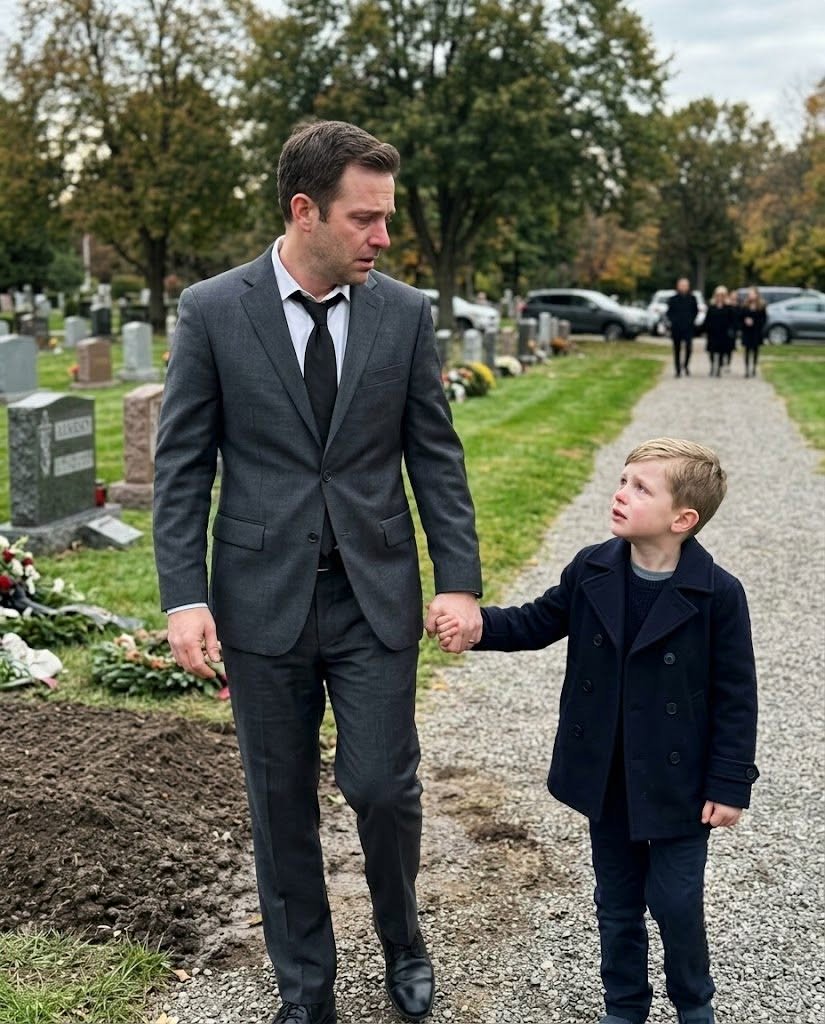
There had been people around me all morning, offering condolences, touching my shoulder, telling me they were sorry, asking whether my son and I needed anything.
I barely remember answering them.
Grief had reduced the world to small tasks.
Stand here.
Shake this hand.
Thank this person.
Make sure my son had his jacket.
Make sure he ate something.
Try not to look too long at the place where the coffin had disappeared beneath the ground.
My son had been unusually quiet through most of it.
At seven, he was old enough to understand that his mother was gone, but young enough that every adult around him seemed to expect his grief to look a certain way.
Crying was understandable.
Silence was understandable.
Asking when Mom was coming home would have been heartbreaking, but understandable.
What he did instead was grab my hand.
His fingers were cold.
When I looked down, his face wasn’t blank with exhaustion. He looked frightened.
Not sad.
Frightened.
“Dad… that’s not Mom.”
For a moment I honestly thought I had misheard him.
People were still moving behind us. Someone was gathering flowers. A relative was speaking quietly several feet away.
I bent closer to him.
“What did you say?”
He looked toward the grave and then back at me.
“That’s not Mom.”
My first reaction was not suspicion.
It was grief.
I thought the day had finally become too much for him.
He had seen adults crying. He had heard people speaking about his mother in the past tense. He had stood through a funeral no child should have to attend.
I told myself his mind was trying to protect him.
Maybe if the woman in the coffin wasn’t really his mother, then his mother could still come home.
It made emotional sense.
That was almost enough for me to dismiss it.
Almost.
I started to tell him we should go.
Then he interrupted me.
“Mom chipped her front tooth the night before she died.”
Everything inside me seemed to stop at once.
That detail was real.
I remembered the moment immediately.
It had been so ordinary that, before my son said it aloud, I hadn’t thought about it since the accident.
My wife had damaged one of her front teeth the previous night.
She had run her tongue over the rough edge and laughed.
Not because it was funny, exactly, but because that was how she handled little annoyances.
She joked that she finally had a reason to make a dentist appointment.
I remembered looking at her smile.
I remembered the chip.
Most of all, I remembered how insignificant it had seemed.
Nobody documents a moment like that.
Nobody thinks, I should remember exactly what this tooth looks like in case I need to identify the person I love tomorrow.
Life doesn’t warn you which ordinary details are about to become important.
I crouched beside my son.
“How do you know?” I asked.
His answer did not make me feel better.
“I saw Mom smile.”
I asked whether he meant in a photograph.
He shook his head.
I asked whether he had dreamed about her.
Again, no.
He kept insisting that he had seen his mother smile after the accident.
And that the smile he remembered did not match what he had seen during the funeral.
That was the part I could not get past.
Children can misunderstand things.
Children can fill gaps in their memories.
Adults do it too.
But my son wasn’t changing his story to match my questions.
He wasn’t inventing extra details every time I challenged him.
He kept returning to the same simple point.
The tooth.
The smile.
The woman in the coffin.
They did not match.
A few family members noticed us talking and came over.
I explained what he had said.
The reaction was exactly what I expected.
They told me he was exhausted.
They said grief could make a child cling to strange ideas.
Someone suggested I take him home and let him sleep.
Another person told me not to encourage him by asking questions.
I understood what they meant.
Part of me wanted them to be right.
Being right meant there was nothing else to investigate.
Being right meant this was simply a terrible day and not the beginning of something worse.
But my son looked at me while the adults talked around him.
He wasn’t pleading for attention.
He was waiting for me to believe him.
That changed my decision.
I had spent his entire life telling him to come to me when something was wrong.
I had told him I would listen.
It would have been easy to mean that promise only when what he said was convenient.
This wasn’t convenient.
This was almost unbearable.
Still, I could not stand beside my wife’s grave and tell my child his certainty meant nothing without checking the one physical detail that could settle the question.
So I asked for the coffin to be opened.
The request spread through the family faster than I expected.
People argued with me almost immediately.
They said the funeral was over.
They said everyone had already been through enough.
They said reopening the coffin would upset my son even more.
One person asked what I expected to accomplish.
I didn’t have a dramatic answer.
I wasn’t accusing anyone.
I wasn’t claiming there had been a conspiracy.
I had one reason.
“My son noticed something,” I said. “I need to check.”
That was all.
The arguments continued.
I stopped trying to win them.
I only repeated the request.
Eventually, the coffin was opened again.
Standing near it the second time felt completely different from standing near it during the service.
Before, I had been trying not to look too closely.
Now I had to.
I stepped forward.
My son stayed near me.
I looked at the woman’s face.
Then I forced myself to look at her teeth.
My knees weakened so suddenly that I reached for the edge beside me.
The detail my son had described was not there the way it should have been.
The tiny imperfection I remembered from the night before my wife’s death—the one my son had remembered too—did not match what I was seeing.
For several seconds, I could hear people breathing around me but almost nothing else.
Nobody had a ready explanation anymore.
The comforting theory that my son had simply been confused no longer worked.
Someone stepped closer.
Someone else whispered my wife’s name.
I looked again because I wanted my own eyes to correct themselves.
They didn’t.
My son had focused on the one feature none of the adults had considered important.
And somehow that tiny detail had made the entire funeral feel uncertain.
I turned toward the people around me.
“Who checked?” I asked.
At first nobody seemed to understand the question.
“Who checked everything before the coffin was closed?”
No immediate answer came.
That bothered me almost as much as the tooth.
Until that moment, I had assumed there had been a clear chain of decisions that I simply hadn’t been emotionally capable of following.
I had been a husband trying to survive the death of his wife and keep a seven-year-old boy standing beside him.
Other people had helped with details because I could barely think.
Now I wanted to know exactly what those details had been.
Who had seen her?
Who had confirmed everything?
Who had been present before the funeral?
The questions were suddenly simple, and yet the room seemed unable to answer them quickly.
Then my son stepped closer to the coffin.
I reached toward him automatically, worried he was getting too near.
But he wasn’t staring at the woman’s face anymore.
He was looking lower.
At the interior lining.
His expression changed.
He pointed.
“Dad.”
I followed the direction of his finger.
At first I saw nothing unusual.
Then I noticed a slight irregularity beneath the fabric.
Something was tucked underneath it.
It wasn’t part of anything my family had intentionally placed inside.
I knew what had been chosen for the funeral.
I knew what relatives had brought.
This wasn’t one of those things.
Before I could stop him, my son reached under the cloth.
My heart kicked hard against my ribs.
He pulled the hidden item free.
People nearby leaned forward.
The atmosphere shifted again.
A few minutes earlier, they had been worried about a grieving child upsetting himself.
Now every adult in the room was watching what that child held in his hand.
I took it from him carefully.
The first thing that struck me was that it did not seem accidental.
It wasn’t loose debris.
It wasn’t something that looked as though it had fallen into the coffin unnoticed.
Its placement suggested intention.
Someone had put it there.
That realization did not answer anything.
It made the questions worse.
I looked from the object to the people around me.
My son pressed close against my side.
I asked again, more specifically this time.
“Who checked everything before we closed the coffin?”
Nobody answered right away.
Then I saw one person look away.
It was a small reaction.
If I hadn’t been watching everyone so closely, I might have missed it.
But after what my son had just proven, small reactions suddenly mattered.
I did not accuse the person.
I didn’t even say their name.
I simply watched.
They avoided my eyes.
That told me there was at least one conversation we had not yet had.
I turned the hidden item over in my hand.
Whatever it was, it was connected to a detail about my wife that very few people knew.
That narrowed the possibilities in a way I wasn’t prepared for.
The funeral no longer felt like the end of a tragedy.
It felt like a scene I had misunderstood while standing in the middle of it.
I thought about the previous night.
Her chipped tooth.
Her laugh.
The accident.
My son’s strange insistence that he had seen her smile afterward.
Then I thought about the woman in the coffin.
The missing detail.
The concealed item.
The person who would not look at me.
I wanted one of those facts to be meaningless.
None of them felt meaningless anymore.
My son tugged lightly at my sleeve.
He did not look triumphant about being right.
That may have been the hardest part.
He looked scared.
He had not wanted to prove everyone wrong.
He had wanted his father to notice what he had noticed.
I put my free hand on his shoulder.
For the first time since the burial, I understood that I could not treat him only as a child who needed protection from difficult information.
He was also the person who had seen the first contradiction.
Still, I needed to be careful.
I asked him no leading questions.
I did not tell him what I thought the hidden object meant.
I did not want my fear becoming his memory.
Instead, I turned back to the adults.
“Someone knows how this got here,” I said.
No speech followed.
No confession came.
There was only a growing awareness that we had crossed a line none of us could uncross.
If the woman we had buried had been identified correctly, there needed to be an explanation for the tooth.
If the object was innocent, there needed to be an explanation for why it had been hidden.
If nobody had done anything wrong, someone still needed to explain why basic questions about the coffin were so difficult to answer.
And above all of that was my son’s statement.
“I saw Mom smile.”
After the accident.
I had originally treated those words as the least reliable part of his story.
Now I wasn’t sure what to think.
I replayed every conversation I could remember from the hours surrounding my wife’s death.
The problem was that grief had blurred them.
People had spoken to me.
People had made arrangements.
People had told me things I had accepted because I lacked the strength to question each one.
I had trusted that everyone around me was moving in the same direction: toward burying the woman we all loved with dignity.
Now one chipped tooth had exposed a gap in that trust.
I looked again at the hidden item.
It was not valuable in the way people usually mean valuable.
Its importance came from what it suggested.
Whoever had placed it there appeared to know something personal about my wife.
That possibility made me scan the faces around me differently.
Family.
People who had helped.
People who had comforted my son.
People who had stood beside me through the service.
I hated myself for becoming suspicious of them.
But suspicion had not started with me.
It had started with evidence I could see.
My son had noticed the tooth.
Then he had found the hidden item.
Now someone would not meet my eyes when I asked who had checked the coffin.
I opened my mouth to ask another question.
My phone rang.
The sound was ordinary.
That almost made it worse.
Everyone’s attention shifted toward me as I pulled it out.
I looked at the screen.
The name there made my chest tighten.
The people nearest me could see my reaction, and their own expressions changed before I said anything.
I answered.
“Hello?”
My son stood so close that his shoulder touched my arm.
Nobody interrupted.
Nobody tried to take the phone from me.
I listened.
The voice on the other end began speaking.
And with its first words, the story we had accepted about the night my wife died no longer seemed certain at all.