I turned from the folded hospital paper to Marlene and waited for her next move, because whatever came out of her mouth would determine what happened to that note—and whether she ever got near my daughter alone again.
She stared at me for a few seconds.
Then she reached for it.
“Give me that.”
I pulled my hand back.
“No.”
Her expression tightened.
Behind me, Lily was still against the wall with her knees pulled to her chest. One hand covered the red marks on her shoulder. Her breathing came in little uneven pulls that I could hear between the voices from the cartoon still playing down the hall.
Marlene glanced at her.
I stepped sideways and blocked the view.
“Look at me,” I said.
She did.
“Why do you have paperwork from my wife’s hospital visit this morning?”
“It wasn’t a visit.”
I looked at the intake stamp again.
10:14 a.m.
“That says otherwise.”
“It was nothing serious.”
“Then why didn’t you tell me?”
Marlene folded her arms.
“Because you make everything into a crisis.”
There it was.
Not an explanation.
A verdict.
For years, that had been Marlene’s favorite way to end an argument. If you were upset, you were dramatic. If you questioned her, you were disrespectful. If you remembered something differently, you were confused.
She didn’t need to prove she was right.
She only needed everyone else to doubt themselves long enough for her version to become the official one.
I had tolerated it when it was aimed at me.
That was my mistake.
I looked back at Lily.
“Sweetheart, were you at the hospital this morning?”
Marlene answered first.
“She doesn’t need to be dragged into this.”
“I’m not talking to you.”
Lily swallowed.
“Yes.”
One word.
Marlene’s jaw moved.
I crouched so Lily didn’t have to look up at me.
“You’re not in trouble. Tell me only what you know.”
Her eyes filled again.
“Mom got really sick.”
My stomach dropped.
I kept my voice level.
“What do you mean?”
“She wouldn’t answer Grandma.”
Marlene cut in.
“Ethan—”
I raised one hand without looking at her.
Lily continued.
“Grandma kept shaking her shoulder. Then she told me to get my shoes.”
I looked at the paper.
The medication schedule suddenly felt heavier than a single sheet should have.
“You went with them?”
Lily nodded.
“She told me not to call you because you were working outside and Mom would be fine.”
I had not been working outside that morning.
I had been at work.
The lawn could wait during the week, so I usually mowed on Saturday afternoon.
Marlene knew that.
She knew exactly where I had been.
I turned to her.
“You told Lily not to call me?”
“She was frightened.”
“That wasn’t my question.”
“I was handling it.”
“Apparently.”
Her eyes flicked toward the paper again.
I noticed it this time.
Not Lily.
Not the marks on Lily’s shoulder.
Not even me.
The paper.
That was what she wanted.
I unfolded it fully.
My wife’s name was at the top. Beneath the intake stamp were ordinary instructions written in plain language, along with a medication schedule in blue ink.
Nothing about the page itself explained why Marlene had attacked Lily.
That made it worse.
Because it meant the fear wasn’t on the page.
The fear was attached to what Marlene thought Lily knew.
“Why was this hidden in your purse?” I asked.
“I picked it up by accident.”
Lily made a small sound behind me.
Not a sob.
A protest.
Marlene heard it too.
Her eyes snapped toward Lily.
I stood immediately.
“No.”
Marlene looked at me.
“No what?”
“You don’t get to look at her like that.”
“For heaven’s sake, Ethan.”
“She’s nine.”
“And she has always had an imagination.”
Lily’s hand slipped from her shoulder.
“She put it in there.”
Marlene’s face went still.
I turned to Lily.
“You saw her?”
Lily nodded.
“At the house.”
“When?”
“When we came back.”
Marlene laughed once, but there was no humor in it.
“She saw me put paperwork away. That’s all.”
Lily shook her head.
“You said Mom didn’t need it.”
Marlene stepped forward.
I stepped forward too.
She stopped.
That tiny movement told me more than another ten minutes of arguing would have.
She still believed she could control Lily if she could get close enough.
She was only beginning to understand that I had seen it happen.
I folded the paper again and put it in my back pocket.
Marlene watched every inch of the movement.
“Take it out,” she said.
“No.”
“That belongs to my daughter.”
“It has my wife’s name on it.”
“I took her for treatment.”
“And then hid the instructions.”
“I did not hide anything.”
Lily whispered, “You told me Daddy would get mad.”
Marlene’s head turned.
This time I moved before she could say anything.
I put myself directly between them.
“Enough.”
My voice wasn’t loud.
It didn’t need to be.
Marlene looked almost offended.
“You’re taking the word of a child over mine?”
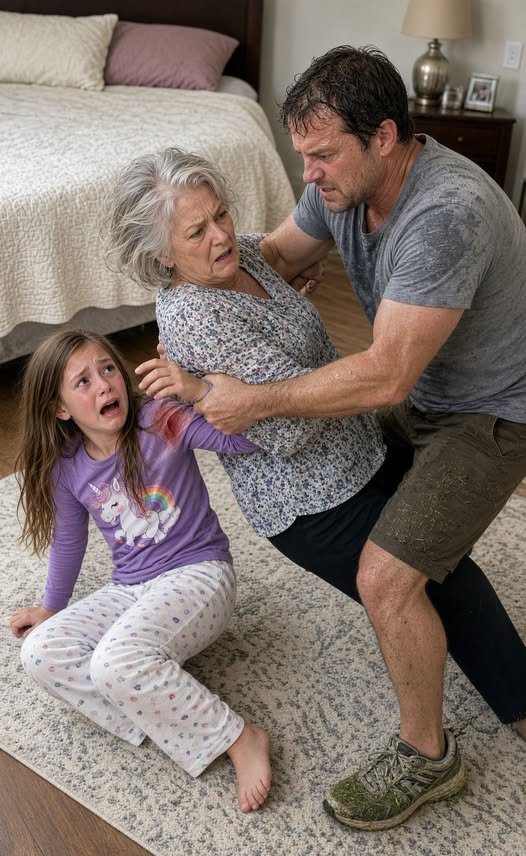
I glanced at the white finger marks fading into red on Lily’s shoulder.
“I walked in while your hand was over her mouth.”
“That was because she was screaming.”
“You threatened her mother.”
“I was trying to make her stop saying ridiculous things.”
“By telling her her mother might not wake up?”
Marlene opened her mouth.
Nothing came out.
That was the first moment she stopped trying to convince me I had misunderstood what I’d seen.
Instead, she changed tactics.
“You don’t understand what your wife has been dealing with.”
The sentence hit me harder than I expected.
Not because I believed Marlene.
Because my wife and I had been tired for months.
Work. Bills. School pickup. Groceries. Laundry. The thousand ordinary things that fill a marriage until two people can spend an entire evening in the same room talking only about what needs to happen tomorrow.
Marlene had started helping more.
At first, I had been grateful.
She brought dinner sometimes. Picked Lily up when schedules collided. Sat with my wife when she wasn’t feeling well.
She also had opinions about everything.
Which doctor was worth listening to.
Which medication was “too much.”
When someone needed rest.
When someone was exaggerating.
I had treated those comments like background noise.
Now I wondered how often my wife had heard them when I wasn’t there.
“What exactly has my wife been dealing with?” I asked.
Marlene hesitated.
It lasted less than a second.
But I saw it.
“So you don’t know,” I said.
“Of course I know.”
“Then tell me.”
“That’s private.”
“You just used it to justify putting your hand over my daughter’s mouth.”
Her face hardened.
“You’ve never respected the bond between a mother and daughter.”
I almost laughed.
Instead, I looked at Lily.
She was watching Marlene carefully now.
Not with the confused fear she’d had when I first entered.
With recognition.
She knew the pattern.
That realization hurt more than the argument.
My nine-year-old already knew when an adult was trying to change the subject.
I held out my hand to her.
“Come here.”
She hesitated only a moment before getting up.
Her knees were shaky.
When she reached me, she wrapped both arms around my waist and buried her face against my shirt.
Marlene sighed loudly.
“This is exactly what I mean. You reward this behavior.”
I looked down at Lily’s hair.
Then back at Marlene.
“What behavior?”
“Drama.”
Lily tightened her arms around me.
Something inside me settled.
Not anger.
A decision.
I didn’t need Marlene to confess to every detail before I acted on what I had personally witnessed.
I had seen enough.
“You’re leaving.”
Marlene blinked.
“This is my daughter’s house too.”
“And right now you are not staying here with Lily.”
“You can’t make that decision by yourself.”
“I can make the decision that you don’t get another minute alone with my child today.”
Marlene stared at me.
Her hand moved toward the purse.
For a second I thought she might grab it and leave.
Instead, she pointed at my pocket.
“You have no idea what you’re doing.”
“Then explain the paper.”
“I already did.”
“No. You gave me three different excuses.”
She looked away.
I counted them silently.
It wasn’t serious.
She picked it up by accident.
It was private.
Each answer had replaced the one before it.
Lily lifted her head.
“Dad?”
“Yeah?”
“Mom thought you knew.”
I looked down at her.
“What?”
“At the hospital.”
Marlene said her name sharply.
“Lily.”
Lily flinched.
That ended any chance Marlene had of controlling the conversation.
I took my phone out.
“Who told Mom I knew?”
Lily pointed at Marlene.
“She did.”
Marlene stepped toward me.
“Do not turn this into something ugly.”
I looked at her.
“You pinned a child to the floor.”
Her mouth closed.
I called my wife.
The first ring felt endless.
The second was worse.
On the third, she answered.
Her voice sounded tired.
“Hey.”
Every muscle in my shoulders loosened at once.
“Are you okay?”
A pause.
“Why?”
I looked at Marlene.
She was watching me now, no smile, no indignation, just calculation.
“Did you go to the hospital this morning?”
Another pause.
“Yes.”
“Why didn’t you call me?”
“I thought Mom did.”
Lily’s fingers gripped the side of my shirt.
I closed my eyes for half a second.
“She didn’t.”
My wife was quiet.
Then she said, “She told me you were already aware of everything.”
Marlene shook her head slowly, warning me without saying a word.
That was the moment the argument stopped being about whose memory was right.
My wife believed I knew.
I didn’t.
Lily believed she wasn’t allowed to tell me.
And the hospital paper meant for my wife had ended up folded inside Marlene’s purse.
Those facts fit together without anyone needing to make a speech.
“Where are you right now?” I asked my wife.
“Resting.”
“Are you somewhere safe?”
“Yes.”
I let out the breath I’d been holding.
“I have the paperwork from this morning.”
“What paperwork?”
Marlene spoke immediately.
“Ethan, stop.”
My wife heard her.
“Is Mom there?”
“Yes.”
“What’s going on?”
I looked at Lily.
I could have told my wife everything in that moment.
I wanted to.
But Lily was still trembling beside me, and I wasn’t going to make her relive it while everyone argued over her head.
“Lily and I are okay,” I said. “But something happened. I’ll explain when I can talk to you without her having to listen.”
My wife went silent again.
Then her voice changed.
“Is Lily hurt?”
“She has marks on her shoulder. I’m with her.”
Marlene’s face tightened.
My wife said, “Keep her with you.”
Four words.
That was all.
Marlene heard them too.
For the first time since I had entered the bedroom, she didn’t interrupt.
I told my wife I would call her again shortly and ended the call.
Then I put the phone in my pocket beside the folded paper.
Marlene looked older suddenly.
Not weaker.
Just stripped of the certainty she carried whenever she assumed the room would eventually bend around her.
“You made me sound like a monster,” she said.
“I barely said anything about you.”
“You implied it.”
“I told her Lily had marks on her shoulder.”
“She bruises easily.”
Lily looked up at me.
That familiar sentence had probably worked before.
Not anymore.
I walked with Lily into the hallway.
Marlene followed.
I stopped and turned.
“Get your purse.”
She stared at me.
“You’re throwing me out?”
“I’m asking you to leave this house today.”
“You will regret humiliating me like this.”
I looked back toward Lily’s bedroom, where the rug was still bunched from the struggle.
Then I looked at my daughter.
“No,” I said. “What I regret is needing to walk in on it before I understood something was wrong.”
Marlene picked up the black purse from the chair.
She checked inside it immediately.
Looking for the paper.
When she realized it was still in my pocket, her eyes lifted to mine.
“Give it back.”
“No.”
“That document is not yours.”
“I’m giving it to my wife.”
Her grip tightened around the purse strap.
“You’re going to destroy this family over one misunderstanding.”
Lily spoke from beside me.
“She told me not to tell.”
Marlene froze.
I rested my hand lightly on Lily’s back.
She didn’t hide behind me this time.
She stood there in her stretched unicorn shirt, eyes red, shoulder sore, voice barely above normal.
But she stood there.
Marlene looked at her granddaughter for several seconds.
Then she looked away first.
There was no dramatic apology.
No sudden confession.
No perfect sentence that fixed the room.
Real families rarely give you those.
What I had instead were facts.
A hospital visit nobody told me about.
A wife who had been assured I already knew.
A daughter who had been warned to stay quiet.
A medical instruction sheet hidden inside someone else’s purse.
And the memory of opening a bedroom door to find an adult holding my child down.
That was enough to change what happened next.
Marlene walked toward the front door.
At the entryway she stopped.
The mower was still visible through the open doorway, sitting crooked in the half-cut yard where I had abandoned it.
The sprinkler clicked back and forth.
Ordinary afternoon sounds.
Twenty minutes earlier, I had been annoyed that I was behind on yard work.
Now the unfinished strip of grass looked like evidence from another life.
Marlene put one hand on the door.
“You’ll call me when you calm down.”
I didn’t answer.
She waited.
Then she walked outside.
I closed the door behind her and turned the lock.
Lily watched my hand do it.
Her shoulders dropped a fraction.
That tiny movement nearly broke me.
I crouched beside her again.
“You never have to protect an adult by keeping something scary from me,” I said.
She rubbed her eyes.
“Even Grandma?”
“Especially if somebody tells you that you’ll get in trouble for telling the truth.”
She nodded.
Then she asked the question I had been afraid of since opening the purse.
“Is Mom going to be okay?”
I looked toward my pocket, where the folded paper pressed against my leg.
“I don’t know everything yet,” I told her. “But we’re going to find out together.”
That was the only promise I could honestly make.
I didn’t promise that Marlene had meant no harm.
I didn’t promise my wife’s health scare was minor.
I didn’t promise the family would go back to normal by dinner.
Some promises are only comforting because nobody plans to keep them.
Instead, I sat with Lily until her breathing slowed.
I brought her water.
I took a clear look at the marks on her shoulder so I would remember exactly what I had seen.
Then I called my wife again.
This time I stepped into the kitchen while Lily stayed close enough to see me.
I told my wife what I had walked in on.
I told her exactly what Marlene had said.
I told her where I found the hospital instructions.
She listened without interrupting.
When I finished, there was a long pause.
“I didn’t know she had taken the paper,” she said.
“I figured.”
“She said she was putting it with my things.”
“She put it in her purse.”
Another pause.
Then my wife asked, “Did Lily really hear her say that?”
“I heard it myself.”
That mattered.
Lily didn’t have to convince us.
She didn’t have to perform fear correctly.
She didn’t have to remember every detail in the perfect order while adults cross-examined her.
I had heard the threat.
I had seen the hand over her mouth.
I had pulled Marlene off her myself.
My wife exhaled slowly.
“Then she doesn’t come back until we figure this out.”
Not forever.
Not a grand declaration.
Just a boundary we could keep that day.
It was enough.
Later, I went back outside and shut off the sprinkler.
The mower was still where I had dropped it.
Grass had collected around one wheel.
I stood there for a moment with my hand on the handle.
Then I left it.
The lawn could stay half finished.
Inside, my daughter was waiting for me.
And in my pocket was a folded piece of paper that no longer felt like the biggest thing I had found that afternoon.
The bigger discovery was simpler.
For too long, we had treated Marlene’s certainty as proof that she was right.
That afternoon, Lily had done something much harder.
She had told me where to look.
And when Marlene reached for the purse, Lily didn’t take the words back.