Chapter One: Minus Ten
It was minus ten degrees Celsius on Christmas Eve when my father locked me out of the house.
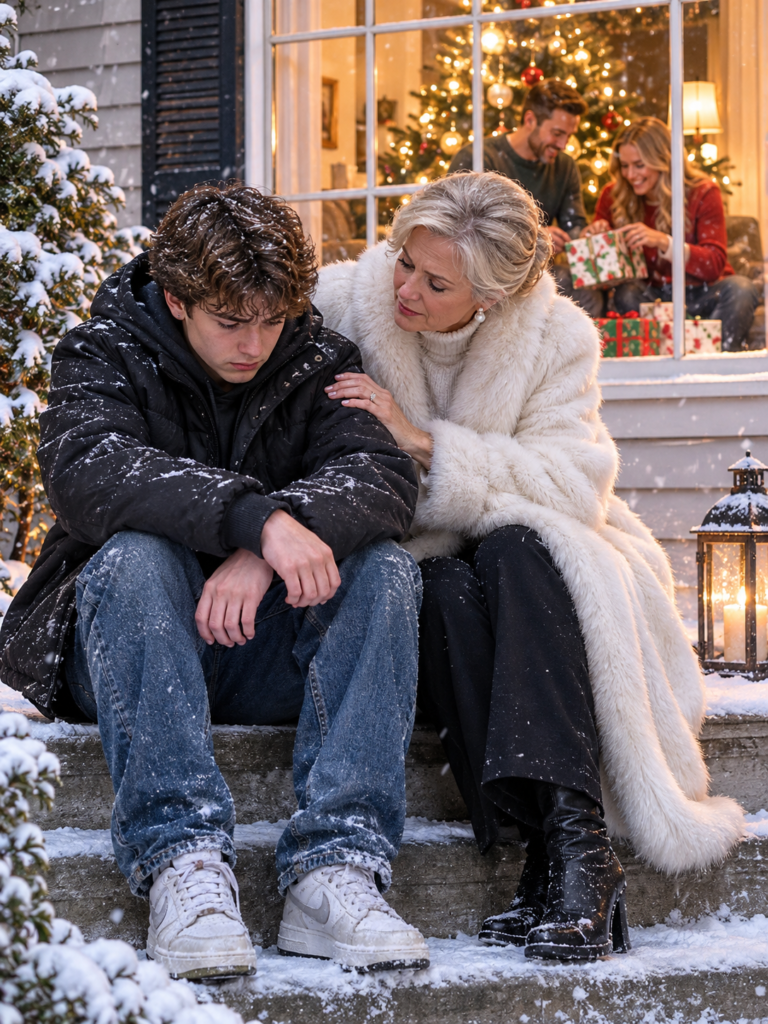
I remember the number because the little thermometer hanging by our front door, the brass one shaped like a fish that my grandmother brought back from Nova Scotia years ago, was the first thing I saw when I hit the porch. Minus ten. The needle was right on it. I saw it in the yellow porch light as I slipped on the icy steps and caught myself on the railing with my bare hand.
Behind me, the front door slammed. I heard the deadbolt slide into place. Then the chain.
I was seventeen years old. I was wearing a gray knit sweater, a pair of jeans, and the fuzzy Christmas socks my little sister had given me that morning. No coat. No gloves. No shoes.
I stood on the porch for a second, too stunned to move. Then I turned around and pounded on the door.
“Dad! Dad, open the door!”
Nothing. Through the frosted glass panel beside the door, I could see his shape moving away down the hallway. He didn’t look back.
I ran down the steps and around the side of the house to the garage. The side door was locked. The big door was down. I ran to the back door, the one that opens into the mudroom by the kitchen. Locked. I banged on it with both fists until they hurt. I could see light through the little window, and the dog, our old golden retriever Maple, standing on the other side of the door with her tail wagging, whining at me.
Nobody came.
I circled the house twice. The snow in the backyard was up to my shins, and my Christmas socks were soaked through in seconds. My feet went from cold to burning to something worse. I tried the basement windows. I tried the sliding door to the deck. Everything was locked. My father had gone around and checked every door. I’d heard him do it.
On my second time around, I collapsed on the front porch. I didn’t mean to. My legs just stopped working. I sat down hard on the top step and curled into myself, my arms wrapped around my knees, my sweater pulled down over my hands.
My teeth were chattering so hard they hurt. My breath came out in little white clouds that hung in the air in front of my face. The street was silent. Every house on Wellington Crescent had its Christmas lights on, red and green and white, and somewhere down the block somebody was playing “Silent Night” on a piano.
I turned my head and looked through the big living room window.
They were opening presents.
Chapter Two: The Dinner
I should tell you how it started.
My name is Sophie DeWitt. I grew up in a big stone house at the top of Wellington Crescent in Linden Falls, Ontario, a small town on the escarpment about forty minutes from Hamilton. It’s the kind of town where everybody knows your last name. And everybody in Linden Falls knows the name DeWitt.
My grandfather, Henry DeWitt, started a trucking company in Hamilton in 1968 with one rig and a borrowed loan. By the time he died in 2009, the DeWitt Group was one of the biggest logistics companies in Canada, with warehouses in six provinces and a fleet of four thousand trucks. My grandmother, Margot DeWitt, ran it with him for forty years and has run it alone for the last sixteen. She’s seventy-nine. People say she’s worth more than two billion dollars. People say a lot of things.
My father, Richard DeWitt, is her only son. He’s a vice president at the DeWitt Group. He has an office on the top floor of the head office in Hamilton with a view of the harbour. I don’t know exactly what he does there. I’m not sure anybody does.
My mother, Megan, met him at Western University when they were twenty. She was going to be a teacher. She never finished. My brother, Owen, is fourteen. My sister, Hazel, is ten.
That Christmas Eve, we’d just finished dinner. Turkey and stuffing and the scalloped potatoes my mother makes every year from her grandmother’s recipe card. Tension had been bubbling under the surface all day, the way it always did when the family was together. My mom pretended not to notice. My siblings tried to laugh too loud at everything. And my father stayed sober just long enough to ruin everything.
He’d started on the wine at three o’clock. By dinner, he was on the scotch. By dessert, he was talking about my mother.
He did it the way he always did it. Little jokes. Sharp ones, wrapped up in a laugh so you couldn’t say anything without looking like you couldn’t take a joke. He made fun of her potatoes. He told Owen and Hazel that their mother had never finished university because she couldn’t handle it. He told a story about how she’d once gotten lost driving to Toronto, and laughed until he coughed.
My mother sat at the end of the table with her hands folded in her lap and smiled. She always smiled.
Then he said something about how lucky she was that he’d married her. How she’d be working at a Tim Hortons somewhere if it weren’t for him. How everything she had, the house, the clothes, the car, came from him. From his family’s money.
My mother smiled at her plate.
And I put my fork down.
“Dad,” I said. “Stop it.”
The table went quiet. Hazel stopped chewing. Owen looked at me with his eyes wide.
My father turned and looked at me down the length of the table. Slowly. Like he couldn’t quite believe what he’d heard.
“Excuse me?”
“Stop talking to her like that,” I said. My heart was pounding. “It’s Christmas. She cooked all day. Just stop.”
He set his glass down very carefully on the tablecloth.
“That,” he said, “is disrespectful.”
I should have stopped there. I knew I should have. I’d learned to stop there a hundred times. But something in me was tired. Seventeen years tired.
“Maybe,” I said, “you’re just not used to someone standing up to you.”
That was it.
He stood up so fast his chair fell over backward. He came around the table, and he grabbed me by the arm, above the elbow, so hard I felt his fingers through my sweater. He pulled me up out of my chair. My mother said, “Richard,” very quietly. Just his name. That was all she said.
He marched me down the hallway to the front door. He opened it. And he threw me out onto the porch, like I was a bag of garbage.
“You can come back in,” he said, “when you learn some respect.”
Then he slammed the door.
Chapter Three: The Window
Through the big living room window, I watched my family open their presents.
They’d moved from the dining room into the living room, the way we always did on Christmas Eve. The tree in the corner was twelve feet tall, decorated by a company from Hamilton that came every year in November. The fireplace was lit. The presents were piled underneath the tree, wrapped in gold and silver paper with big ribbons.
My father sat in his leather armchair by the fire with a fresh glass of scotch. He was grinning. He’d gotten a new watch from my mother. A Rolex, in a green box. He held it up to the light and laughed.
Hazel was tearing the paper off a box. She was ten. She was crying a little, I could see her face, and she kept looking at the window. At me. My mother knelt down beside her and said something, and Hazel wiped her eyes and kept opening the present.
Owen sat on the couch with a box in his lap that he wasn’t opening. He was looking at his phone. He kept looking at it.
My mother smiled like nothing had happened. She handed out presents. She took a picture of Hazel with her new doll. She refilled my father’s glass.
She never looked at the window. Not once.
I stopped being able to feel my feet. Then my fingers. I knew enough from Grade 11 biology to know that wasn’t good. I knew that when you stop shivering, it’s worse. I was still shivering. I told myself that was good. I curled up tighter on the top step with my back against the cold stone railing and pressed my hands into my armpits.
I thought about getting up and walking to a neighbour’s house. The Hendersons, two doors down. But I couldn’t feel my feet, and the street was covered in black ice, and I didn’t know if I could make it. And the Hendersons were in Florida for the holidays. Their house was dark.
I thought about my phone. It was upstairs on my bed, charging. I’d left it there before dinner because my father didn’t allow phones at the table.
I thought I might pass out from the cold.
I remember thinking, very calmly, that this is how people die. In the cold, on a porch, ten feet from a fireplace. I remember thinking about the Christmas socks Hazel gave me, with little reindeer on them, soaked black with snow. I remember thinking it was a stupid way to die.
I don’t know how long I sat there. Later, the police report said it was forty-four minutes.
Then I saw headlights.
Chapter Four: Headlights
A long black car turned onto Wellington Crescent at the bottom of the hill and came up slowly through the snow, its headlights sweeping across the frozen lawns. It wasn’t a car I knew. It was huge. A stretch Lincoln, black, with tinted windows.
It turned into our driveway.
I sat up on the porch steps, dazed. I couldn’t understand what I was seeing.
The car stopped. A man got out of the driver’s seat, tall and broad in a dark overcoat and a flat cap, and walked around to the back passenger door. I knew him. Theo Barrett. He’d driven my grandmother for twenty-two years, and he’d been a police officer in Hamilton before that.
He opened the back door.
My grandmother stepped out onto our driveway.
Margot DeWitt is not a tall woman. She’s five foot three. She wore a long camel-coloured wool coat and black leather gloves and a gray cashmere scarf, and her white hair was pinned up the way she always wears it, and she stood in our driveway in the snow like she owned it.
Which, as I would learn later, she did.
She wasn’t supposed to come that year. She’d told us at Thanksgiving she’d be spending the holidays in Aspen with her friend Dorothy from the board. She’d sent presents in October, already wrapped. She’d called my father on Christmas Eve morning to wish us a merry Christmas from Colorado.
She looked at me.
I must have looked pathetic. My knees red from kneeling on the ice. My face blotchy from crying. My sweater soaked through, and my socks black, and my hair frozen stiff where it had gotten wet. Shaking so hard I couldn’t sit still.
She didn’t say anything. She just looked at me for a long moment.
Then she turned her head and looked at the house. At the big living room window, where my family was opening presents. At my father in his leather armchair with his new Rolex and his glass of scotch, laughing.
Her lips went thin. She took one long, deliberate breath, and I watched it come out of her in a white cloud.
And then she turned to her driver and said one word.
“Demolish.”
Theo Barrett didn’t ask what she meant. He just nodded, once, and took out his phone.
My grandmother didn’t knock on the door. She didn’t go inside. She didn’t ask what happened. She didn’t need to.
She came up the front walk, through the snow, to the bottom of the porch steps. She took off her right glove. She extended her bare hand to me.
I took it.
Her hand was warm. That’s what I remember most. Her hand was so warm.
She pulled me up off the step. I couldn’t stand on my feet. Theo was there before I could fall, and he lifted me up like I weighed nothing and carried me down the steps to the car. My grandmother walked beside us with her hand on my back.
As we walked toward the limo, I didn’t look back once.
Behind me, through the window, I heard my sister scream my name.
Chapter Five: The Limousine
The inside of the car was warm, so warm it hurt. Theo set me down on the long leather seat, and my grandmother climbed in beside me and pulled the door shut. She took off her camel coat and wrapped it around me. She took off her scarf and wrapped it around my neck. She took my frozen feet in their soaked Christmas socks and pulled them into her lap and held them between her hands.
“Theo,” she said. “St. Joseph’s. As fast as you can safely go.”
The car backed out of our driveway. I could see my father’s face in the living room window. He’d stood up from his armchair. He was staring at the car. He had his drink in his hand.
Then we turned down Wellington Crescent and he was gone.
“Grandma,” I said. My teeth were chattering so hard I could barely talk. “You were in Aspen.”
“I was in Toronto,” she said. “At the Royal York. I flew back yesterday. Dorothy had the flu.” She was rubbing my feet between her hands, hard. “I was going to surprise you tomorrow morning. Christmas brunch.”
“How did you…”
She reached into the pocket of her coat, which was wrapped around me, and took out her phone. She held it up so I could see the screen.
It was a text message. From Owen. Sent at 8:52 p.m.
Grandma please come. Dad locked Sophie outside. No coat. Its so cold. Mom wont do anything. Please.
And then another one, two minutes later.
Shes sitting on the porch and shes not moving much. Please hurry.
“I was in the car on the QEW when he sent it,” my grandmother said. “I told Theo to drive.”
I looked at the phone. At my little brother’s text messages, with the typos and the missing apostrophes. I thought about him sitting on the couch in the living room with an unopened present in his lap, looking at his phone, while my father laughed.
He was fourteen. And he was the only one in that house who’d done anything.
I started to cry then. Really cry. I put my head on my grandmother’s shoulder in the back of that car, wrapped in her camel coat, and cried until I couldn’t breathe. She held my feet in her lap and didn’t say a word.
At St. Joseph’s Healthcare in Hamilton, the emergency doctor said I had mild hypothermia and first-degree frostbite on four toes and two fingers. My core temperature was thirty-four point eight degrees. She said another half hour on that porch, and it would have been a different conversation. They wrapped me in a warming blanket that blew hot air, and put my feet in warm water, which hurt so much I bit through my lip.
The doctor’s name was Dr. Amara Osei. She was about forty, with tired, kind eyes. When she was done examining me, she sat down on the stool beside my bed.
“Sophie,” she said gently. “I need to ask you how this happened. And I need you to know that whatever you tell me, I’m required by law to report it. Because you’re under eighteen.”
I looked at my grandmother, sitting in the chair in the corner with her hands folded in her lap.
My grandmother nodded at me. Just once.
So I told the doctor the truth.
Chapter Six: The Word
My grandmother’s house is on the lake in Burlington, a big old stone house with a slate roof that my grandfather built in 1979. She brought me there from the hospital at two in the morning on Christmas Day. Theo carried me up the stairs to a guest room with a canopy bed and a fire already burning in the fireplace, because she’d called ahead.
She sat on the edge of my bed with a cup of hot chocolate and made me drink the whole thing.
“Grandma,” I said, when I was done. “What did you mean? When you said that word? To Theo?”
She took the empty cup from me and set it on the nightstand. She was quiet for a long time.
“When I was eleven,” she said, “in the winter of 1958, in Hamilton, my father came home from the steel mill drunk on a Friday night. He’d been paid. He’d spent most of it at the Royal Connaught bar. My mother asked where the money was.” She looked at the fire. “He hit her. I stood up and told him to stop.”
I didn’t say anything.
“He put me out on the back stoop,” my grandmother said. “In my nightgown. It was February. Twenty below. He locked the door.” She folded her hands in her lap. “My grandmother lived next door. She heard me crying. She came over in her housecoat and took me home with her. I never went back to that house.”
“Grandma.”
“She was a tough old Scottish woman,” Margot said. “She looked at my father’s house the next morning, through her kitchen window, and she said, Margot, a house where a child is left out in the cold isn’t a home. It’s just walls. And walls can come down.” My grandmother smiled a little. “I never forgot it.”
She reached over and smoothed my hair back from my forehead.
“When your grandfather and I started building our company, we built our own houses,” she said. “This one. And the one on Wellington Crescent. I built that one in 1994. For your father. As a wedding present. I put it in my name, through the company, because your grandfather didn’t trust him with property.” She paused. “Your grandfather was right about a lot of things.”
“So it’s your house,” I said slowly. “Not Dad’s.”
“It has always been my house,” she said. “Your father has lived in it for thirty years. He’s never paid a dime for it. He’s never paid the property taxes. The company pays them. His car is a company car. His salary comes from a company that I own sixty-one percent of.” She looked at me. “Everything your father told your mother at that dinner table tonight, about where everything came from. He was right. It all came from his family. It came from me.”
I stared at her.
“Demolish,” my grandmother said quietly. “It’s a word Theo and I have used for twenty years. It means: begin taking it apart. All of it. The house, the salary, the car, the title, the office with the harbour view. Everything I gave him that he used to make a little girl sit in the snow.” She looked at the fire. “I never thought I’d have to say it about my own son.”
Chapter Seven: Christmas Morning
A police officer came to my grandmother’s house at ten o’clock on Christmas morning. A woman about thirty-five from the Halton Regional Police, in her uniform, with a notebook. Her name was Constable Patel. Dr. Osei had made the report at the hospital, and it had gone to the police and to the Children’s Aid Society of Hamilton.
Constable Patel sat in my grandmother’s living room by the big window that looks out over Lake Ontario, frozen and gray. My grandmother sat beside me on the couch. Theo stood by the door.
I told Constable Patel everything. The dinner. What my father said about my mother. What I said. His hand on my arm. The door. The deadbolt. The chain. Forty-four minutes.
She wrote it all down. When I was done, she looked at me for a long moment.
“Sophie,” she said. “Your brother Owen called us too. At nine-thirty last night. After your grandmother took you. He gave us a statement on the phone. He also sent us a video.”
I stared at her.
“He recorded it,” Constable Patel said gently. “From the living room. On his phone. You, on the porch, through the window. Your father, in his chair. Fourteen minutes of it.” She closed her notebook. “And your father, on the video, saying, quote, She’ll come crawling back when she gets cold enough.”
I put my hand over my mouth.
At eleven o’clock, a woman from the Children’s Aid Society came. A soft-spoken woman about fifty named Mrs. Gallagher, with a big canvas bag and reading glasses. She asked me questions too. Different ones. About my father. About other times. About whether I felt safe going home.
“No,” I said.
She asked about Owen and Hazel.
I thought about Hazel, screaming my name through the window. About Owen, sitting on the couch with his phone.
“I don’t know,” I said. “He’s never hurt them. Not like that. He just… he yells. He drinks. He says things.” I looked at my grandmother. “Mostly to me. And to Mom.”
Mrs. Gallagher wrote it down. Then she said she’d be visiting the house on Wellington Crescent that afternoon. Christmas Day. To talk to my mother and my brother and sister.
My grandmother stood up when Mrs. Gallagher got up to leave.
“Mrs. Gallagher,” she said. “I’d like the children to stay with me. Owen and Hazel. If their mother agrees. Until this is sorted out.”
Mrs. Gallagher looked at her. At the big stone house, and the fire, and the view of the lake.
“That would be up to their mother, Mrs. DeWitt,” she said. “And it would depend on what I find at the house.” She paused. “But I’ll let her know the offer is there.”
My mother called at three o’clock that afternoon. On my grandmother’s landline.
I answered. My grandmother put it on speaker.
“Sophie,” my mother said. Her voice was shaking. She’d been crying. “Sophie, baby, are you okay? The hospital wouldn’t tell me anything. The police were here. And a woman from Children’s Aid.”
“I’m okay, Mom,” I said.
“I’m so sorry,” my mother said. “I’m so sorry. I should have opened the door. I should have…”
“Why didn’t you?”
She didn’t answer for a long time. I could hear her breathing on the other end of the line.
“Because I was afraid,” she said finally. “I’ve been afraid for twenty years.”
Chapter Eight: Boxing Day
My grandmother went to the house on Wellington Crescent on Boxing Day morning.
She didn’t take me. I wanted to go. She said no. She said I’d had enough of that house. She went with Theo. And with a woman from the DeWitt Group’s legal department in Hamilton, a sharp, quiet lawyer named Patricia Lindqvist. And with a locksmith from Linden Falls, who’d been told he’d be paid double for working on a holiday.
Owen told me what happened. He was there. He told me that night, at my grandmother’s kitchen table, after my mother brought him and Hazel to Burlington.
My grandmother rang the front doorbell at nine o’clock in the morning. My father answered it in his bathrobe. He was hungover. He hadn’t shaved. He looked at his mother standing on the porch in her camel coat with a lawyer and a locksmith and her driver behind her, and he went white.
“Mother,” he said. “What are you doing here?”
“Inside, Richard,” my grandmother said. “Kitchen. Now.”
They sat at the kitchen table. My father and my grandmother and Patricia Lindqvist. My mother stood by the sink. Owen and Hazel were on the stairs, listening.
Patricia Lindqvist laid papers on the table, one at a time.
The first was the deed to the house. In the name of DeWitt Residential Holdings Limited, a company owned by the DeWitt Group. My grandmother’s company. Not my father’s.
The second was a letter from the board of directors of the DeWitt Group, signed that morning by the chair of the board. My grandmother. Terminating Richard DeWitt’s employment as Vice President of Business Development, effective immediately, for conduct unbecoming an officer of the company. With one month’s severance, as required by his contract.
The third was a letter from the company’s fleet department. Instructing him to return his company vehicle, a black Range Rover, by five p.m.
The fourth was a written notice. Telling Richard DeWitt that he no longer had permission to occupy the property at 14 Wellington Crescent. That he had sixty days to vacate.
“Sixty days,” my grandmother said. “Because Megan and the children live here too, and I won’t put them on the street. That’s more than you gave my granddaughter.”
My father stared at the papers on the table.
“You can’t do this,” he said. His voice was hoarse. “You can’t. I’m your son. This is my house. My job.”
“It’s my house,” my grandmother said. “It’s my company. You’ve never once in your life paid for anything you have.” She folded her gloved hands on the table. “I gave you everything, Richard. Everything. And you used it to stand in that window with a glass of my scotch and watch your daughter freeze.”
“It was forty minutes,” my father said. “She was fine. She’s dramatic. She’s always been dramatic.”
My grandmother looked at him for a long time.
“She was thirty-four point eight degrees,” she said. “Her core temperature. When they brought her into St. Joseph’s. Dr. Osei said another half hour and we’d be planning a funeral.” She paused. “Owen has it on video, Richard. Fourteen minutes. You, laughing. She’ll come crawling back when she gets cold enough.”
My father turned around in his chair and looked at Owen on the stairs. Owen said he’d never seen that look on his father’s face. Not anger. Something else. Something like fear.
“You recorded me?” my father said.
“Somebody had to do something,” Owen said. “Grandma always says, if you can’t stop it, write it down.”
Chapter Nine: Richard
My father stood up from the kitchen table. Owen said he stood there for a long time, swaying a little, holding on to the back of his chair. Then he started shouting.
He shouted that his mother had always hated him. That she’d always loved the company more than her own son. That she’d never once come to his hockey games, his school plays, his graduation from Western. That she’d sent him to boarding school in Port Hope when he was nine because he was in the way. That his father, Henry, had told him every day of his life that he’d never amount to anything without the DeWitt name.
“And you know what?” my father shouted. “He was right! I never did! You made sure of it! You gave me a job I didn’t earn and a house I didn’t pay for and a title that means nothing, and you made sure everybody in Hamilton knew it!” He was crying now. “You made me nothing, Mother. And then you made me a vice president of nothing.”
My grandmother didn’t move. She sat at the kitchen table with her gloved hands folded and let him shout. Owen said she didn’t flinch once.
When my father finally stopped, out of breath, my grandmother spoke.
“Some of that is true,” she said quietly.
My father stared at her.
“I wasn’t there,” my grandmother said. “Your father and I built a company, and we built it on your childhood. We sent you away because it was easier. I missed your hockey games. I missed your plays. I wasn’t at your graduation because I was in Calgary buying a warehouse.” She took a breath. “And when you were grown, I gave you money instead of time, because money was what I knew how to give. I gave you a job because I felt guilty. I gave you a house because I couldn’t give you a mother.” She looked at him. “That’s on me, Richard. I’ll carry that until I die.”
My father sat back down in his chair, slowly.
“But you’re forty-nine years old,” my grandmother said. “Not nine. I’m sorry I was cold to you. I am. But you took that cold and you put it on your own daughter’s back, on a porch, in her socks, on Christmas Eve. And I won’t let you hand it down one more generation.”
She stood up from the table.
“There’s a place in Guelph,” she said. “Homewood. They treat alcohol. It’s one of the best in the country. I’ve already called. They have a bed for you on the second of January.” She picked up her purse. “I’ll pay for it. Every dollar. It’s the last thing I’ll ever pay for, Richard. But I’ll pay for it.”
“And if I don’t go?”
My grandmother looked at her son.
“Then you’ll have sixty days,” she said, “to figure out who you are without my money. Either way, Richard, it starts now.”
She walked out of the kitchen. At the front door, she stopped and turned to the locksmith, who’d been standing in the front hall the whole time with his tool bag.
“The deadbolt,” she said. “And the chain. Take them both off.”
Chapter Ten: Mom
My mother brought Owen and Hazel to my grandmother’s house that evening. She came up the long driveway in her little blue Honda, the only thing she owned in her own name, and she parked by the garage and sat in the car for a long time.
Then she got out and came up the front steps, with Hazel holding one hand and Owen carrying two duffel bags.
I was waiting in the front hall. I’d been waiting at the window for an hour.
Hazel ran to me and threw her arms around my waist and sobbed. Owen dropped the duffel bags and stood there awkwardly, fourteen years old and too old to hug his sister, and then he hugged me anyway, hard.
“Thank you,” I said into his shoulder. “For the text. For the video.”
“I should’ve opened the door,” he said. “The back door. I was right there. I could’ve just opened it.”
“He would’ve thrown you out too,” I said.
“I know,” Owen said. “That’s why I didn’t. I’m sorry, Soph.”
My mother stood in the doorway. She looked smaller than I’d ever seen her. She’d been crying for two days. She stood there in her coat and looked at me, at my bandaged fingers, at the thick wool socks my grandmother had given me to cover the frostbite on my toes.
“Sophie,” she said.
I didn’t go to her. I couldn’t. Not yet.
We sat in my grandmother’s kitchen that night after the kids were asleep. My mother and my grandmother and me, at the long oak table, with tea.
“Why didn’t you open the door, Mom?” I asked again. I needed to hear it. “You were right there. You walked past it. I saw you.”
My mother looked down at her tea for a long time.
“The first time he hit me,” she said quietly, “you were two. You don’t remember. We were in the kitchen on Wellington Crescent. I’d burned the roast.” She swallowed. “Afterward, he cried. He said he’d never do it again. He said if I told anyone, his mother would take everything. The house. The money. You.”
My grandmother put her cup down very carefully.
“He said Margot would take you away from me,” my mother said. “That she had lawyers. That she’d say I was an unfit mother because I never finished school and didn’t have a job. He said I’d never see you again.” She looked at my grandmother across the table. “And I believed him. For fifteen years. Every time he drank. Every time he said something at dinner. I thought, if I just keep smiling, if I just keep everything calm, he won’t do anything that makes her take the children.”
“Megan,” my grandmother said. Her voice was strange. Thick. “I would never. Not once. I would have helped you.”
“I know that now,” my mother said. “On Christmas Eve, when your car pulled into the driveway, and you took Sophie’s hand, and you didn’t even come inside.” She was crying. “I stood in the living room and watched you walk her to that car, and I thought, she’s not taking her away from me. She’s taking her away from him.”
She looked at me across the table.
“I didn’t open the door,” she said, “because I’d forgotten how. Twenty years of keeping the peace. I forgot that some doors you have to open, even if it starts a war.” She reached across the table for my bandaged hand. “I’m so sorry, Sophie. You stood up for me. At that table. Nobody’s stood up for me in twenty years. And I let you sit in the snow for it.”
I let her take my hand. I didn’t squeeze back. Not yet. But I let her hold it.
Chapter Eleven: Winter into Spring
My father went to Homewood in Guelph on the second of January. He stayed for six weeks.
The police charged him in late January. Assault, for grabbing my arm. And failing to provide the necessaries of life to a child under sixteen, for Hazel, who’d been in the house, and a separate charge relating to me. Constable Patel called to tell me. She said Owen’s video and Dr. Osei’s report made it a strong case. She said the Crown Attorney would want to speak with me.
I met the Crown Attorney in February, in an office at the courthouse in Hamilton. A tired woman in her fifties named Ms. Achterberg. She asked me what I wanted.
I didn’t know. I’d thought about it every night for six weeks.
“I don’t want him to go to jail,” I said finally. “I don’t think. I want him to stop drinking. I want him to never do it to Hazel. I want him to know what he did.”
Ms. Achterberg nodded slowly. She said that because it was his first offense, and he’d completed treatment voluntarily, and because of what I’d just told her, the Crown would likely be willing to resolve the case with a guilty plea to the assault charge, a conditional sentence, and a long period of probation. With conditions. No alcohol. Continued treatment. And no contact with me unless I asked for it.
“Is that what you want?” she asked.
“Yes,” I said.
He pleaded guilty in April. I wasn’t there. My grandmother went. She told me afterward that when the judge asked him if he had anything to say, he stood up and said, “I’m sorry. I’m sorry to my daughter. I’m sorry to my son, who had to record his father. I’m sorry to my little girl, who had to watch.” She said his voice broke. She said he didn’t look at her once.
My mother filed for divorce in March. My grandmother paid for her lawyer. Not a DeWitt Group lawyer. A family lawyer in Hamilton, a woman named Dana Ruiz, who’d never done a day’s work for the company. My mother said she wanted someone who didn’t owe my grandmother anything.
My grandmother bought her a house. Not a big one. A four-bedroom brick house on a quiet street in Burlington, eight minutes from her own, near Owen’s new high school and Hazel’s new elementary school. She put it in my mother’s name. Only my mother’s name.
“I’ve owned enough houses that other people lived in,” she said, when my mother tried to refuse. “This one’s yours, Megan. Nobody can ever lock you out of it.”
In April, my mother enrolled at McMaster University. Part-time. To finish her teaching degree. She was forty-four. The first day of classes, she called me from the parking lot, crying.
“Everybody’s twenty,” she said. “Sophie, everybody’s twenty.”
“So were you, once,” I said. “Go in, Mom.”
She went in.
I got my acceptance letter from the University of Waterloo in May. For architecture. I’d applied in January, from my grandmother’s kitchen table, with my bandaged fingers, because I couldn’t stop thinking about houses. About walls. About doors that lock from the inside and doors that don’t.
I wrote my application essay about a brass thermometer shaped like a fish.
Chapter Twelve: The Warm House
My father moved out of the house on Wellington Crescent on the first of March. Sixty-six days after Christmas Eve. He moved into a one-bedroom apartment in Guelph near his outpatient program, and got a job at a car dealership, selling used trucks. He’s been sober for ten months now. He writes me a letter every month. My grandmother keeps them in a drawer for me. I’ve read three. Someday, maybe, I’ll read the rest.
In June, after school was out, my grandmother asked me to drive with her to Linden Falls.
Theo drove. We sat in the back of the long black car together. When we turned onto Wellington Crescent at the bottom of the hill and came up through the summer trees, I saw it.
There was a yellow excavator in the driveway of the stone house. A big one, with a long arm and a bucket with teeth. And a dumpster the size of a train car. And a chain-link fence around the whole property, with a sign on it.
DeWitt Residential Holdings. Demolition in Progress.
My grandmother hadn’t told me. She’d told me she wanted to show me something.
Theo parked at the curb. We got out. We stood together on the sidewalk, the two of us, by the chain-link fence, in the June sunshine.
The excavator’s arm swung up. It came down on the corner of the roof. The slate tiles cracked and slid. The big stone chimney, where the fireplace used to be, where my father sat in his leather armchair, swayed for a moment. Then it fell inward with a long, low roar.
I stood there and watched the house I grew up in come down. The living room with the big window. The front porch where I sat for forty-four minutes. The brass thermometer by the door was already gone. My grandmother had asked the crew to save it. Theo had it in a box in the trunk.
I didn’t cry. I thought I would. I didn’t.
“Grandma,” I said, when the dust started to settle. “What are you going to build here?”
My grandmother took a folded piece of paper out of her coat pocket and handed it to me.
It was a drawing. An architect’s rendering. A long, low building, two stories, with big windows and a wraparound porch. Warm wood and stone. Lights in every window.
At the top, it said: The Warm House. Emergency shelter and support for youth ages 12 to 18.
“Twelve beds,” my grandmother said. “For teenagers who’ve been put out. Or who’ve had to leave. Kids who can’t go home.” She looked at the excavator. “Hamilton has three youth shelters, Sophie. For a region of six hundred thousand people. Most nights in winter, they’re full. Kids sleep in bus shelters. In parking garages. On porches.” Her voice caught. “I looked it up. In January. I couldn’t stop thinking about it.”
I stared at the drawing.
“I want you to help design it,” my grandmother said. “If you want to. Next summer. After your first year at Waterloo. The architect says he’ll take you on as an intern.” She almost smiled. “I told him you’d have very particular opinions about the doors.”
I looked at the drawing for a long time. At the big front porch. At the big front door.
“No deadbolts,” I said finally. “On the outside. Not one. The door only locks from the inside. So nobody can ever be locked out.”
“I’ll tell him,” my grandmother said.
“And heated benches,” I said. “On the porch. In case somebody comes in the middle of the night and doesn’t want to knock. So they can sit somewhere warm while they decide.”
My grandmother looked at me. Her eyes were wet.
“Heated benches,” she said. “Yes.”
“And a thermometer,” I said. “By the front door. A brass one. Shaped like a fish.”
My grandmother put her arm around me there on the sidewalk on Wellington Crescent, in the June sun, with the dust settling over the ruins of my father’s house. Seventy-nine years old and five foot three, with her white hair pinned up, holding me the way she held my frozen feet in the back of the car.
“A house where a child is left out in the cold isn’t a home,” she said quietly. “It’s just walls. And walls can come down.”
“Your grandmother said that,” I said.
“My grandmother said that,” she said. “Now you say it.”
The Warm House opened eighteen months later, on the twenty-fourth of December.
It was minus twelve that night. I was nineteen, home from my second year at Waterloo for Christmas. I’d spent the summer in an architect’s office in Hamilton arguing about door hardware. I’d won.
My grandmother was there, eighty-one now, in her camel coat, with Theo beside her. My mother was there, a first-year teacher at an elementary school in Burlington, with her new teaching certificate framed in her living room. Owen was there, sixteen and taller than me, who’d volunteered every Saturday since the building went up. Hazel was there, twelve, who’d painted a mural of reindeer in the front hall.
And at nine o’clock, standing at the bottom of the front walk in the snow, there was a man in a worn parka with his hands in his pockets.
My father.
He didn’t come up the walk. He just stood there on the sidewalk, looking at the building. At the long porch with its heated benches. At the big front door with no lock on the outside. At the brass thermometer shaped like a fish, beside the door.
I went out to him. My grandmother watched from the porch. She didn’t stop me.
He looked older. Thinner. Sober. His eyes were clear.
“Sophie,” he said. “I’m sorry. I shouldn’t be here. I just wanted to see it.”
“It’s okay,” I said.
He looked at the thermometer by the door. Then at me.
“Minus twelve,” he said quietly.
“Minus twelve,” I said.
He didn’t say anything else for a long time. Then he took his hands out of his pockets. He was holding a pair of gloves. Thick, warm, sheepskin-lined winter gloves.
“I bought these for the shelter,” he said. “I didn’t know who to give them to.” His voice cracked. “For a kid who shows up without any.”
I took them from him.
“Thank you,” I said.
He nodded. He looked at the front door one more time. The door that only locks from the inside.
Then he turned and walked back down the street in the snow.
I stood on the sidewalk holding the gloves until he was out of sight. Then I walked back up the path, past the heated benches, onto the porch, where my grandmother was waiting.
She didn’t ask what he’d said. She just held out her bare hand to me, the way she did two years before, on a different porch, on the same night.
I took it. Her hand was warm.
We went inside together and left the porch light on, and the front door wide open to the cold, so that anybody who needed it could walk right in.