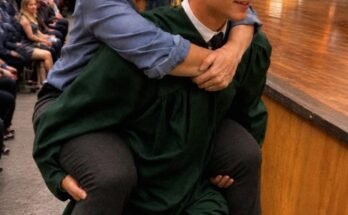
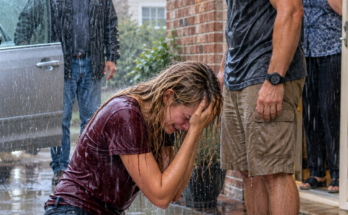
At my graduation ceremony, my father sl@pped me so hard that my cap flew off and landed on the floor. My mother shouted, “You’re nothing but a failure in a gown!” Everyone thought I would break down in tears, but instead, I picked up my diploma, took the microphone, and exposed the secret my family had kept hidden for four long years.
“You don’t deserve that degree,” my father hissed, a split second after hitting me with a slap so violent that my maroon graduation cap went flying across the university’s main quad.

The strike echoed sharply through the courtyard of Hudson Valley University. It wasn’t just a random noise; it was one of those definitive, bone-chilling sounds that slices straight through the atmosphere and forces everyone to freeze, as if someone had abruptly yanked the power cord on the entire ceremony.
My cap landed right beside the sleek leather case of my diploma, rolling unceremoniously across the stone floor. I stood there, my left cheek burning like ice, my hand trembling uncontrollably as I kept my eyes locked onto the man who had just publicly degraded me in front of hundreds of fellow students, professors, media photographers, and families.
My father, Gerald Hollis, was completely crimson with unadulterated rage.
“You are an absolute embarrassment,” he muttered through his teeth, stepping closer. “Standing up on that stage acting as if you actually engineered something worth celebrating.”
Before I could even gather enough oxygen to respond, my mother, Constance, marched forward, her features contorted into a mask of pure venom.
“A failure in a graduation gown, that’s exactly what you are!” she shrieked loudly. “Stop making this family look bad in public!”
A collective, horrified gasp rippled through the nearby rows of parents. A senior professor lowered his camera, his jaw open. A campus security officer immediately adjusted his belt and began marching purposefully toward our perimeter, but I calmly lifted my uninjured left hand, keeping my eyes fixed directly on my parents.
“No,” I said, my voice dropping to a terrifying, quiet register. “Let him finish his thesis.”
My best friend, Tori, who was standing just a few paces away in her own gown, rushed to my side, her face completely pale. “Delaney, are you okay? What is happening?”
I didn’t answer her. Not because I lacked the capacity to hear her, but because I had spent four grueling years calculating the exact metrics of this moment. Perhaps I hadn’t anticipated the physical strike, or the way my soul would feel tightly compressed under the heat of the crowd, but I had absolutely anticipated the day my parents would finally run out of shadows to hide behind.
For years, Gerald and Constance had systematically distributed a meticulous lie to our extended family, claiming I had dropped out of the university. They told everyone I was fundamentally lazy, that I had run off with a toxic crowd, and lacked the cognitive discipline to finish my education. They played the roles of long-suffering, broken-hearted parents who simply didn’t know how to salvage an ungrateful daughter.
But the actual database told an entirely different story.
I had successfully secured a competitive partial academic scholarship. I pulled grueling double shifts every morning at a local diner near the historic district, managed private tutoring contracts in the afternoon, and studied until the early hours of dawn. There were weeks where I survived on three hours of sleep. Weeks where I budgeted my meals down to coffee and stale bread to protect my tuition balance. There were nights I locked myself inside the library restrooms, weeping silently in the dark just so nobody would witness me coming apart at the seams.
Yet on that beautiful morning, when the clinical dean announced my name with Summa Cum Laude honors, the entire courtyard erupted into a massive wave of applause.
And that was the exact fraction of a second my younger brother, Spencer, stopped smiling.
Spencer was standing right behind our parents, looking immaculate in a tailored designer suit, a luxury watch, and brand-new leather shoes. He had always been designated as the “pride of the legacy,” despite the proven fact that he had flunked out of the institute twice and entirely liquidated a logistics startup I had warned him was structurally unsound. For his life, there was always an endless flow of corporate capital—advanced courses, gas cards, flagship smartphones, and European vacations.
For my life, they flatly claimed the accounts were entirely dry.
When Gerald witnessed his independent daughter ascend the steps of the stage to collect her honors diploma, his features completely fractured. It wasn’t a look of hidden pride. It was pure, volatile fury—as if every single round of applause from the audience was a physical strike against his executive ego.
That was why he breached the crowd to confront me. That was why he hit me.
I bent down slowly, calmly retrieved my fallen cap, and wiped a trace of dust from my diploma case. My cheek was throbbing with pain, but my frequency remained dead calm.
“You’re entirely correct, Dad,” I said, my voice echoing clearly against the brick masonry. “Everyone in this courtyard deserves to hear the absolute truth.”
My mother’s eyes widened in sudden caution. “Delaney, don’t you dare create a scene.”
But I was already walking purposefully toward the main podium staircase. The university president stood near the microphone, looking deeply disoriented, entirely unsure whether to deploy security or terminate the broadcast.
I reached inside the hidden silk lining of my graduation gown and withdrew a heavy, wax-sealed manila folder. I had carried that weight against my chest all afternoon, like a silent, ticking asset waiting for the exact window to detonate.
“Dr. Whitmore,” I said, stepping directly up to the live microphone, my voice filling the entire university PA system. “Before I formally exit this institution, I need to file an official compliance report against the individuals who systematically embezzled my tuition capital, forged federal signatures under my identity, and attempted to forensically delete me from my own family.”
From the center aisle below, Gerald let out a desperate, unhinged roar: “Shut your mouth, Delaney!”
But the system was already online. And the audio channel was wide open.
The whole courtyard fell silent.
Dr. Whitmore looked at the thick folder I was holding out to him, then down at my parents. Their faces had gone from aggressive dominance to open panic.
“Ms. Hollis,” he said carefully into the microphone, “are you making a formal statement for the record?”
“I am,” I said. “And I have the documents to back every word.”
My mother laughed, a sharp, brittle, country-club laugh meant to discredit a claim before anyone could examine it.
“Don’t indulge this nonsense, Dr. Whitmore,” Constance told the parents around her. “Delaney has been unstable since she was a child. She invents these dramas to make herself the center of attention.”
I turned and looked down at her from the podium. “Did I invent the three federal student loans taken out in my name? Using my Social Security number and a forged signature?”
The laugh died in her throat.
A murmur rolled through the crowd. Photographers who had lowered their cameras as the ceremony wound down raised them again, no longer to capture a routine commencement but to record a prominent family coming apart in real time.
I took a slow breath of the cool morning air. “Four years ago I came to this university on a partial merit scholarship. I was responsible for the rest. I worked double shifts from my very first semester, and I never asked my parents for a dime. But during my junior year, I pulled my own credit report and found three high-interest student loans under my name. I never applied for them. The money had been routed into an account controlled only by my parents.”
Gerald lunged toward the steps. “This is a private family matter! Turn off that microphone!”
Two campus security officers stepped into his path. “Sir, step back. Now.”
Spencer stared at his expensive shoes. The golden-boy smirk was gone, and he looked like a kid caught with his hand in the register.
I handed Dr. Whitmore the folder. Inside were certified bank records, backdated transfers, signature comparisons, IP logs, and a summary prepared by a consumer protection attorney who had spent six months quietly helping me build the case.
“When I confronted them with it,” I went on, my voice steady over the speakers, “my father told me I owed them for the cost of raising me. My mother told me no court would ever believe me over her, because she’d spent months telling people I was mentally unstable. I was nineteen, alone, scared, and broke. So I did the only smart thing I could. I kept quiet, I finished my degree, and I saved every receipt.”
Tori climbed the steps and took my hand. “Finish it, Delaney,” she whispered.
I swallowed against the ache in my throat. “They didn’t just take my money. They told our relatives I’d dropped out because of drugs. They told them I refused to hold a job. And they used my credit to cover the debts from Spencer’s failed startup while I slept on a bench at the bus station after closing the diner at 3 a.m.”
A gasp came from the front rows. A well-dressed older woman pushed past the security line, her face stricken. It was my Aunt Loretta, my mother’s older sister, and she was staring at Constance in horror.
“Constance, you told the trustees Delaney skipped family events because she was in a psychiatric facility!”
The words hit me like a second slap. That wasn’t in my files. My parents had used my name to cut me off from the family trust, too.
My mother stumbled toward the stage. Real tears cut through her makeup, but they weren’t tears of remorse. They were the panicked tears of someone who had just been caught.
“Delaney,” she whispered, pleading. “Please. Think about your brother’s future. Think about Spencer.”
I looked down at him. He offered no apology, no denial, no defense. His silence answered everything.
Gerald grabbed my mother’s arm. “We’re leaving. Let’s go.”
Dr. Whitmore’s voice boomed from the secondary microphone. “You are not going anywhere, Mr. Hollis. Local police are already at the gates.”
And just when I thought it couldn’t cut any deeper, Spencer finally raised his chin and looked up at me with cold, breathtaking selfishness.
“She knew that money was for my business, Dr. Whitmore,” he said flatly. “She always knew.”
I felt the podium shift under my heels.
It wasn’t my father’s roar, or the sting on my cheek, or even my mother’s lies that broke the last piece of my childhood. It was hearing Spencer say it so casually, as if my name, my credit, and my future were just a spare bank account opened to cover his mistakes.
“What did you just say, Spencer?” I asked, my voice carrying across the quad.
His jaw tightened, and the old arrogance crept back. “I said you knew. Everyone in the house knew I needed capital to keep the company afloat. It was going to pay off big. I just needed a little bridge money.”
“A little bridge money?” I let out a short, shaky laugh. “I worked sixteen-hour days. I pawned Dad’s vintage watch to cover my sophomore tuition. I lived in my car for three weeks because I couldn’t afford a security deposit. And you call my life your bridge money?”
Gerald lunged again. “That’s enough of this show!”
But nobody in that courtyard answered to him anymore. Not security, not the president, and certainly not the families who had come with flowers and balloons to celebrate their own kids, only to watch the truth come out in front of them.
Aunt Loretta stepped right up to my mother. “You swore to me that Delaney was a disgrace to this family.”
Constance dropped her gaze. “I did what I had to do to protect my son’s future.”
That one sentence hurt more than the slap. Standing on that stage, I finally accepted what had taken me years to understand. My mother hadn’t made a mistake. She had chosen to sacrifice her daughter for her son.
Police cruisers rolled into the plaza before the ceremony even ended. There was no triumphant music, and no caps thrown in the air. The graduates collected their diplomas in stunned quiet, and families drifted toward the parking decks in low voices, giving us a wide berth like people steering around a spill.
Gerald, Constance, and Spencer were escorted into the administration building. Spencer tried to claim his name wasn’t on any of the loan paperwork, but the officers didn’t let him get far. I stayed outside on a concrete bench in the shade, my gown still zipped to my throat, pressing a cold pack to my cheek.
Tori sat beside me and wrapped an arm around my shoulders. “You did it, Delaney.”
I looked at the gold lettering on my diploma case. “I didn’t want my graduation to look like this.”
“I know,” she whispered. “But they made the choice.”
She was right. Nobody dreams of putting their own family on trial on graduation day. Nobody puts on a cap and gown imagining they’ll be giving statements to detectives by dinner. Freedom doesn’t always feel like victory. Sometimes it feels like burying the last hope that the people who raised you could ever love you the right way.
Within a week, the fraud investigation became a formal grand jury case.
The stolen identity, the wire transfers, the intercepted tuition refund checks, the signatures traced from my old high school forms—every piece lined up with painful clarity. Gerald claimed on the record that I had given verbal permission for the loans. Constance filed a statement saying she’d only managed the money because her daughter was “emotionally fragile.” Spencer insisted he had no idea where his investors’ money came from.
But the records told a different story.
Our attorneys recovered messages from my parents’ email accounts. In one thread, Constance had written to Gerald:
“As long as Delaney never pulls her credit report, she’ll never see it.”
In another, Spencer had asked:
“When does the next tuition refund hit? My office lease is overdue.”
Reading those lines was the moment I stopped crying. Not because it stopped hurting, but because I finally stopped doubting myself.
For four years, I had asked myself whether I was just being too sensitive. Maybe my parents had a reason for being so cold. Maybe a good daughter was supposed to endure it, stay quiet, smile at holiday dinners, and let herself be pushed aside to protect the family’s image.
But a decent family doesn’t drain one child’s future to prop up another’s vanity.
Six months later, Gerald and Constance accepted a plea deal. They avoided long prison terms but were hit with heavy civil judgments and ordered to repay every dollar. The fraudulent loans were wiped from my record after an expedited review. Spencer was held liable for knowingly receiving the stolen money, and his startup, a fragile illusion built entirely on theft, was dissolved by court order before the end of the year.
The extended family split along predictable lines. A few aunts and uncles said I had done the right thing to protect myself. Others whispered that I should have kept it “in the family,” as if blood outranked the law.
Aunt Loretta was the one who drove to my new apartment with a box of kitchen supplies, a wool blanket, and swollen, red eyes.
“Forgive me, Delaney,” she said, her voice breaking at the door. “Forgive me for believing them without ever looking for you.”
I didn’t offer her a comforting lie. But it was the first apology from anyone in my family that didn’t come with a price attached.
With my last scholarship stipend, a junior analyst job at a consulting firm, and Tori’s constant support, I rented a small, quiet apartment near the park. It held a folding desk, two chairs, a secondhand espresso machine, and a big window framing a blooming jacaranda tree.
To me, it was a palace.
Two months later, my framed diploma arrived by courier. I took it out carefully, as if it were something alive. I hung it above my desk, not to prove anything to strangers, and not because it showed I’d survived my parents’ cruelty.
I hung it there because it proved I’d had the courage to tell the truth.
Behind the frame, hidden from view, I taped a small photo Tori had taken in the administration lounge minutes after the confrontation. In it, my cheek is raw and red, my eyes are full of tears, and I’m clutching my honors diploma to my chest. I look shattered.
But I also look completely, undeniably free.
Late one night, my father sent me a text:
“One day you’re going to regret destroying this family.”
I read it three times in the quiet room. Then I looked up at my diploma, my tidy desk, my open window, and the small, beautiful, independent life I was finally building with my own hands.
I typed back one reply:
“I didn’t destroy this family, Gerald. I just stopped hiding what you did in the dark.”
Then I blocked his number for good.
My parents meant that graduation morning to be the day of my public humiliation. They wanted everyone in our city to remember me as the unstable dropout, the ungrateful failure in a cap and gown, the daughter who had no right to stand on that stage.
Instead, it became the day the truth finally came out about who they really were.
And it was the day I learned something nobody in that big house had ever taught me: sometimes honoring your family name doesn’t mean keeping quiet for the people who hurt you. Sometimes it means having the courage to be the first person in the room to stand up and tell the truth.