Okay
The Driveway
The rain had been falling for hours. It was the quiet kind that soaks through your clothes so slowly you don’t notice until everything feels heavy.
I barely noticed it as I turned onto Maple Ridge Drive in Glastonbury, Connecticut. My head was full of ordinary things. A furnace job in West Hartford that had gone sideways. An invoice I’d forgotten to send. Whether I had eggs at home.
I’d only come this way because I’d dropped off a set of ductwork drawings two streets over. Claire’s house was on the way back. I almost didn’t look.
Then I saw her.
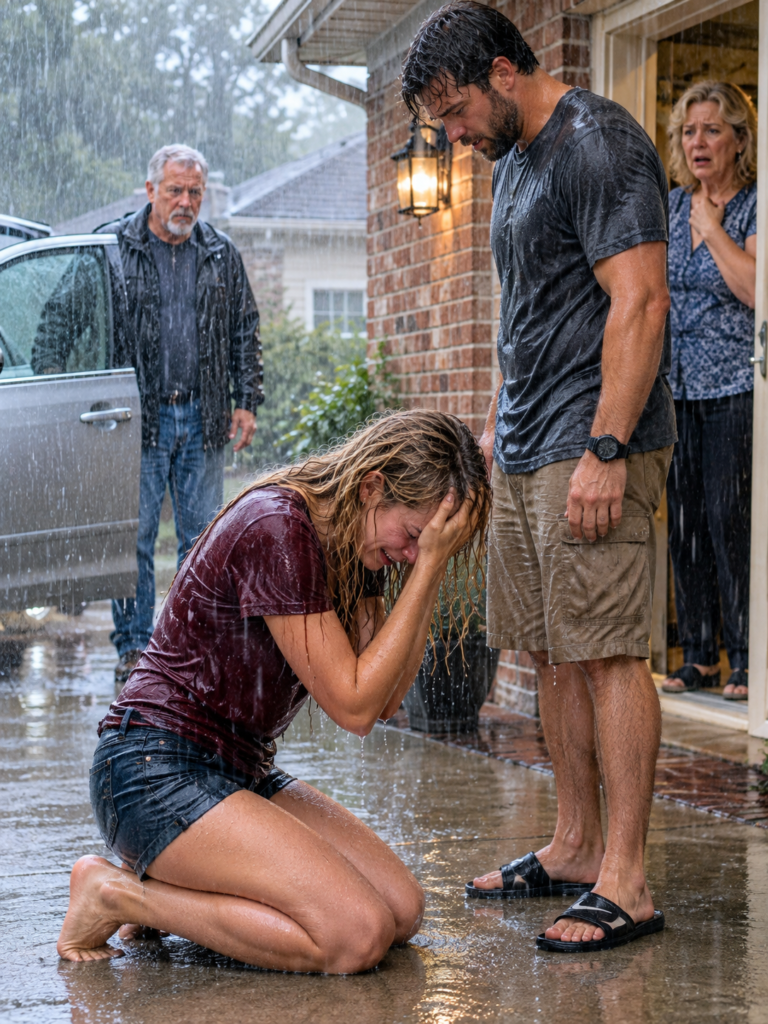
At the edge of the driveway. On her knees.
For a second my brain wouldn’t accept it. I thought it was a bag of leaves. A tarp. A shadow.
Then the headlights swept across her, and I saw her hair plastered flat against her head, and her shoulders folded in, and her hands resting on her thighs, palms down, like a kid waiting outside the principal’s office.
My daughter. Thirty-one years old. Kneeling on wet concrete in the dark.
I slammed on the brakes so hard my clipboard flew off the passenger seat. I left the truck running in the middle of the street with the door open and the chime going.
“Claire?”
She flinched. Not like someone surprised. Like someone caught.
Her face came up, and I saw fear flash across it. Not relief. Fear.
“Dad,” she said quickly. “Dad, please. You should go. I’m okay. Please just go.”
That word.
Okay.
It had followed her for years. She was okay at her mother’s funeral, when she couldn’t stop shaking. She was okay when she quit the job she loved at the children’s hospital. She was okay when she stopped coming to Sunday dinner, and okay when she missed my sixtieth birthday, and okay every single time I called and Mark answered her phone.
I pulled off my work jacket, the heavy canvas one with ELLISON HEATING & AIR stitched over the pocket, and wrapped it around her shoulders. She was trembling so hard her teeth clicked. Under my hands, through her soaked sweater, I could feel her shoulder blades. She was so thin.
“You’re not okay,” I said. I kept my voice level. Something hard was settling into my chest, low and heavy, like a stone dropping to the bottom of a pond. “Tell me what’s happening.”
Her eyes flicked toward the house.
The front windows were bright and gold. Through them, I could see shapes moving. A tall man by the couch. Two older people in armchairs. Another couple at the dining table. Glasses in hands.
“I bought a dress,” Claire whispered. “Just one. For the charity dinner next month. Diane’s dinner.” She swallowed. “Mark said it was disrespectful. That I didn’t ask. And his mother said I was spending money that wasn’t mine.”
“Whose money was it?”
“Mine.” Her voice broke. “It was the birthday money you gave me. The two hundred. I hid it in a tampon box so they wouldn’t find it.”
I stared at her.
“They told me to stay outside until I learned my lesson,” she said. “Mark said it’s called correction. His family does it. It’s how they teach.”
From inside the house came a burst of laughter.
It was easy and loose and comfortable. The laughter of people having a good evening. Somebody clinked a glass. Somebody said something I couldn’t hear, and everyone laughed again.
My daughter was kneeling in the rain, and they were laughing.
Something in me shifted then. I’ve been asked since if it was anger. It wasn’t. Anger is hot and messy, and I’ve been angry plenty of times in my life. This was different.
This was cold and clear. Like reading a schematic. Like finding the exact wire that’s been shorting out the whole system.
I bent down and slid one arm under her knees and the other behind her back, and I lifted her.
She was so light. That’s what I’ll never forget. My little girl, who I used to carry up the stairs asleep after long car rides, who got too heavy for me around age eleven. She weighed almost nothing.
“Dad, no,” she said weakly. “Dad, don’t, they’ll be so mad—”
Then her hands found my shirt, and she grabbed it in two fists, and she held on like she thought I might disappear.
The laughter grew louder as I carried her up the front steps. Rain ran off my sleeves onto the porch boards. My jaw ached from how tight I was holding it.
The door wasn’t locked. Of course it wasn’t. Why would they lock it? She wasn’t going anywhere.
I pushed it open with my foot.
It hit the wall so hard the picture frames in the hallway jumped.
The laughter stopped like someone had cut the power.
Mark Whitford stood by the couch, a glass of whiskey in his hand, his mouth still half-open in a smile that hadn’t caught up with his face yet. He was thirty-four, tall, handsome in the way of men in insurance commercials. He was wearing a quarter-zip sweater I’d once complimented at Thanksgiving.
His mother, Diane, sat upright in the wingback chair by the fireplace. She raised her chin like a judge whose courtroom had been interrupted. Her pearls caught the light.
His father, Gordon, leaned back in his recliner. Already, I could see it on his face, the look of a man who believes he’s being wronged simply because someone walked into the room without permission.
At the dining table sat Mark’s sister, Lauren, and her husband. Lauren had her hand over her mouth. She was the only one who looked at Claire instead of at me.
I stepped all the way inside. Water dripped onto their nice runner rug. I turned so my body was between them and my daughter.
And I said five words.
“My daughter is leaving. Now.”
Part 2: The Door
Mark recovered first. He always did. He set his glass down on the side table and laughed, a short sound with nothing behind it.
“Robert. Wow. Okay.” He spread his hands. “You can’t just walk into my house. This is between my wife and me.”
“No,” I said. “This is about control. And humiliation. And cruelty. And it ends today.”
Diane pressed a hand flat against her pearls.
“How theatrical,” she said. Her voice was smooth as a church organ. “Robert, really. Young women need guidance. Structure. Claire has always struggled with impulses. You know that. Anne knew that.”
Hearing my dead wife’s name in that woman’s mouth almost undid me.
Behind me, Claire stiffened in my arms.
“It was my money,” she said. It came out very small, but it came out. “I didn’t take anything from him.”
“Claire,” Mark snapped. “Stop.”
That’s all he said. Stop. One word. And I felt her whole body go tight, like a dog hearing a leash rattle.
I didn’t raise my voice. I didn’t have to.
“She didn’t disrespect you,” I said to Mark. “You disrespected yourself. By treating her like she’s something you own.”
Gordon stood up slowly from his recliner. He was a big man, sixty-five, with a retired-banker belly and a voice that had spent forty years telling people no.
“You don’t understand how families function, Robert,” he said. “A marriage needs order.”
At the word order, Claire shrank against my chest.
That told me everything. Whatever had happened in this house, that word had been part of it. That word had teeth.
I turned my head and looked down at her.
“Claire,” I said. “Look at me. Not at them. At me.”
She lifted her eyes. Her mascara had run in two black lines down her face.
“Do you want to stay here?”
She didn’t answer right away. I watched her look past my shoulder at Mark. I watched her try to measure what it would cost her to say it.
Then she looked back at me.
Tears were running down her face. She shook her head.
“No,” she said. “I can’t anymore. Dad, I can’t.”
I nodded once.
“That’s all I needed to hear.”
I turned toward the door.
Mark stepped in front of it.
He did it casually, like he just happened to be walking that way. He put one hand on the doorframe. He smiled at me. It was the smile of a man who has always been the most reasonable person in any room, as long as he controls the room.
“Robert,” he said quietly. “Let’s not do this. She’s upset. She gets like this. Let her get warm, let her have some tea, and we’ll talk tomorrow like adults.”
“Move.”
“She doesn’t have anything, you know.” His voice stayed soft. “No car. No phone that works without me. No bank account. Everything’s in my name. Where’s she going to go? What’s she going to do?”
“She’s going to come home,” I said.
“And then what? She’ll be back by Sunday. She always comes back.”
He looked past me at Claire.
“Don’t you, babe?”
I felt Claire’s hands tighten on my shirt.
“Mark,” I said. “I’m sixty-one years old. I have crawled through attics in August and basements full of rats. I have carried a two-hundred-pound furnace up three flights of stairs by myself. I am carrying my daughter out that door. You can step aside, or you can find out what happens when you don’t.”
For a long moment, nobody moved.
Then Lauren, Mark’s sister, stood up from the dining table so fast her chair scraped the floor.
“Mark,” she said. “Let them go.”
He turned and stared at her like she’d slapped him.
“Stay out of it, Lauren.”
“Let them go,” she said again, louder. Her voice was shaking. “Or I’m calling the police myself. I mean it.”
Mark held her eyes for three long seconds. Then he dropped his hand from the doorframe and stepped back.
“There’s one more thing,” Claire said into my shoulder. “Dad. My mom’s ring.”
I stopped.
“Diane keeps it,” Claire whispered. “In her jewelry box. Upstairs. She said it was too valuable for me to wear because I lose things.”
I looked at Diane in her wingback chair.
“I’ll be back for the ring,” I said. “With a police officer. You’ll want to have it ready.”
Diane’s mouth tightened into a line so thin it almost disappeared.
I carried Claire down the front steps and across the wet lawn to my truck, which was still running in the middle of Maple Ridge Drive with the door open and the chime going.
Behind us, Mark came out onto the porch. He stood under the light with his arms crossed, and he called out after us. His voice was pleasant. Friendly, almost.
“You’ll be back by Sunday, Claire! You always come back!”
I set her in the passenger seat and buckled her in like she was five years old. I turned the heat all the way up. I closed her door.
Then I walked around to the driver’s side, and I looked back at that bright gold house one more time.
He thought this was a scene. They all did. A family argument. Something that would blow over by the weekend, the way these things always had.
They had no idea what walking out that door was going to cost them.
They had no idea whose name was on the deed.
Part 3: Her Old Room
My house is in Wethersfield, fifteen minutes away. A small Cape with blue shutters that Anne picked out in 1993. Claire grew up there. Her height marks are still penciled on the pantry doorframe, the last one at age fourteen.
I ran her a hot bath, the way her mother used to when she came home from soccer games in the cold. I set out a towel and a pair of Anne’s old flannel pajamas, which I’d never been able to give away.
I sat on the floor in the hallway outside the bathroom door the whole time. I don’t know why. I just couldn’t leave her alone.
After a while, I heard her crying in the water. Quietly, with her hand over her mouth. The way you cry when you’ve learned that crying gets you in trouble.
I sat there and listened, and I didn’t knock, and I didn’t leave.
When she came out, wrapped in Anne’s pajamas with her wet hair in a towel, she looked like a kid. She looked like she was fifteen and had just broken up with her first boyfriend.
Except for her wrist.
The sleeve of the pajamas slid up when she reached for the tea I’d made, and I saw it. A bruise on the inside of her left wrist. Four marks in a row, faded yellow and green at the edges.
Fingers.
She saw me see it. She pulled the sleeve down fast.
“It’s nothing,” she said. “I bruise easy. You know that.”
“Claire.”
“I’m okay, Dad.”
I put my tea down very carefully on the kitchen table. My hands weren’t steady enough to hold it.
She slept in her old room that night, under the purple comforter Anne bought her in eighth grade. I’d kept the room the same. I’d told myself it was because I never got around to changing it. The truth is I’d always hoped she’d need it someday.
I didn’t sleep. I sat in the living room in Anne’s reading chair and stared at the dark window.
Around two in the morning, I heard the floor creak. Claire came down the stairs in her socks with the comforter wrapped around her shoulders, and she sat down on the end of the couch.
“I can’t sleep,” she said. “It’s too quiet. Nobody’s listening.”
“What do you mean, nobody’s listening?”
She pulled the comforter tighter.
“At the house,” she said. “Somebody’s always listening. Diane sleeps with her door open. Mark checks my phone. Gordon has cameras on the porch and in the kitchen. I stopped talking out loud to myself two years ago. I used to sing in the shower. I stopped.”
So I asked her to tell me. All of it. From the beginning.
And at two in the morning, in her mother’s pajamas, on the couch where she used to watch Saturday cartoons, she did.
She met Mark six years ago. Seven months after Anne died. Claire was twenty-five, a pediatric speech therapist at Connecticut Children’s in Hartford. She worked with little kids who had trouble talking. Kids who stuttered, kids with autism, kids who’d had strokes before they could walk.
She loved that job. She used to call me on her drive home and tell me about the little boy who’d finally said “truck” or the girl who’d sung the whole alphabet song for the first time.
Mark was a financial advisor at his father’s old firm. He was charming. Funny. He brought her soup when she was sick. He remembered Anne’s birthday and took her to the cemetery with flowers. He said he wanted to take care of her.
“He was so good at first, Dad,” she said. “He was so good. You remember.”
I remembered. I liked him. God help me, I liked him. I shook his hand at the wedding and told him to take care of my girl.
It started small. It always does, I’ve learned since.
He didn’t like her friends. They were “a bad influence.” He didn’t like her going out after work. He didn’t like her driving in the snow, so he took her car keys “for safety.” He thought she was too tired from her job, so he convinced her to go part-time, and then to quit.
“You don’t need to work, babe,” he’d said. “I make enough. Let me take care of you.”
Once she wasn’t working, she didn’t have money. So he gave her an allowance. Forty dollars a week. She had to keep the receipts and show them to him every Sunday night.
Then Diane and Gordon sold their house in Avon and moved in “for a few months” while their new condo was being built.
That was three years ago.
“Diane does the receipts now,” Claire said. “Sunday nights. At the kitchen table. She has a ledger. A real one, with columns. Income. Expenses. And a column for corrections.”
“What’s a correction?”
Claire looked at her hands.
“It’s what happens when you do something wrong. Gordon did it to Mark and Lauren when they were kids. Diane says it’s how the Whitfords raise people with character.” She said it in a flat voice, like reciting from a book. “If you talk back, you stand in the corner. If you waste money, you go without dinner. If you embarrass the family, you kneel. Outside. Until they say you can come in.”
“How many times, Claire?”
She didn’t answer.
“How many times have you knelt in that driveway?”
She was quiet for a long time.
“I stopped counting at eleven,” she said.
I got up and went into the kitchen. I stood at the sink with both hands on the counter and stared at the black window over it.
Eleven times. At least eleven times, my daughter had knelt in a driveway while a house full of people laughed. And I’d been fifteen minutes away. Fixing furnaces. Sending invoices. Wondering why she didn’t call.
“I should have known,” I said. I didn’t turn around. “I should have seen it. After your mom, I just— I let you go. I thought you were happy. I thought you were busy. I didn’t push.”
Claire came up behind me. She put her hand on my back, between my shoulder blades. Her mother used to do that.
“He made sure you didn’t see it, Dad,” she said. “That’s the whole point. That’s what he’s good at.”
Then she said something that made me turn around.
“Mark says the house is his,” she said. “He tells me all the time. He says if I ever leave, I’ll leave with nothing. Because it’s his house, and his money, and his name on everything.”
I looked at my daughter for a long moment.
“Claire,” I said slowly. “Did you ever see the deed?”
She frowned. “No. Mark handles all that. Why?”
I went to the hall closet and got down the fireproof box from the top shelf. The one Anne and I kept our important papers in. I set it on the kitchen table and unlocked it with the little key on my keychain, and I pulled out a folder I hadn’t opened in five years.
Inside was a deed. For a four-bedroom colonial at 114 Maple Ridge Drive, Glastonbury, Connecticut.
The owner’s name was Robert J. Ellison.
Part 4: What Anne Knew
Claire stared at the deed for a long time. She read it twice. Then she looked up at me.
“I don’t understand,” she said. “You gave us the house. For the wedding. Mark said you gave it to us.”
“I let you live in it,” I said. “I bought it. I paid cash. And I kept it in my name.”
“Why?”
I sat down across from her at the kitchen table. I took a deep breath.
“Because your mother told me to.”
Anne got sick the spring Claire turned twenty-four. Ovarian cancer, stage three. She fought it for fourteen months. She died in a hospital bed we set up in our living room, right where Claire was sitting on the couch tonight.
Mark came to see her twice in the hospital before she died. He’d only been dating Claire a couple of weeks then, maybe a month. He brought flowers. He was charming. He talked to Anne about her garden.
After the second visit, when Claire walked him out to the car, Anne grabbed my hand.
She was so weak by then. She could barely squeeze. But she squeezed.
“Bobby,” she said. She was the only person who ever called me Bobby. “I don’t like how he holds her arm.”
“What do you mean?”
“When they walked out. He had her by the elbow. Like he was steering her.” She closed her eyes. “I don’t like it. I can’t explain it. I just don’t.”
I told her she was tired. I told her he seemed like a nice young man.
She opened her eyes and looked at me, and even dying, she was the smartest person I’d ever known.
“If she marries him,” Anne said, “and you help them, and you will, because you can’t help yourself— keep your name on it. Whatever it is. Keep your name on it until you know he’s good. Promise me.”
So I promised.
Claire was crying again. Silent tears, running down her face onto her mother’s pajamas.
“She saw it,” Claire said. “Mom saw it. In two visits.”
“She did.”
“And I didn’t see it for six years.”
“You were grieving,” I said. “And he was good at it. And I didn’t see it either, Claire. Your mother was smarter than both of us.”
I’d almost forgotten about the promise. That’s the honest truth. After Anne died, my life turned into one long gray blur of work and grief. When Claire and Mark got engaged, I wanted to do something for her. Something big. Something Anne would’ve wanted.
I’d been saving for retirement for thirty years. I took a big piece of it and bought them a house. A real one, with a yard and a porch and a tree where Claire could hang a swing someday for her kids.
And when the lawyer asked whose name to put on the deed, I heard Anne’s voice in my head. Keep your name on it.
So I did. I told Mark and Claire it was for tax reasons, something about estate planning. Mark had nodded and smiled. He’d never asked about it again.
I’d paid the property taxes every year. The insurance. Mark thought I was being generous.
I was keeping a promise to a dead woman.
“Dad,” Claire said. “What are you going to do?”
I looked at the deed. Then at my daughter’s wrist, with the yellow bruise under the flannel sleeve.
“I’m going to call a lawyer,” I said. “First thing in the morning. And then I’m going to keep my promise.”
Part 5: Joanna
Joanna Pratt’s office was above a bakery in Old Wethersfield. It smelled like cinnamon rolls all the way up the stairs.
Joanna was sixty, with short silver hair and reading glasses on a beaded chain. She’d handled my business contracts for twenty years. She’d also, it turned out, spent the first fifteen years of her career as a family law attorney in Hartford before she switched to business law.
“Because I couldn’t sleep anymore,” she told me, when I asked why she’d switched. “Every case was this. Every single one.”
She listened to Claire for an hour and a half without interrupting. She took notes on a yellow legal pad. When Claire got to the part about the ledger with the column for corrections, Joanna put her pen down and took off her glasses.
“Claire,” she said. “Do you know that Connecticut has a law about this?”
Claire shook her head.
“It’s called Jennifer’s Law,” Joanna said. “Passed a few years back. It’s named after a woman whose husband controlled her for years before he killed her. The law changed how this state defines family violence.”
She leaned forward.
“Family violence doesn’t have to mean a punch anymore. Not in Connecticut. It includes coercive control. Isolating someone from friends and family. Controlling their money. Monitoring their phone and where they go. Humiliating them. Forcing them to do degrading things.” She paused. “Like kneeling in a driveway in the rain.”
Claire’s hands were shaking in her lap.
“So what he did,” she said, “is against the law?”
“What he did is grounds for a restraining order,” Joanna said. “And it’ll matter a great deal in any divorce. And given the bruise on your wrist, it may be more than that.”
“I don’t want to send him to jail,” Claire said quickly. “I just want him to leave me alone.”
Joanna looked at her for a long, gentle moment.
“That’s okay,” she said. “You don’t have to decide any of that today. Today, we start with safe. Okay? First you’re safe. Then we figure out the rest.”
Then Joanna turned to me.
“Now, Robert,” she said, and I saw something sharp and almost happy flicker behind her reading glasses. “Tell me about this deed.”
I put it on her desk. She read it carefully, every line.
Then she sat back in her chair and laughed. Just once, a short bark of a laugh.
“Your wife was a genius,” she said.
“I know.”
“No, Robert. You don’t understand. This house isn’t marital property. It was never Claire’s or Mark’s. It’s yours. They’re living in it with your permission.” She tapped the deed. “Which means Mark Whitford, and his mother, and his father, are guests in your house. And you can revoke that permission.”
“How fast?”
“In Connecticut, you serve a Notice to Quit. Then if they don’t leave, it goes to housing court. It’s not overnight, but with a protective order in place and the facts we’ve got, they won’t be in that house long.” She smiled. “And Mark won’t be able to touch it in the divorce. Not one shingle.”
Claire was staring at the deed.
“He used to tell me,” she said quietly, “that if I left, I’d be homeless. He said it every time I cried. ‘Where are you going to go, babe? Back to Daddy? You’ve got nothing. It’s all mine.’”
Joanna slid a box of tissues across the desk.
“Well,” she said. “He was wrong about that too.”
Part 6: Sunday
The texts started that first night. By Saturday morning, there were eighty-four of them.
Claire’s phone had been set up by Mark, on Mark’s account, with Mark’s tracking. Joanna told us to turn it off and put it in a drawer, and to get Claire a new phone on my plan with a new number. But first, we screenshotted everything.
The texts went like this.
“Babe come home, you’re embarrassing yourself.”
“Your dad is not well. He’s grieving. He doesn’t understand us.”
“I’m not mad. Just come home and we’ll talk.”
“Mom is very hurt by what you said about her.”
“You know what happens if you make this worse, Claire.”
“I love you. You know I love you. Nobody will ever love you like I do.”
“You’ll be back by Sunday. You always come back.”
Then Diane called my phone. I didn’t recognize the number, and I picked up.
“Robert,” she said. That church-organ voice. “I’d like to speak to my daughter-in-law.”
“She doesn’t want to speak to you, Diane.”
“She’s confused. She has a history of emotional instability, Robert. Mark has been very patient. We all have.” She paused. “I wonder if you know what a burden she’s been.”
I held the phone away from my ear for a second. Then I put it back.
“Diane,” I said. “In about four days, you’re going to get some papers. I’d read them carefully if I were you.”
“Is that a threat?”
“No,” I said. “It’s a courtesy. More than you gave her.”
I hung up.
Gordon called next, an hour later. He didn’t say hello.
“If you think you can break up my son’s marriage with some kind of emotional stunt,” he said, “you’ve got another thing coming. We have lawyers, Robert. Good ones. You’ll be in court for years.”
“Gordon,” I said. “Whose name do you think is on the deed to that house?”
There was a pause on the line. A long one.
“What?”
“Ask Mark,” I said. “Ask him to show you.”
And I hung up again.
Sunday came. I’ll admit I was afraid of it. Mark had said it so many times, so confidently. You’ll be back by Sunday. You always come back.
Claire was quiet all morning. She sat on the back porch with a cup of coffee, staring at Anne’s old garden, which had gone mostly to weeds.
At two in the afternoon, a car pulled into my driveway. Mark’s silver Audi.
He got out carrying a huge bouquet of white roses. He was wearing the quarter-zip sweater. His hair was perfect. He walked up my front steps and rang the doorbell like a man showing up for a first date.
Claire was in the kitchen. She heard the doorbell, and she froze.
I went to the front window and looked out. Mark saw me through the glass. He smiled and lifted the roses, like, hey, look, I come in peace.
I didn’t open the door. I went back into the kitchen.
Claire was standing by the refrigerator, holding onto the counter. Her face had gone completely white.
“It’s him,” I said. “He brought flowers.”
“White roses,” she whispered. “He always brings white roses after a correction. Always.”
“Claire,” I said. “This is your choice. Not mine. If you want to talk to him, I’ll stand right next to you. If you don’t, I’ll tell him to go.”
The doorbell rang again. Then again. Then Mark’s voice came through the door, warm and soft and loving.
“Claire? Babe? I just want to talk. Five minutes. I’m sorry, okay? I’m so sorry. I miss you. Please, babe.”
I watched my daughter’s face. I watched her want to go. I watched every part of her that had been trained for six years pulling her toward that door, toward the roses, toward the warm voice and the apology and the promise that it would be different this time.
She took one step toward the hallway.
Then she stopped.
She looked down at the inside of her left wrist. The bruise was almost gone now, just a faint yellow shadow. She pulled up her sleeve and looked at it for a long time.
“Dad,” she said. “Can you tell him something for me?”
“Anything.”
“Tell him it’s Sunday,” she said. “And I’m not coming back.”
I opened the front door. Mark’s face lit up for a second, then fell when he saw it was me.
“Robert, I just—”
“She says to tell you it’s Sunday,” I said. “And she’s not coming back.”
Mark’s face changed. It was like watching a mask slide off. The warmth drained out of it all at once, and what was underneath was flat and cold and hard.
“She’ll come back,” he said quietly. “She always does. She’s got nowhere else to go.”
“She’s got here,” I said. “She’s always had here. You just made sure she forgot.”
And I closed the door on him.
Through the window, I watched him stand on my porch for almost a full minute. Then he walked back to his Audi and dropped the white roses into my garbage can at the end of the driveway.
Behind me, I heard Claire start to cry. But it was different this time. She cried out loud.
Part 7: Lauren
On Monday, Claire’s new phone rang. It was a number she didn’t know.
She almost didn’t answer. Then she did. She put it on speaker so I could hear.
“Claire? It’s Lauren.”
Mark’s sister. The one who’d stood up at the dining table and told Mark to let us go.
“How did you get this number?” Claire asked.
“Your dad’s on the Ellison Heating and Air website,” Lauren said. “I called the office and asked for him and his secretary gave me his cell. I hope that’s okay. I called him first, and he said I could have yours if you wanted to talk to me.” A pause. “Do you?”
Claire looked at me. I nodded.
“Okay,” Claire said.
Lauren was quiet for a long time. When she talked again, her voice was shaking.
“I knelt in that driveway too,” she said. “When I was thirteen. And fourteen. And sixteen. The last time, I was seventeen, and it was February, and I’d come home twenty minutes past curfew. Dad made me kneel on the ice for an hour. Mom watched from the kitchen window with a cup of tea.”
Claire put her hand over her mouth.
“Mark used to bring me a blanket,” Lauren said. “When we were little. He’d sneak out with a blanket when they weren’t looking. He was the only one who ever helped me.” She stopped. “And then he grew up and did it to you.”
“I should have said something,” Lauren went on. “Years ago. I saw how he talked to you. I saw you get thinner. I saw Mom with that ledger. I knew exactly what it was. I knew because I’d lived it. And I didn’t say anything. Because I was scared of them, even now, even at thirty-six with my own kids.”
“You said something on Friday,” Claire said quietly.
“Not enough.”
“It was enough for the door.”
There was a long silence on the line.
“Claire,” Lauren said. “I want to help. Your dad told me about the lawyer. I want to give a statement. About how they raised us. About the kneeling. About the ledger.”
“You’d do that?”
“I’ll do more than that,” Lauren said. “I have something you need to see.”
What Lauren had was a screenshot.
The Whitford family had a group chat. Mark, Diane, Gordon, Lauren, and Lauren’s husband. On Friday night, at 7:42 p.m., about forty minutes before I turned onto Maple Ridge Drive, Mark had posted a picture in it.
It was a photograph taken from the living room window. It showed Claire kneeling at the end of the driveway in the rain.
Under it, Mark had written: “Lesson’s going well. 😂 Who wants another drink?”
Diane had replied with a thumbs-up.
Gordon had written: “Good man. Structure builds character.”
Lauren’s message under that was the only one that didn’t fit. It was just two words.
“Mark, stop.”
Nobody had replied to her.
Claire stared at the picture on my phone for a long, long time. I don’t think she’d ever seen herself from the outside like that. Small. Soaked. Alone at the edge of the driveway with the gold windows glowing behind her.
“That’s me,” she said finally.
“That’s you,” I said.
“He took a picture. He took a picture and made a joke.”
Then she did something I didn’t expect. She handed the phone back to me, wiped her face with both hands, and sat up straight.
“Send it to Joanna,” she said. “All of it. The picture. The texts. Everything.”
Part 8: The Hearing
The application for a restraining order was heard at Hartford Superior Court eleven days later.
Joanna had filed it the week before, with Claire’s sworn statement, Lauren’s statement, the photographs of Claire’s wrist, the screenshot from the family chat, and all eighty-four of Mark’s texts. The judge had granted a temporary order the same day, until the full hearing.
Mark showed up with a lawyer named Preston Hale who wore a suit that probably cost more than my truck. Diane and Gordon sat in the gallery behind him like a wall.
Claire sat next to Joanna at the other table. She was wearing a plain gray sweater and slacks. Her hair was pulled back. She’d gained three pounds in eleven days, eating my terrible scrambled eggs and Anne’s old soup recipes.
I sat right behind her. Lauren sat next to me.
Mark’s lawyer went first. He talked about a happy marriage going through a rough patch. A loving husband. A wife with a history of anxiety, still grieving her mother’s death. A father-in-law who had overreacted to a private family matter.
“There was no violence, Your Honor,” Preston Hale said. “There was a disagreement about finances. My client asked his wife to take a moment outside to collect herself. That’s all.”
The judge was a woman in her fifties named Patricia Okonkwo. She had a reputation for being calm and thorough and almost impossible to impress.
“To collect herself,” she said. “On her knees. In the rain.”
“Kneeling was her choice, Your Honor.”
“Was it?” Judge Okonkwo looked down at the papers in front of her. “I have a photograph here, counselor. Posted by your client to a family group chat. With the caption ‘Lesson’s going well,’ followed by a laughing emoji.” She looked up. “Is it your position that a lesson was her choice too?”
Preston Hale didn’t answer right away.
Then Claire testified.
Joanna had told her she didn’t have to look at Mark. She could look at Joanna, or at the judge, or at me. But when Claire got up on the stand and put her hand on the Bible, she looked right at him.
And she told the court everything.
The keys. The job. The forty dollars a week. The Sunday night receipts. The ledger with the column for corrections. The cameras in the kitchen. The phone tracking. The bruise on her wrist from the night she’d tried to call me and Mark had grabbed the phone out of her hand.
“He told me I’d be homeless if I left,” Claire said. “He told me no one would ever love me like he did. He told me I was lucky. He told me that every time I knelt in that driveway, it was because I’d earned it.”
Her voice didn’t break once.
When she finished, Judge Okonkwo asked if Mark’s lawyer had questions for her.
Preston Hale stood up. He walked toward the witness stand slowly, smiling a little.
“Mrs. Whitford,” he said. “You stayed in that house for six years, correct?”
“Yes.”
“If things were so terrible, why didn’t you leave?”
The courtroom got very quiet.
Claire looked at him for a long time. Then she said something I’ll never forget.
“Because I was okay,” she said. “That’s what I always said. I’m okay. I’m fine. Don’t worry about me. I said it so many times I started to believe it.” She took a breath. “I wasn’t okay. I haven’t been okay in six years. That’s why I didn’t leave. Because he taught me that okay is what you say when you’re too scared to say anything else.”
Preston Hale opened his mouth. Then he closed it.
“No further questions,” he said.
Then Lauren testified. She talked about the driveway when she was thirteen, and the ice when she was seventeen, and her mother watching from the kitchen window with a cup of tea. Diane stared straight ahead the whole time. Gordon’s face went red, then purple.
When Lauren got down off the stand, she walked right past her parents without looking at them. She sat down next to me. Her hands were shaking. I put one of mine over both of hers.
Judge Okonkwo granted the restraining order for a full year. No contact with Claire. Mark had to stay at least a hundred yards away from her, from my house, and from her new workplace when she found one.
Then she said something else.
“Mr. Whitford,” she said, looking down at Mark from the bench. “I want to say something to you directly. Not as a legal finding. As someone who has sat in this chair for nineteen years.”
Mark looked up at her.
“You were raised to believe that cruelty is structure,” Judge Okonkwo said. “That humiliation is discipline. That love means control. Your sister sat in that chair today and told us that once, when you were a boy, you brought her a blanket.” She paused. “That boy knew the difference. I hope someday you find him again.”
Mark didn’t say anything. He just looked down at the table.
But I saw his hands. They were shaking.
Part 9: The Ring
The Notice to Quit was served on 114 Maple Ridge Drive on a Tuesday morning in November.
A state marshal brought it. I went with him, along with a police officer from the Glastonbury department, for what Joanna called a civil standby. The officer was there to keep the peace while I collected a few of Claire’s things.
Diane answered the door. When she saw the marshal, and the officer, and me standing behind them on the porch, her face did something I’d never seen it do before.
It went blank. Completely blank. Like a computer screen that had crashed.
The marshal handed her the papers. She read the first page standing in the doorway.
“This can’t be right,” she said. “This is our house. Mark’s house. Robert gave it to them.”
“Robert let them live in it,” I said. “Robert owns it. It’s been in my name since the day I bought it.”
Gordon came up behind her. He snatched the papers out of her hands and read them himself. His big face went gray.
“You can’t do this,” he said. “We’ve lived here three years. We sold our house. Our condo isn’t finished.”
“Then I guess you’ll need to finish it,” I said.
Mark wasn’t there. Under the restraining order, he couldn’t be anywhere near Claire, and Joanna had made sure he knew I’d be collecting Claire’s things that morning. He’d gone to a hotel.
I went upstairs with the officer. Claire had given me a list. Her clothes. Her books. Her old speech therapy flashcards in a shoebox under the bed. A framed picture of Anne from the bedroom dresser.
And the dress.
It was hanging in the back of Diane’s closet in a garment bag. Deep blue silk, simple, with long sleeves. The tag was still on it. Claire had bought it at a little consignment shop in West Hartford for a hundred and eighty-six dollars of her birthday money.
I took it off the hanger very carefully and laid it over my arm.
Then I went to Diane’s dresser, where she kept her jewelry box.
Diane had followed us upstairs. She stood in the bedroom doorway with her arms crossed and her pearls on.
“Diane,” I said. “Anne’s ring.”
She didn’t move.
“It’s a gold band with a small sapphire,” I said. “Anne’s grandmother brought it from Ireland in 1921. Anne wore it every day for thirty years. She gave it to Claire two days before she died.”
Diane’s mouth tightened.
“Claire loses things,” she said. “I was keeping it safe.”
The officer stepped forward.
“Ma’am,” he said politely, “is the ring in that box?”
Diane looked at him. She looked at me. Then she walked to the dresser, opened the jewelry box, took out a small velvet pouch, and dropped it into my hand without a word.
I opened it. There it was. Anne’s ring. A tiny sapphire, catching the gray November light from the window.
I closed my hand around it.
As I was leaving, carrying the dress and the shoebox of flashcards and the framed picture of Anne, Diane said one more thing.
“You’ve ruined this family, Robert.”
I stopped on the stairs and looked back up at her.
“No, Diane,” I said. “I just stopped letting you ruin mine.”
They moved out in December. Two days before the court date in housing court. Gordon’s condo still wasn’t finished, so they moved into an extended-stay hotel off I-91 with Mark.
When I went to check on the house after they left, it was spotless. Diane had cleaned it top to bottom. Every surface shone. Every floor was polished.
But in the driveway, at the very edge, where it met the street, there was a stain in the concrete. A faint dark patch, about the size of two knees.
I stood and looked at it for a long time.
Then I went back to my truck, got my pressure washer, and spent two hours blasting that driveway until there was nothing left.
Part 10: The Words
Claire went back to work in February.
Connecticut Children’s had a position open in the outpatient speech therapy clinic. Her old supervisor, a woman named Dr. Fiona Gallagher, remembered her. When Claire called, Dr. Gallagher cried on the phone.
“We wondered what happened to you,” she said. “You were the best I ever had with the little ones. You just disappeared.”
“I know,” Claire said. “I’m back now.”
The first week back, Claire came home every night exhausted and shaking. She’d forgotten how to be around people without checking their faces for anger. She’d forgotten how to eat lunch without counting what it cost. Twice, she called me from the hospital parking lot in tears because her supervisor had asked her a simple question and she’d panicked.
But she kept going back.
By the third week, she was calling me on her drive home again. Just like she used to, before Mark. Telling me about her kids.
There was a little boy named Diego, five years old, who’d stopped speaking after his father left. He hadn’t said a word in eight months. He just pointed at things.
“I’m working with him on feelings words,” Claire told me. “Happy. Sad. Mad. Scared. We use these little cards with faces on them.”
“Is it helping?”
“Today he pointed at the scared card,” she said. “And then he pointed at me. And I said, ‘You’re scared?’ And he nodded.”
She was quiet for a second on the phone.
“And then he pointed at another card,” she said. “The one that says okay. And he shook his head. No. He shook his head no.”
Her voice wobbled.
“He was telling me he’s not okay, Dad. And that’s the first true thing he’s said in eight months.”
The divorce was final in June.
Mark didn’t fight it as hard as I expected. Joanna said his lawyer had probably told him that with the restraining order, the photograph, Lauren’s testimony, and Jennifer’s Law, any judge would take one look at him and side with Claire on everything.
Claire got half of the savings accounts that Mark had built out of her old salary. She got her car back. She got her name back. She got Anne’s ring, which she wears now on her right hand.
She didn’t get the house. She didn’t want it.
“I never want to see that driveway again,” she said.
So I sold it. To a young couple with a baby and a golden retriever. I told the real estate agent to make sure they knew there was a perfect tree in the backyard for a swing.
Lauren and Claire see each other every Wednesday now. They have lunch at a diner in Rocky Hill. Lauren’s kids call Claire “Aunt Claire” even though technically she isn’t their aunt anymore.
“Technically doesn’t matter,” Lauren told her. “You’re stuck with us.”
Lauren hasn’t spoken to her parents since the hearing. She says she’s not sure she ever will. She says she’s learning, slowly, that a person can love their parents and still refuse to hand them their children.
I don’t know what happened to Mark, exactly. I know he left his father’s firm. Lauren heard he’s living alone in an apartment in Springfield, Massachusetts. She heard he’s seeing a therapist.
I hope that’s true. I hope he’s looking for that boy with the blanket. I hope he finds him.
But I’m not holding my breath.
Part 11: The Dinner
The charity dinner Diane had been planning was the Hartford Women’s Hope Gala. It raised money every year for a shelter for women and children leaving domestic violence.
I didn’t know that until Lauren told me. I had to sit down when I heard it.
“She was the chair,” Lauren said. “For six years. She’d stand up at the podium every November and give a speech about how no woman should ever be afraid in her own home.”
Diane wasn’t the chair anymore. Lauren had sent a letter to the gala’s board after the hearing, with a copy of the restraining order and the screenshot. The board asked Diane to step down two weeks later.
The next November, a year after the night in the driveway, the gala’s new chair called Claire.
Her name was Monica Reyes. She’d spent ten years running the shelter itself. She’d read the court records.
“We’d like you to speak,” she said. “At this year’s dinner. Only if you want to. Only what you’re comfortable with. But a lot of women in that room think it can’t happen to someone like them. You could show them it can.”
Claire didn’t answer for a long time.
“Can I think about it?” she asked.
“Take all the time you need.”
Claire hung up. She sat at my kitchen table for an hour. Then she got up, went upstairs, and came back down holding the garment bag.
The dark blue silk dress. The one with the tag still on it. A hundred and eighty-six dollars of birthday money.
“I’m going to wear it,” she said. “I’m going to wear it to the dinner I wasn’t allowed to go to.”
The gala was held at a hotel ballroom in downtown Hartford. Four hundred people. White tablecloths, candles, a string quartet in the corner.
I sat at a table near the front with Lauren and her husband and Joanna Pratt. Dr. Gallagher from the hospital came. So did Monica Reyes.
When they called Claire’s name, she stood up from our table and walked to the podium.
She was wearing the blue dress. It fit her now. She’d gained back the weight she’d lost, and her face had color in it, and her hair was down around her shoulders the way it used to be in college. On her right hand, Anne’s ring caught the light.
She looked out at all those people. Then she looked down at our table and found me.
I nodded once.
“A year ago,” Claire said into the microphone, “I bought this dress. To come to this dinner. And because I bought it, I spent three hours kneeling in my husband’s driveway in the rain.”
The ballroom went completely silent.
“I’m not going to tell you everything that happened in that house. Some of it’s mine to keep. But I want to tell you about one word.”
She paused.
“Okay.”
She looked out at the room.
“I said it every day for six years. When I was scared. When I was hurt. When I was so hungry I couldn’t sleep. When people asked me how I was. I’m okay. I’m fine. Don’t worry about me.” She took a breath. “And every single time, it was a lie. And the person who taught me to say it was the same person who made it a lie.”
“I’m a speech therapist,” Claire said. “I help little kids find their words. And here’s what I’ve learned this year. The hardest words to find aren’t the big ones. They’re the small true ones. The ones like ‘No.’ Or ‘Help.’ Or ‘I’m not okay.’”
She looked down at me again.
“My dad found me on my knees a year ago. And he didn’t ask me if I was okay. He told me I wasn’t. And then he asked me one question. Do you want to stay?”
Her voice cracked for the first time.
“Nobody had asked me what I wanted in six years. That was the question that saved my life.”
She talked for twelve minutes. When she finished, nobody clapped at first. The room was too quiet. Then a woman at a table near the back stood up. Then another. Then the whole room was on its feet.
Claire stood at the podium in her blue dress, crying, and she let them see her cry.
Afterward, a line formed. Dozens of women. Some of them old, some of them young. They didn’t want autographs. They just wanted to hold her hands for a second. Some of them whispered things to her I couldn’t hear.
One young woman, maybe twenty-two, held onto Claire’s hands for a long time. When she finally let go, Claire turned and looked at me across the ballroom, and her face was wet and shining.
Later, in the car, she told me what the girl had said.
“I’m not okay either. Can you help me?”
And Claire had said, “Yes. Yes. Let’s start right now.”
Part 12: Rain
It was raining when we drove home that night. The same kind of rain as a year before. Slow and steady and quiet, the kind that soaks you through before you notice.
I pulled into my driveway in Wethersfield. Blue shutters. The porch light Anne picked out.
Claire got out of the truck first. I grabbed the umbrella from behind the seat and went around to the passenger side to hold it over her.
But she wasn’t waiting for me.
She was standing in the middle of the driveway, in her blue silk dress, with her face turned up to the sky. Her arms were out at her sides. The rain was running down her face and soaking her hair and darkening the silk.
And she was laughing.
I stood there with the umbrella in my hand and didn’t open it. I just watched her.
My daughter. Thirty-two years old now. Standing in the rain in the dress she’d knelt for, laughing like a little girl in a summer storm.
Standing. Not kneeling.
“Claire,” I called. “You’re going to ruin that dress.”
She turned around, still laughing, and looked at me.
“It’s okay, Dad,” she said.
Then she stopped. Her face went soft and serious, the way her mother’s used to when she was about to say something true.
“No,” she said. “Wait. Let me say it right.”
She walked over to me through the rain and took my hand, the one that wasn’t holding the umbrella.
“I’m okay,” she said. “I’m really okay.”
I looked at her for a long time. At the rain on her face. At her mother’s ring on her right hand. At her eyes, clear and bright and finally, completely her own.
I’ve heard my daughter say that word ten thousand times. I’ve heard it as a lie, and as a plea, and as a wall she hid behind.
That night in the rain, for the first time in six years, I heard it as the truth.
I dropped the umbrella on the wet concrete. And I stood there in the driveway with her, two soaked fools in the dark, until we were both laughing so hard we couldn’t stand up straight.
Somewhere, I think, Anne was laughing with us.