The Jar
My husband announced it on a Sunday night in September, standing in our kitchen with his arms folded.
From now on, every dollar I earned in tips belonged in the household jar. Every single one. No more keeping a little back for gas or lunch or Ava’s school stuff. All of it went in the jar, and he would decide how much I could take back out.
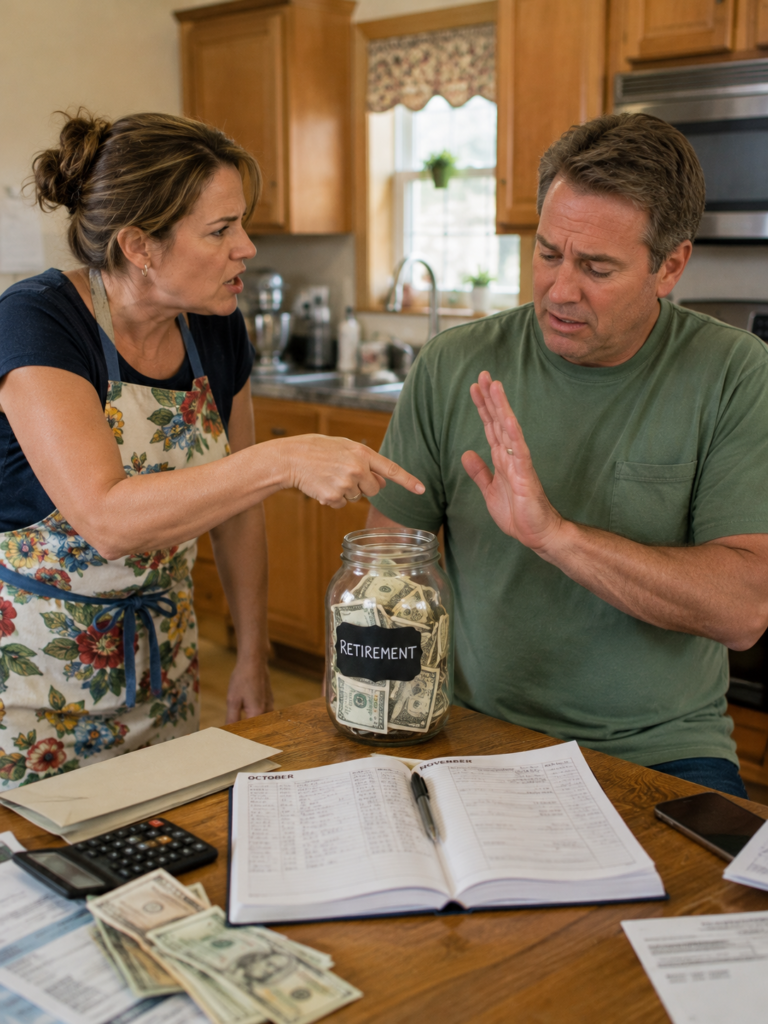
“It’s all family money, Lita,” he said. “I’m not controlling you. I’m just keeping things organized.”
I was still in my work clothes. Black pants, black shirt with the steakhouse logo on the pocket, the black apron with the two deep front pockets. My feet hurt. I’d worked a double. Eleven hours on a Sunday, which is the busiest day of the week at Gallagher’s Steakhouse on Route 23.
I looked at him for a long moment.
Then I smiled.
I emptied my apron pockets onto the kitchen table. Crumpled twenties and tens and fives and ones, all mixed together, the way tips come out at the end of a shift. A few quarters. A folded fifty somebody left under a plate.
I counted it out right there in front of him. Stacked by denomination. Out loud.
“Two hundred and eleven,” I said.
Then I picked it up and dropped it into the glass jar on the counter.
Duane nodded, satisfied. He went back to the living room and turned on the Browns game.
I stood at the kitchen counter for a while, looking at the jar.
It’s a big glass jar. The kind you buy pickles in at Sam’s Club. We’d been using it for eleven years. It sat on the counter next to the coffee maker, and every night when I came home I dropped my tips in it.
Every Sunday night, Duane counted it. And wrote the total on the little whiteboard stuck to the side of the refrigerator with magnets.
What Duane didn’t know was that I’d been recording every dollar I earned for eleven years.
Every shift. Every tip. Every single night.
And for the past twenty-two weeks, exactly forty dollars had disappeared from that jar every single Sunday.
I didn’t say anything that night. I went upstairs and took a shower and got into bed and lay there in the dark, listening to the Browns lose through the floor.
But in my purse, on the dresser, there was a small black notebook.
And it was full of numbers.
Chapter Two: The Black Notebooks
My name is Carlotta Reyes Kowalski. Everyone calls me Lita.
I’m thirty-nine. I was born in Toledo to a Puerto Rican mother and a Polish father, and I grew up in a house where money was always tight and always counted. My mother cleaned offices downtown. My father worked at the Jeep plant. They kept their money in an envelope in a kitchen drawer, and every Friday night they sat at the table and counted it together.
Together. That’s the part I remember.
I’ve worked as a waitress at the same steakhouse in Chillicothe, Ohio, for eleven years.
Gallagher’s. A family place with red leather booths and white tablecloths and a salad bar with a sneeze guard that’s been there since 1987. People come for the prime rib on Saturdays. Anniversary dinners. Prom dates. Retirement parties. Funeral lunches.
I’m good at it. I’ll say that plainly. I remember names. I remember who wants extra horseradish and who’s allergic to shellfish and whose husband just died. I’ve got regulars who won’t sit in anybody else’s section.
On a busy Saturday, I sometimes earn more in tips than Duane makes during an entire shift at the plant.
But his family doesn’t know that.
Duane works at the paper mill on the edge of town. Twelve-hour shifts, rotating. He makes good money. Twenty-six dollars an hour, plus overtime.
But some Saturdays, I make three hundred dollars in tips in a single double. Some Mother’s Days, I make five hundred.
Duane doesn’t like people to know that.
Duane prefers telling everyone that he provides for our household while I merely help with expenses.
I’ve heard him say it. At his mother’s house at Thanksgiving. At the Moose Lodge. At church.
“Lita helps out,” he says. “She’s got her little job at the steakhouse.”
Her little job.
His mother, Dolores, once asked whether the restaurant actually allowed waitresses to keep their tips.
That was at Easter, three years ago. Dolores is seventy-one. She’s lived her whole life in Chillicothe. She calls me “the waitress” when she thinks I can’t hear.
“Do they let you keep that money?” she asked me, at her dining room table, passing the ham. “The tips? Or does the restaurant take it?”
I laughed politely because arguing never seemed worth the trouble.
“We keep it, Dolores,” I said.
“Hm,” she said. And passed me the green beans.
Our arrangement had started simply enough.
When we got married, fourteen years ago, we sat at the kitchen table in our first apartment and figured it out. I’d put my tips in a jar. He’d deposit his paycheck into our joint account at the credit union.
Then, every week, the jar money would go into the joint account too. And we’d pay everything out of there. Mortgage. Groceries. Electric. Car insurance. Ava’s braces. Ava’s softball fees. Ava’s everything.
Ava is sixteen now. A junior at Chillicothe High. She plays shortstop and wants to be a physical therapist.
Every Sunday, Duane counted the jar.
That was his job. He liked doing it. He’d sit at the kitchen table with the jar and sort the bills into stacks and count them and write the total on the whiteboard. Then on Monday, he’d take the money to the credit union and deposit it.
I never questioned it. Why would I? He’s my husband. It’s our money.
But every waitress I know counts her money before she leaves work.
It’s a habit. You learn it your first week. At the end of every shift, you sit down in the back booth with your apron and you count your tips before you leave the building. You write it down. Partly for your taxes, because the IRS wants to know. Partly because if something’s missing, you want to know right away.
I kept a small black notebook in my purse, recording my tips after every shift.
The cheap kind, from the Dollar General. Three for two dollars. Black cover, lined pages.
Date. Shift. Tables. Cash tips. Credit card tips. Total.
Over eleven years, those notebooks had become a detailed history of my earnings.
I’ve filled thirty-four of them. They’re in a shoebox on the top shelf of my closet. Every dollar I’ve earned since the day I started at Gallagher’s.
One Sunday in August, Duane wrote $1,240 on the whiteboard.
I was getting a glass of water. I glanced at it. Something about the number bothered me. I didn’t know why at first.
I went upstairs and got my notebook out of my purse. I added up the week.
My notebook showed I’d contributed $1,280.
Forty dollars.
I thought maybe I’d made a mistake. Maybe I’d forgotten to drop one night in the jar. Maybe I’d spent some on gas.
So I checked the week before.
The previous week, he’d recorded $1,190 when I’d actually brought home $1,230.
Forty dollars again.
I sat on the edge of my bed with the notebook in my lap. Then I got up and went into my closet and took down the shoebox.
I checked twenty-two consecutive weeks.
I went back to March. I compared every week in my notebook to every number I could remember Duane writing on the whiteboard. I’d taken pictures of the whiteboard sometimes, on my phone, to send to Ava when she asked about money for softball. I scrolled through my photos and found eleven of them.
Every single one was short by forty dollars.
That added up to eight hundred and eighty dollars.
Chapter Three: Forty Bucks
On Monday evening, I placed my notebook beside the jar.
I didn’t say anything at first. I just set it there. Open. On the counter, next to the jar, where he’d see it when he came in from his shift.
He came in at six-thirty. He hung his jacket on the hook. He went straight to the refrigerator for a beer.
He didn’t notice the notebook.
I waited until he sat down in front of the TV.
“Duane,” I said. “Why does the board say twelve-forty when I put in twelve-eighty?”
He barely glanced up from the television.
“Probably counted wrong.”
“You’ve counted exactly forty dollars too little for twenty-two weeks.”
He sighed. The big sigh. The one that means I’m being unreasonable.
“Seriously, Lita? You’re making a big deal over forty bucks?”
“It’s eight hundred and eighty dollars.”
His expression changed.
Just for a second. Something went across his face. Fast. Like a shadow over a field. Then it was gone, and he was frowning at me.
“You’ve been keeping track?”
“I’m a waitress,” I said. “Counting money is part of my job.”
“Of the jar?”
“Of my tips. Every shift. For eleven years.” I picked up the notebook from the counter and held it up. “It’s all in here. And thirty-three more just like it.”
He stared at the notebook.
“So what?” he said. “So I counted wrong. So I’m a little off. I’ve got a lot on my mind, Lita. I work twelve-hour shifts.”
“Twenty-two weeks in a row,” I said. “Exactly forty. Not thirty-nine. Not forty-one. Forty.”
He muttered something about trust and returned to watching television.
I stood there in the kitchen doorway for a long time. He didn’t look at me again. He turned up the volume.
I went upstairs.
Ava was in her room with her door open, doing homework on her bed. She looked up when I passed.
“Mom? What’s going on? Why’s Dad mad?”
“He’s not mad, honey,” I said. “We’re just talking about money.”
She looked at me for a long moment. She’s sixteen. She’s not stupid.
“Okay,” she said.
Chapter Four: The Locker
The next evening, I left my tips in a sealed envelope inside my locker at work.
Gallagher’s has a little room in the back by the kitchen with eight metal lockers for the servers. Mine is number four. It has a combination lock my mother gave me when I was in high school.
I counted my tips that night like always. One hundred and eighty-four dollars. I wrote it in my notebook. Then I put the money in a plain white envelope and licked it shut and wrote the date on the front.
And I put it in my locker. And locked it.
I drove home with my apron pockets empty.
The jar sat on the counter that night with nothing new in it.
I did the same thing Wednesday morning. A lunch shift. Ninety-two dollars. Envelope. Date. Locker.
On Wednesday, Duane noticed.
He was standing at the counter when I came home, looking at the jar. It was still at the same level it had been on Monday.
“Where’s yesterday’s money?”
“Somewhere safe.”
He frowned.
“What does that mean?”
“It means I’m not contributing another dollar until you explain what’s missing.”
His face went red. Fast. All the way up to his hairline.
“You’re treating me like a thief,” he said. “In my own house. Like I’m some kind of criminal.”
“I’m not treating you like anything, Duane.”
“You’re hiding money from me.”
“I’m keeping my money in my locker,” I said. “Until somebody tells me where eight hundred and eighty dollars went.”
He accused me of treating him like a thief.
I told him I was asking for an explanation, not permission.
He stood there in the kitchen with his fists clenched. For a second, I thought he was going to yell. Duane doesn’t yell much. But when he does, the windows rattle.
He didn’t. He grabbed his keys off the hook by the door. He went out to his truck. I heard it start up and back out of the driveway too fast.
He didn’t come home until after midnight.
Ava came downstairs after he left. She stood in the kitchen doorway in her softball sweatshirt.
“Mom,” she said. “What’s going on? For real.”
I thought about what to tell her. I thought about lying. I thought about saying it was nothing, grown-up stuff, don’t worry about it.
But I’d been raised in a house where people counted money together at the kitchen table. Where nothing was hidden.
“Somebody’s been taking forty dollars out of the jar,” I said. “Every week. For twenty-two weeks.”
Ava’s face changed.
“Not me,” she said quickly. “Mom, I swear. I would never.”
“I know, baby,” I said. “I know it’s not you.”
She looked at the door Duane just went out of. Then back at me.
She didn’t say anything else. But I watched her understand.
Chapter Five: Tina
Thursday afternoon, a regular customer named Tina came into the steakhouse with her sister.
Tina Sutherland. She’s maybe fifty-five. She comes in every Thursday at two o’clock for the soup and salad bar. Always sits in my section. Always orders the French onion and a Diet Coke with extra ice.
Her husband, Burt, worked at the same plant as Duane.
I knew Burt. Big man, bald, with a gray goatee. He worked maintenance at the paper mill. He and Duane bowled together on the plant team for a few years, before Duane quit.
When I brought their coffee, Tina leaned closer.
She waited until her sister went up to the salad bar. Then she put her hand on my arm.
“Lita,” she said quietly. “There’s something you ought to know.”
My stomach tightened. I didn’t know why. Something in her face.
“Okay,” I said.
She explained that Burt had repeatedly seen Duane buying forty dollars’ worth of scratch-off lottery tickets at a gas station near the plant.
The Speedway on Bridge Street. Right outside the plant gates. Where every guy on the shift stops for coffee and cigarettes on the way in.
Every Monday.
Since spring.
I gripped my order pad.
Every Monday. The day he took the jar money to the credit union.
Forty dollars.
“Since spring?” I said. My voice sounded strange to me. “When in spring?”
“March, Burt thinks,” Tina said. “Maybe April. He said Duane started buying them right after Easter. The big ones. Ten-dollar tickets. Four at a time.”
March. Twenty-two weeks.
“Has he ever won anything?” I asked.
Tina hesitated.
She looked over at the salad bar, where her sister was taking a long time choosing croutons. She looked back at me.
“That’s the strange part,” she said. “Burt said he won four thousand dollars back in June. The station even put his picture on the wall.”
June.
I stood there holding the coffeepot. Somebody at table nine was waving at me for a refill. I didn’t move.
That was the month Duane told me his truck needed an expensive transmission repair and insisted we cut back on spending.
Chapter Six: June
I remember June very clearly.
Duane came home from work on a Thursday and sat down at the kitchen table with his head in his hands.
“Transmission’s going on the truck,” he said. “I took it to Fred’s on Western Avenue. He says it’s thirty-two hundred, maybe more. And it’s got to be done. I can’t get to work without it.”
His truck is a 2016 Silverado. It has a hundred and forty thousand miles on it.
I believed him. Why wouldn’t I?
“We’ve got to tighten up,” Duane said. “Everything. No eating out. No extras. I’m going to pay for it out of the joint account, so the jar needs to be fuller. Can you pick up some shifts?”
“Of course,” I said.
I’d picked up three extra shifts to help cover the supposed expense.
Three doubles. Eleven hours each. Three Sundays in a row in June.
I missed Ava’s softball tournament for one of them. The district semifinals in Circleville. She went three for four and made a diving catch at short to end the game.
I saw it on video. On my phone. In the back room at Gallagher’s, on my break, standing next to the walk-in cooler with my feet aching.
She looked for me in the stands. You can see it on the video. After the catch, she turns around and looks at the bleachers.
I wasn’t there.
And the transmission.
I’d never seen a bill. I’d never seen a receipt. Duane said he paid Fred cash. He said Fred gave him a discount for cash.
I never asked to see it. Why would I? He’s my husband.
The truck ran fine in June. It ran fine in July. It’s running fine now.
I finished serving Tina’s table without mentioning another word.
I refilled their coffees. I brought her French onion soup. I brought her sister a second plate from the salad bar. I smiled.
I know how to smile. Eleven years of waiting tables teaches you that. You smile at the man who sends back his steak three times. You smile at the family whose kids throw crackers on the floor. You smile at the table that leaves a dollar on a sixty-dollar check.
When Tina paid her bill, she left me a twenty on a fourteen-dollar check. She squeezed my hand.
“I’m sorry, honey,” she whispered.
“Thank you for telling me, Tina.”
Chapter Seven: The Gas Station
The following morning, I drove to the gas station.
The Speedway on Bridge Street. Right across from the paper mill gates. I got there at nine-fifteen. Duane’s shift started at six. He’d be inside the plant until six tonight.
I parked by the air pump. I sat there in my car for a long time.
Then I went inside.
Behind the counter was a photograph of Duane smiling proudly beside a ceremonial check for four thousand dollars.
It was on a corkboard on the wall behind the register, next to the cigarettes. A whole board of them. Pictures of winners. The Speedway puts them up to sell more tickets.
Most of them were small. Fifty dollars. A hundred. A guy with a five-hundred-dollar check. A woman with a thousand.
And right in the middle, the biggest one. Duane. In his paper mill work shirt. Grinning ear to ear. Holding a big cardboard check from the Ohio Lottery that said FOUR THOUSAND DOLLARS AND 00/100.
It was dated June 9th.
I stood in front of that counter and stared at it.
I hadn’t seen my husband smile like that in years. Not at our anniversary dinner. Not at Ava’s birthday. Not at Christmas.
That smile.
The clerk remembered him immediately.
A young guy, maybe twenty-five. Skinny, with a scruffy beard and a Speedway polo shirt. His name tag said KYLE.
“That’s Duane,” he said, when he saw me looking. “Great guy. Comes in every Monday. You know him?”
“I’m his wife,” I said.
Kyle’s face did something funny. Just for a second.
“Oh,” he said. “Cool. Yeah. He was pretty excited that day. Hit it on a Monday morning before his shift. Ten-dollar Cash Explosion ticket. Four grand. He couldn’t believe it.”
“Did he say what he was going to do with it?” I asked.
I tried to make it sound casual. Like I was just curious. Like it was nothing.
Kyle shrugged.
“He said he was saving that money for his girl,” the man explained.
I felt my stomach tighten.
His girl.
Duane had never mentioned the winnings.
And he certainly hadn’t bought anything expensive for me. Not in June. Not in July. Not ever.
Then the clerk added something that made me forget about the missing eight hundred and eighty dollars.
“He showed me her picture on his phone,” Kyle said. “Seemed pretty proud of her.”
I put my hand on the counter. I needed to hold onto something.
“What did she look like?” I asked.
Kyle looked uncomfortable now. He looked at the door. Like he wished somebody would come in.
“Uh,” he said. “I don’t know. Young? Like early twenties, maybe? Dark hair. Long. Pretty. She had on some kind of uniform. Black shirt. Like a restaurant.” He scratched his beard. “She had a little tattoo. On her wrist. A little bird. I remember because my sister has the same one.”
As he spoke, I realized I knew exactly who he was talking about.
A little swallow. Inside her left wrist. I’d noticed it the first day I trained her.
And she’d been sitting at my kitchen table just two weeks earlier, thanking me for helping her pay her rent.
Chapter Eight: Jenna
Her name is Jenna Marsh. She’s twenty-two.
She started at Gallagher’s in April. As a hostess first. Then a busser. Then, in July, Big Frank, the manager, asked me to train her as a server.
I liked her right away. She was quick and she was polite and she never complained. She remembered table numbers on her first day. She had long dark hair she wore in a braid and big brown eyes and a little swallow tattooed on the inside of her left wrist.
She’d moved to Chillicothe from Indiana in March. By herself. She didn’t know anybody in town.
I took her under my wing. That’s what you do. Some old waitress did it for me eleven years ago, when I was twenty-eight and had a five-year-old at home and no idea what I was doing.
I taught Jenna how to carry four plates at once. How to read a table, to know which ones want to chat and which ones want to be left alone. How to handle the man who snaps his fingers at you. How to count your tips before you leave and write them down in a notebook.
I bought her one. A black one from Dollar General.
Two weeks ago, she was short on her rent.
She told me in the back room, crying. Her landlord was going to evict her. She was three hundred dollars short. She had nobody to ask.
So I invited her home for supper after our shift. I made arroz con pollo, my mother’s recipe. Ava was there. Duane was there.
After supper, I gave Jenna three hundred dollars. Cash. Out of my own pocket. Out of my tips. I didn’t put it in the jar that night.
She cried at my kitchen table and hugged me and said she’d pay me back. I said don’t worry about it.
And Duane.
I remembered now. Sitting in my car in the Speedway parking lot. I remembered how strange he’d been that night.
He barely said a word all through supper. He kept looking at Jenna across the table. When she laughed at something Ava said, he got up and went into the kitchen and stood at the sink for a long time.
When I handed her the three hundred dollars, he left the room.
I’d thought he was annoyed. About the money. About me giving it away without asking him.
Now I thought something else.
He was saving that money for his girl.
He showed me her picture on his phone. Seemed pretty proud of her.
Young. Dark hair. Long. Pretty.
A little bird on her wrist.
I sat in the Speedway parking lot for forty-five minutes.
I didn’t cry. I want to be clear about that. I thought I would. I sat there with my hands on the steering wheel waiting for it.
It didn’t come.
What came instead was something cold and clear and steady. The same thing that comes over me on a Saturday night at Gallagher’s when the kitchen’s backed up forty minutes and I’ve got eight tables and somebody’s yelling about their steak.
You count it. You write it down. You deal with it.
I drove home. I went upstairs to my closet. I got down the shoebox.
I took out all thirty-four black notebooks. I laid them out on my bed in order. Eleven years.
Then I took out a fresh one. The thirty-fifth.
On the first page, I wrote:
$880. Jar. March to September.
$4,000. Lottery. June 9.
$3,200. Transmission. June. No receipt.
3 extra doubles. June. Missed Ava’s semifinal.
$300. Rent. Jenna. September.
I looked at that list for a long time.
Then I picked up my phone and texted Jenna.
Can I come by your place tonight? I need to talk to you.
Chapter Nine: The Swallow
She lived in a little apartment above a nail salon on Paint Street. Two rooms, with a window that looked out at the Ross County courthouse.
She opened the door before I knocked. She must have been watching from the window.
She was still in her Gallagher’s uniform. Black shirt, black pants. Her braid coming loose.
She looked at my face. And I watched her know.
“You found out,” she said quietly.
I didn’t answer. I stood in her doorway with my purse on my shoulder and my thirty-fifth notebook inside it.
“Can I come in?” I asked.
She stepped back. She let me in.
The apartment was tiny and clean. A futon. A card table with two folding chairs. A hot plate. A stack of textbooks on the floor by the futon. Anatomy and Physiology. Fundamentals of Nursing.
On the card table, there was a framed photograph. I looked at it.
It was Duane.
Duane at maybe seventeen. Skinny. Long hair. A Chillicothe Cavaliers football jersey. With his arm around a girl with long dark hair and big brown eyes.
I stood there and looked at that picture for a long time.
“That’s my mom,” Jenna said behind me. “Rachel Marsh. She went to Chillicothe High. She was a junior when that was taken. She got pregnant that spring.”
I didn’t turn around. I couldn’t.
“Her parents moved her to Indiana,” Jenna said. “To her aunt’s in Terre Haute. Before she even started showing. They didn’t want anybody to know. She had me there in December.”
I finally turned around.
Jenna was standing by the door with her arms wrapped around herself. Her eyes were full.
“He’s my father, Lita,” she said.
I sat down on one of the folding chairs. My legs just went.
She came and sat down across from me at the card table. With the picture between us.
“Mom died in January,” she said. “Breast cancer. She was thirty-nine.” She swallowed. “Your age.”
I didn’t say anything.
“She told me before she died,” Jenna said. “Who my father was. I never knew. My whole life, she said it was some boy from high school who didn’t want anything to do with us. But at the end, in hospice, she told me his name. Duane Kowalski. Chillicothe, Ohio.”
“So you came here,” I said.
“I found him on Facebook,” Jenna said. “I saw your picture. And Ava’s. I saw you worked at Gallagher’s. You’d posted about it.” She looked down at the table. “I didn’t know what else to do. I didn’t have anybody. So I came.”
“And you got a job at my restaurant.”
“I wanted to see you,” she said. “Both of you. Before I decided anything. I wanted to know if he was a good person. If you were. If I should even…” She stopped.
“When did he find out?” I asked.
“April,” Jenna said. “I wrote him a letter. Sent it to the plant. I didn’t want to send it to your house.” She wiped her eyes. “He called me the next day. He drove up here after his shift. He sat right there on that futon and cried for an hour.”
She looked at me.
“He didn’t know, Lita. I swear. Mom never told him. Her parents never told him. He thought she just moved away.”
I sat there at that card table and tried to breathe.
“And the lottery money,” I said. “The four thousand.”
Jenna’s face went red.
“He gave it to me,” she said quietly. “In June. For nursing school. At Hocking College. I start in January. It’s for the deposit and my first semester books.” She shook her head. “I told him I couldn’t take it. He said he won it. He said it was luck. He said it wasn’t anybody’s money but his.”
“It was my money,” I said.
She looked at me.
“He bought those tickets out of my tips,” I said. “Forty dollars a week. Out of the jar. For twenty-two weeks. Without telling me. And then he told me his truck needed a transmission, and I picked up three extra shifts to pay for it. And I missed my daughter’s softball game.”
Jenna’s face went white.
“I didn’t know,” she whispered. “Lita. I swear to God. I didn’t know where the money came from.”
She got up from the card table. She went to the futon. She reached under it and pulled out a little metal cash box, the kind you buy at Walmart.
She opened it. She took out an envelope. She came back and set it on the table in front of me.
“It’s the three hundred,” she said. “From your kitchen. For my rent. I never used it. I got an extra shift and paid the landlord myself. I couldn’t spend it.” Her voice broke. “Not after he looked at me like that at your table. I knew you didn’t know. I knew he hadn’t told you.”
I looked at the envelope. Then at her.
Twenty-two years old. Her mother dead nine months. Alone in a town where nobody knew her. Sitting across from her father’s wife, holding out three hundred dollars she hadn’t spent.
“Why didn’t he tell me?” I asked. “Why didn’t he just tell me?”
Jenna sat back down. She looked at the picture of her mother and her father at seventeen.
“Because he’s scared of his mother,” she said. “Isn’t he?”
Chapter Ten: Sunday Dinner
Dolores knew.
That’s what came out. Not that night. On Sunday. At Dolores’s dining room table. In front of everybody.
I’d thought about it for two days. About how to do it. About whether to just confront Duane alone, in our bedroom, with the door closed.
But I’d been married to Duane for fourteen years. And I knew how that would go. He’d go quiet. He’d say I was overreacting. He’d go to his mother’s. And Dolores would tell him it was none of my business.
So I decided we’d do it the way my parents did it. At the table. Together. Counting everything.
Sunday dinner at Dolores’s house is every week at four. Pot roast, always. Mashed potatoes. Green beans. Rolls from the Kroger bakery.
Duane’s sister, Karen, comes with her husband. Duane’s brother, Mike, comes alone, because his wife won’t. Ava comes because she has to.
That Sunday, I brought a guest.
Jenna stood next to me on Dolores’s front porch in a navy blue dress she’d bought at the Goodwill that morning. She was shaking so hard I could see it.
“I can’t do this,” she whispered.
“Yes, you can,” I said.
“Lita, she’s going to hate me.”
“Maybe,” I said. “But you’re not the one who should be ashamed. Remember that.”
I rang the doorbell.
Dolores opened it. She looked at me. She looked at Jenna.
And her face went the color of the mashed potatoes.
She knew. Right then. In one second. I watched it happen. She looked at Jenna’s long dark hair and her big brown eyes and her face, and she knew exactly who she was looking at.
Rachel Marsh’s daughter.
“What is this?” Dolores said. Her voice was very quiet.
“This is Jenna,” I said. “She works with me at the steakhouse. I brought her for dinner.”
Duane was in the living room watching the pregame. He heard the door. He looked up.
He saw Jenna.
He stood up so fast he knocked over his beer.
Nobody said anything for a long time.
Karen and her husband were sitting on the couch. Mike was in the recliner. Ava was at the dining room table, setting out the forks.
They all looked at Duane. At his beer soaking into his mother’s carpet. At his face, gone completely white.
Then they all looked at Jenna.
“Lita,” Duane said finally. His voice cracked. “What are you doing?”
“We’re going to have dinner,” I said. “And then we’re going to count.”
I took my purse off my shoulder. I took out my thirty-fifth black notebook. I walked to the dining room table and set it down next to Dolores’s good china.
“Everybody sit down,” I said. “Please.”
Chapter Eleven: The Count
They sat.
I don’t know why. Maybe because nobody had ever heard me talk like that. Maybe because Duane’s face scared them. Maybe because Jenna was standing in the doorway in her Goodwill dress, and everybody at that table had seen that face before, a long time ago, in a high school yearbook.
Dolores sat at the head of the table. She folded her hands. They were shaking.
Duane sat across from me. He wouldn’t look at Jenna. He wouldn’t look at me.
Ava sat next to me. She kept looking from her father to Jenna and back again.
I opened the notebook.
“Eight hundred and eighty dollars,” I said. “Missing from the tip jar. Forty dollars a week. Twenty-two weeks. March through September. I have every week written down.”
Nobody said anything.
“Forty dollars a week in scratch-off tickets,” I said. “At the Speedway on Bridge Street. Every Monday morning. Burt Sutherland saw him.”
Mike, Duane’s brother, made a sound.
“Four thousand dollars,” I said. “Won on June ninth. His picture’s on the wall at the Speedway. And the same week, he told me his truck needed a thirty-two-hundred-dollar transmission. And I worked three extra doubles. And I missed Ava’s semifinal.”
Ava turned and looked at her father.
“Three hundred dollars,” I said. “I gave Jenna for her rent. At our kitchen table. Two weeks ago.” I looked at Duane. “While you sat there and didn’t say a word.”
I closed the notebook.
“And one daughter,” I said. “Twenty-two years old. Born in Terre Haute, Indiana, in December 2003. Whose mother died in January.”
The silence in that dining room was so loud I could hear the kitchen clock.
Then Dolores spoke.
“Rachel Marsh,” she said. Very quietly. To the tablecloth.
Every head at that table turned to look at her.
Duane stared at his mother.
“You knew,” he said.
Dolores didn’t answer.
“Mom,” Duane said. His voice was rising. “You knew. About Rachel. About the baby.”
Dolores closed her eyes.
“Her father came to the house,” she said. “In April of ‘03. Bill Marsh. He sat right there in your father’s chair and told us Rachel was pregnant. And that they were moving her to Indiana. And that if we ever tried to contact her, he’d ruin your scholarship.”
“What scholarship?” Ava asked.
“Football,” Duane said hoarsely. “To Ohio University. I had a scholarship.” He was looking at his mother. “I got hurt the next fall anyway. Tore my knee. Never played a down.”
“We thought it was for the best,” Dolores said. She was crying now. “You were seventeen. You had your whole life. We didn’t want you to throw it away.”
“So you never told me,” Duane said. “For twenty-two years. I had a daughter. For twenty-two years.”
“I thought…”
“Mom,” Duane said. “Her mother died in January. Of cancer. Thirty-nine years old. And I never met her. I never met my own kid until she sent me a letter at the plant.”
Dolores put her face in her hands.
I watched her. Seventy-one years old. Sitting at the head of her table with her good china and her pot roast, crying.
The woman who called me the waitress. Who asked if they let me keep my tips. Who’d spent twenty-two years keeping the biggest secret in the family, and never once let anybody else count anything.
Then Duane turned and looked at me.
“Lita,” he said. “I’m sorry.”
“For which part?” I asked.
He flinched.
“All of it,” he said. “The jar. The tickets. The transmission. Lying to you.” He put his head in his hands. “I didn’t know how to tell you. About Jenna. I didn’t know how to come home and say, I’ve got a twenty-two-year-old daughter you’ve never heard of, and she needs money for nursing school, and I can’t give it to her out of our account without you seeing.”
“So you took it out of my tips.”
“Forty dollars,” he said. “I thought you wouldn’t notice. I thought forty dollars a week wouldn’t show. And I thought if I could win something big, I could give it to her and nobody would have to know where it came from.”
“And then you won.”
“And then I won,” he said. “And I gave it to her. And I lied about the truck. Because I couldn’t figure out how to explain having four thousand dollars and not putting it in the account.” He looked up at me. His eyes were red. “And then you made me count. Every Sunday. And I knew it was wrong. Every single Sunday I knew.”
“Duane,” I said. “Why did you announce the new rule? Two weeks ago? Every dollar in the jar. You decide what I take back.”
He didn’t answer for a long time.
“Because you gave her three hundred dollars,” he said finally. Very quietly. “At our kitchen table. My daughter. And I sat there and watched my wife take care of my kid out of her own pocket. And I couldn’t say anything.” He shook his head. “And I felt like such a failure. And I thought, if I could just control the money. If I could just be the one deciding.”
He stopped.
“I’m not controlling you,” he said. “That’s what I told you. I’m managing our finances.”
He laughed. A terrible little sound.
“That’s what my mother used to say,” he said. “To my dad. Every Sunday.”
Chapter Twelve: Terms
Nobody ate the pot roast.
Karen and her husband left first, quietly, without saying goodbye. Mike stayed. He went over to Jenna, who was still standing in the dining room doorway, and he held out his hand.
“I’m your Uncle Mike,” he said. “I’m sorry nobody told you.”
Jenna shook his hand. Then she burst into tears.
Ava got up from the table.
She walked over to Jenna. She stood in front of her. The two of them, side by side. Sixteen and twenty-two. Same height. Same chin. I don’t know how I’d never seen it before.
“So you’re my sister,” Ava said.
“Half,” Jenna whispered.
Ava thought about that.
“I don’t really do halves,” she said. “Mom taught me to count all the way.”
She hugged her.
I took Duane home. I drove. He sat in the passenger seat with his hands in his lap.
When we got home, I made a pot of coffee. I set two cups on the kitchen table. Next to the jar.
I sat down. He sat down across from me.
I opened my notebook to a fresh page.
“Here’s how it’s going to be,” I said.
“First,” I said. “The jar’s done. No more jar.”
He looked at it. Sitting on the counter by the coffee maker. Eleven years.
“I opened my own account,” I said. “At the credit union. Friday. In my name. My tips go in there now. I’ll put my share of the bills into the joint account every month. Half the mortgage. Half the utilities. Half of everything for Ava.” I looked at him. “Because I make about what you make, Duane. Some months more. And I’m done pretending I don’t.”
He didn’t argue.
“Second,” I said. “The eight hundred and eighty. You pay it back. Not to me. To the joint account. Forty dollars a week. Every Monday. Same as you took it.”
“Okay.”
“Third. The four thousand.” I looked at him. “That was gambling winnings. It’s taxable income. The Ohio Lottery reported it. There’s a W-2G with your name on it coming in January. On our joint return.” I tapped the notebook. “I do our taxes, Duane. You’d have gotten caught in April anyway.”
He closed his eyes.
“We’ll report it,” I said. “We’ll pay the tax. Out of your overtime.”
“Fourth,” I said. “No more scratch-offs. Not one. You’re going to a meeting. There’s a Gamblers Anonymous group at the Methodist church on Thursday nights. I already called.”
“Lita, it’s not a problem. It was just…”
“Forty dollars a week for twenty-two weeks out of your wife’s tips, so you could lie about a transmission,” I said. “It’s a problem.”
He didn’t say anything.
“And we’re going to counseling,” I said. “Both of us. Dr. Ferris, on Water Street. Wednesdays. I made the appointment.”
“Fifth,” I said.
I closed the notebook. I looked at my husband across the table.
“Jenna,” I said.
He looked up.
“She’s your daughter,” I said. “She’s Ava’s sister. She doesn’t have anybody else. Her mother’s dead. Her grandparents moved her away to hide her.” I took a breath. “She’s family. She comes to Sunday dinner. At our house. Not your mother’s. Every week.”
Duane stared at me.
“And her nursing school,” I said. “We help. Out in the open. On the books. A line in the budget. Written down. Every dollar.”
He started crying then. At our kitchen table. With his big paper mill hands over his face.
I didn’t comfort him. Not yet. I sat there and drank my coffee and let him cry.
When he was done, he wiped his face on his sleeve. He looked at me.
“Why?” he asked. “After what I did. Why would you do that for her?”
I thought about it.
“Because my mother and father counted their money at the kitchen table,” I said. “Together. Every Friday. Nothing hidden. And I swore I’d have that too.” I set down my coffee cup. “And because I gave that girl a black notebook her first week of training and told her to write everything down. And she did. And she brought me back three hundred dollars she never spent.”
That was a year ago.
Duane goes to his meeting every Thursday. He hasn’t bought a scratch-off since that Sunday. He paid back the eight hundred and eighty, forty dollars at a time, every Monday, for twenty-two weeks. He writes it on the whiteboard by the refrigerator when he does it.
We see Dr. Ferris every other Wednesday now. Some weeks are better than others.
Dolores came to our house for Thanksgiving. First time in fourteen years she let me host. She brought a pie. She sat next to Jenna at the table and didn’t say much. But at the end of the night, she asked Jenna for her phone number.
She’s called her every Sunday since.
Jenna started at Hocking College in January. Practical nursing program. She’s working Friday and Saturday doubles at Gallagher’s to pay for her apartment. She’s in my section’s rotation. She asks me questions about anatomy on our breaks, and I pretend I know the answers.
She comes to Sunday dinner every week. At our house. She and Ava sit on the back porch after, talking about things I’m not allowed to know.
The jar’s gone.
I didn’t throw it away. I washed it out and put it on a high shelf in the pantry. Ava found it there last spring.
She took it down. She washed it again. She stuck a strip of masking tape on the front and wrote on it in marker.
Then she put it back on the counter, next to the coffee maker. Where it used to be.
It says: COLLEGE. AVA & JENNA. ANYBODY CAN PUT IN. EVERYBODY WRITES IT DOWN.
There’s a black notebook next to it now. The cheap kind, from Dollar General. Whoever puts money in writes it in the notebook. Date. Name. Amount.
I flipped through it last night, after my shift.
Duane, $40, every Monday. Mike, $25. Ava, $12 from babysitting. Jenna, $20, with a little drawing of a swallow next to it.
And on the last page, from Sunday, in slanted old-woman handwriting I’d know anywhere, because it used to sign my birthday cards “Dolores” and nothing else:
Grandma, $100. For both my granddaughters. Should have started 22 years ago.
I stood at the kitchen counter for a long time looking at that line.
Then I took out my own notebook. The thirty-sixth. Still in my apron pocket from the night’s shift.
I wrote down my tips the way I always do. Date. Shift. Total.
Two hundred and twenty-six dollars.
And under it, for the first time in eleven years, I added one more line.
Kept: $226.
I closed the notebook. I took out a twenty. And I put it in the jar on the counter, because I wanted to, and I wrote my name in the book beside it, where everybody could see.