My neighbor stood at the fence and made my six-year-old carry apples across our yard to him, one armful at a time.
I watched it happen from my own deck.
I was holding a basket of wet laundry. I’d come outside to hang the beach towels on the line. I stood there with a damp towel in one hand and a clothespin in the other, and for about forty seconds, I couldn’t understand what I was seeing.
Then I understood.
And I’ve been trying to forgive myself for those forty seconds ever since.
The tree is Dale’s.
I’ll say that right at the start, because it matters. It’s a big old apple tree, McIntosh I think, with a thick gray trunk and branches that spread out wide like arms. It grows on his side of the fence, about six feet back from the property line.
But about a third of it hangs over our fence. So every August and September, we get apples in our grass. In the flower bed. Under the swing set. In the driveway, where they get squashed under the car tires and turn into brown mush that sticks to everything.
I’ve raked them. Every year. For five years.
I’ve bagged them in those big brown paper lawn bags and dragged them to the curb. Twelve bags one year. I counted.
Two years ago, one rotted against the side of our shed in the corner of the yard and left a dark brown stain on the white paint. It’s still there. Rob scrubbed it twice. It didn’t come off.
I never complained. Not once. Not to Dale. Not to anybody.
It was just apples. That’s what I told myself. It’s a tree. Trees drop things. That’s what trees do.
My name is Sarah. I’m thirty-six. My husband, Rob, is thirty-eight. He’s an insurance claims adjuster, which means he spends all day reading reports and looking at photographs of damaged things and figuring out exactly who’s responsible for what.
That turned out to be important.
We have two kids. Maya is six. She has curly brown hair she refuses to let me brush and a habit of narrating everything she does out loud. Now I’m putting on my sock. Now I’m putting on my other sock. Leo is seven. He’s quieter. He thinks hard about things before he says them, which makes him seem older than he is. He likes bugs and dinosaurs and knowing the rules to everything.
We bought our house five years ago, when Maya was a baby. It’s a small blue two-story with a big backyard. That’s why we bought it. The yard. Rob built the swing set himself the first summer, with a slide and two swings and a little wooden fort on top. It sits right in the middle of the grass, under the part of Dale’s tree that hangs over the fence.
Dale is fifty-eight.
He’s lived in the house next door for almost thirty years. Much longer than us. It’s a tan ranch house with a perfectly mowed lawn and a garage full of tools that are organized by size.
When we first moved in, I baked a batch of chocolate chip cookies and carried them over with Maya on my hip. Dale opened the door about six inches. He looked at the cookies. He looked at the baby.
“I don’t eat sugar,” he said.
Then he looked at Maya again.
“Is it going to cry a lot?”
I laughed, because I thought he was joking.
He wasn’t joking.
Over the years, Dale complained about a lot of things.
The kids being too loud in the backyard on Saturday mornings. Our recycling bin being two feet over the edge of our driveway. Leo’s soccer ball coming over the fence, which happened maybe twice a summer. He’d throw it back without a word. Once he kept it for three days.
He complained when we got a sprinkler. He said it was splashing his car. He complained when Rob mowed on a Sunday. He complained when we had a birthday party for Leo and parked a few cars on the street in front of his house.
I learned to smile and wave and keep my distance. Some neighbors are like that, I figured. Some people are just prickly. You don’t have to be friends with everybody.
I never thought he’d go after the kids.
Last Sunday, the kids were out back after lunch.
It was the second week of September, warm and bright. The apples had been falling for about two weeks. There were maybe fifteen or twenty of them scattered around the yard. Some were still good. Most were bruised or split or had bites taken out of them by squirrels.
Maya and Leo had found a soft one near the fence. A really rotten one, brown and squishy. They were throwing it against the fence post to see how far it would come apart. Every time it hit, it made a wet splat and a little more of it went flying. Maya was shrieking with laughter. Leo was keeping score.
I was inside folding laundry. I could hear them through the kitchen window. I remember smiling.
Then I heard a different voice.
Dale came out on his side of the fence.
He never opened the gate. He never set foot on our grass. I want to be clear about that, because later, when people asked, it seemed like it should matter.
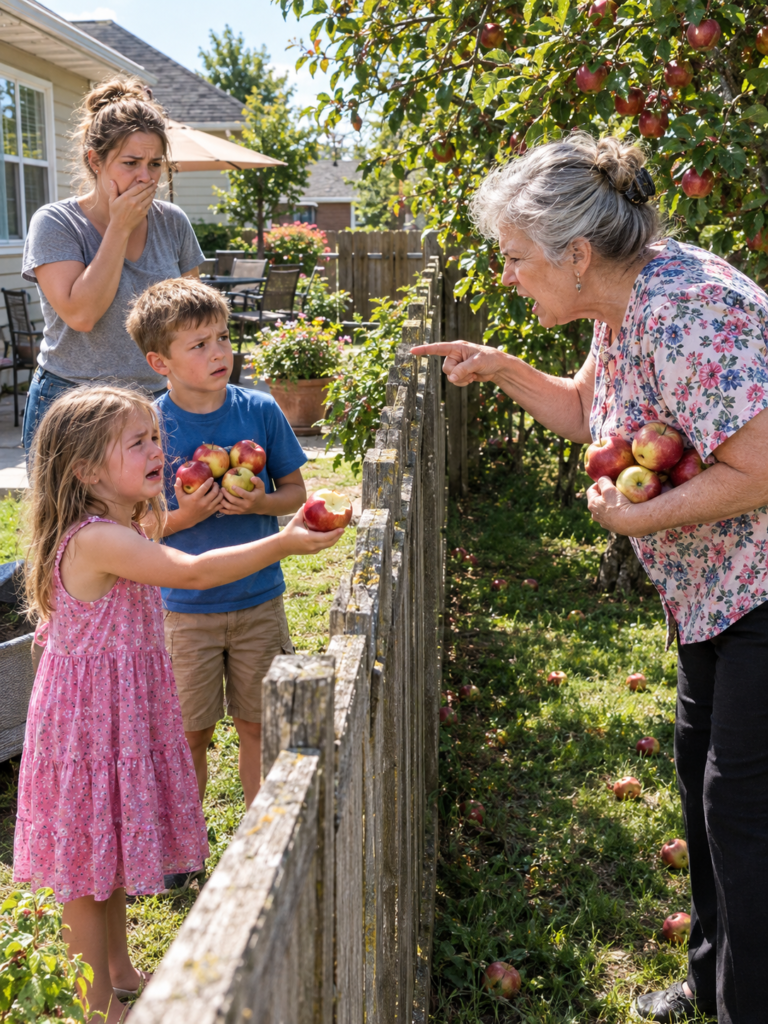
He just stood at the fence with his arms folded across his chest and looked at my children through the slats.
“Those are mine,” he said. “Bring them here.”
Leo stopped. He looked up.
“What?”
“All of them,” Dale said. “Every one that came off my tree. Bring them to the fence.”
“They fell on our side,” Leo said.
I could hear his voice through the window. He wasn’t being rude. He was confused. He was seven. He was just telling Dale a fact, the way he tells you facts about stegosauruses.
“Doesn’t matter where they land,” Dale said. “It’s my tree. They’re my apples. You’re taking things that don’t belong to you. Bring them here.”
And they did it.
That’s the part I can’t get out of my head. Even now. Months later.
They did it.
They didn’t run inside to get me. They didn’t argue. They didn’t cry, not at first. They just obeyed him, like they’d done something terrible and been caught.
My kids walked around their own backyard picking up apples. The good ones and the rotten ones and the ones with squirrel bites in them. They carried them over to the fence in their arms.
Dale stood on his side. He reached over the top of the fence and took each load from them, one at a time, and dropped the apples into a white plastic grocery bag.
Leo carried five or six at a time, cradled against his T-shirt. He didn’t say anything. He just walked back and forth.
Maya couldn’t carry more than three. Her hands are too small.
She made four trips.
That’s when I came out onto the deck with the laundry basket.
I don’t know how long it had been going on by then. A few minutes, maybe.
I stood there at the top of the deck stairs with a wet towel in my hand, and I watched my six-year-old daughter walk across the grass carrying three apples against her chest. Very carefully, so she wouldn’t drop them. She walked all the way to the fence and held them up over her head, and Dale reached down and took them from her.
She turned around to go get more.
She looked up at me on the deck.
She kept looking up at me. Every trip. She’d pick up the apples and look at me. Walk to the fence and look at me. Walk back and look at me.
I’ve thought about that look a thousand times.
She was waiting for me to tell her it was okay to stop.
“Dale,” I said.
He didn’t turn his head.
“Dale.”
He didn’t look at me. He just kept holding out his hand over the fence, waiting for the next apple.
I don’t know why I didn’t run down the stairs. I don’t know why I didn’t scream. I think I was in shock. I think some part of my brain just couldn’t believe a grown man was doing this. It felt like a nightmare where you can’t move your legs.
Maya picked up the last apple. It was a rotten one, the same one they’d been throwing at the fence post. Half of it was gone. She carried it over in both hands and held it up.
Dale took it with two fingers, like it was disgusting, and dropped it in the bag.
When they were done, Dale pulled the bag shut and tied the handles in a knot.
Then he looked up and saw me standing there on the deck.
He looked right at me. He smiled. It wasn’t a nice smile.
“Nice,” he said. “Raising thieves young, are we?”
Maya cried.
She burst into tears right there in the middle of the yard. Loud, gasping sobs. She ran across the grass toward the deck stairs with her arms out.
Leo didn’t cry.
That was worse.
He just stood in the middle of the yard with his hands covered in dirt and rotten apple, looking at the ground. Not moving. His ears were going bright red, the way they do when he’s embarrassed. When he’s ashamed.
He looked like he’d been caught stealing.
He was standing in his own backyard.
I picked up Maya and held her. She buried her face in my neck and sobbed.
Dale turned around and walked back toward his house with his bag of apples. He didn’t look back.
Over Maya’s head, I looked at Leo.
“Leo,” I said. “Come here, buddy.”
He didn’t move.
“Leo. You didn’t do anything wrong. Come here.”
He walked over slowly. He didn’t look at me. He wiped his dirty hands on his shorts.
I wanted Rob to see what Dale had done to them.
I wanted him to see Leo’s red ears and the dirt on his hands and the way Maya was clinging to me. I wanted him to see their faces.
I held Maya with one arm, and with the other, I got my phone out of my back pocket. I took two photos through the deck railing. One of Leo standing in the yard looking at the ground. One of the empty grass where the apples had been, with Dale’s back disappearing through his sliding door.
I sent them to Rob at work with one line.
He stood at the fence and made them bring him every apple in our yard.
Rob called me forty seconds later.
I was sitting on the deck stairs with Maya in my lap. Leo had gone inside. I could see him through the sliding door, sitting on the couch with his knees pulled up, not watching TV, just sitting.
“Say it again,” Rob said.
His voice was very quiet.
I said it again. All of it. The fence. Those are mine. Bring them here. Maya’s four trips. Raising thieves young.
When I was done, Rob didn’t say anything for a long moment.
“Send those photos to my personal email,” he said. “Not my work one. And don’t delete them off your phone.”
“Rob.”
“Sarah,” he said. “I need you to not rake this year. Not one apple. Leave every single one exactly where it falls.”
I thought I’d heard him wrong.
“What?”
“Don’t rake the apples.”
“Why?”
“Just trust me.”
That’s not a sentence husbands should use if they want their wives to stay calm.
“Rob,” I said. “What are you planning?”
“Nothing stupid.”
“That doesn’t answer my question.”
“It does in my head.”
“Rob.”
He let out a long breath on the other end of the line.
“I’m going to find out exactly where the property line is,” he said. “And exactly what we’re allowed to do about that tree.”
I looked out at the yard.
Maya had stopped crying. She was sitting in my lap, hiccupping, holding onto my shirt with both fists.
Through the glass door, Leo was still on the couch. He’d pulled a pillow over his face.
“You want the apples to stay there,” I said slowly. “For evidence.”
“Exactly.”
That word made me feel two things at once. Relieved, because Rob was on my side, completely, without even a second of maybe you misunderstood. And a little ridiculous.
Evidence.
Over apples.
But then I looked at my son through the glass door with a pillow over his face.
This wasn’t really about apples anymore.
That afternoon, Rob came home early.
He walked in at three-thirty, still in his work clothes, his tie loosened. He kissed me. He hugged Maya. He went over to the couch and sat down next to Leo and put his arm around him.
“Hey, bud,” he said.
“Hey,” Leo said into the pillow.
“Mom told me what happened.”
Leo didn’t say anything.
“You didn’t do anything wrong,” Rob said. “You know that, right?”
There was a long pause.
“He said we were stealing,” Leo said finally. His voice was muffled.
“He was wrong.”
“But they were his apples. From his tree.”
“They fell in our yard,” Rob said. “When something falls in your yard, you’re allowed to pick it up. You’re allowed to play with it. You’re allowed to throw it at the fence and see how far it goes.” He squeezed Leo’s shoulders. “You weren’t stealing. You were being a kid.”
Leo lowered the pillow a little. He looked at his dad.
“Are you sure?”
“I’m sure,” Rob said. “And I’m going to prove it.”
Then Rob went out into the backyard.
He didn’t knock on Dale’s door. He didn’t yell across the fence. He didn’t do any of the things I half expected him to do, and half wanted him to do.
He just took out his phone and started taking pictures.
He crouched down beside the swing set and photographed everything. The low branches hanging over our yard, heavy with apples. The four or five new apples that had fallen since the kids picked up the others. The little dents in the grass where apples had hit hard. The stain on the shed. He took a picture of the shed stain from three different angles.
Then he walked along the fence line and photographed the fence itself, every few feet. He took pictures of where the trunk of the tree was, on Dale’s side. Where the branches crossed over. Where they ended, way past the swing set.
He measured things with the tape measure from the junk drawer and wrote numbers in a little notebook.
I watched him from the kitchen window with my arms crossed.
Dale came out about ten minutes later.
He stood on his patio holding a cup of coffee and watched Rob for a while. Then he walked over to the fence.
“Got yourself a photography hobby now?” he said.
Rob didn’t look up from his phone.
“Just documenting our yard.”
“Those apples are mine,” Dale said.
Rob finally turned around.
“We know,” he said. “You made that very clear. To two little kids.”
Dale shrugged.
“They were taking what’s not theirs.”
“They were playing with fruit that fell into our yard.”
“From my tree.”
Rob stood up from where he was crouching by the swing set.
“Right,” he said.
There was something in the way he said it. Something calm and flat and final.
Dale frowned.
“What?”
“Nothing,” Rob said.
Dale stared at him. Then he looked over at me in the kitchen window. Then back at Rob.
Then he turned around and went back inside.
That evening, after the kids were asleep, Rob sat me down at the kitchen table and showed me what he’d been researching.
It wasn’t just random comments on the internet. He’d made actual phone calls.
He’d called our town’s property office first, on his lunch break. They pulled up our survey from when we bought the house. They confirmed exactly where the property line was.
Then he called a local arborist. A tree doctor. Somebody who’d know about branches and fruit trees and what you could and couldn’t do.
Then, because apparently he was determined to become the most overprepared husband in the history of the world, he called a property lawyer who offered a free twenty-minute phone consultation.
“You called a lawyer?” I said. “Today?”
“I called three,” Rob said. “One called back.”
The answer was annoyingly complicated.
The rules about trees, fallen fruit, overhanging branches, and property lines can be different depending on where you live. They change from state to state, sometimes even from town to town.
But in our area, a few things were clear.
We couldn’t just hack Dale’s tree apart. We couldn’t cut it down, or poison it, or do anything that would kill it or seriously damage it.
But we could trim branches that hung over onto our property. As long as the work was done properly, by a professional, and didn’t recklessly hurt the tree.
And if the overhang was causing a recurring problem on our side, a nuisance or a safety issue, documentation mattered. A lot.
“So the apples matter,” I said.
“The apples matter,” Rob said.
“You’re really going to leave them all there?”
“Every single one.”
“Do you know what our yard’s going to smell like?”
“Justice,” Rob said.
I stared at him.
“Rotten apples,” I said.
“Justice can smell complicated,” he said.
I laughed. I hadn’t laughed all day. It came out of me like a hiccup.
The next morning, Maya refused to go near the fence.
I found her sitting on the deck steps in her pajamas, holding a little plastic sand bucket. She was staring at the backyard.
“What’s wrong, sweetie?”
“Nothing.”
“You wanted to play outside. You’ve been asking all morning.”
She pointed at the apple tree. There were three new apples on the grass that had fallen overnight.
“I don’t want him to think I’m stealing,” she said.
That did it.
I sat down on the step beside her.
“Maya,” I said. “You are not stealing anything. Not ever. Not one thing.”
“But he said…”
“Dale was wrong.”
She looked at me with her big brown eyes.
“Adults can be wrong?”
I almost laughed.
“Constantly,” I said.
She thought about that for a long time. She turned the sand bucket around in her hands.
“Even you?” she said.
“Especially me,” I said.
That got a small smile.
Leo was different.
He acted like he didn’t care. He went out to play like normal. He rode his bike around the driveway. He swung on the swing set.
But he stayed away from the side of the yard closest to the fence. He went way around it, like there was an invisible line on the grass.
And once, when an apple fell off the tree while he was on the swing, it landed in the grass about three feet away from him with a soft thump.
Leo jumped off the swing mid-air. He landed hard. He walked away fast, toward the house, without looking back.
He didn’t touch it.
He didn’t even look at it.
That bothered Rob more than anything.
“This is their yard,” he said that night. We were lying in bed in the dark. “Their yard, Sarah. I built that swing set for them.”
“I know.”
“They’re scared of fruit in their own backyard.”
“I know.”
He was quiet for a long time. I could hear him breathing.
Then he looked toward the window, toward Dale’s house. I could see the dark shape of the apple tree against the streetlight.
“So we’re done being polite,” he said.
For the next eleven days, we didn’t rake.
Every apple stayed exactly where it fell.
I photographed them every morning. That was my job. Rob made me a little chart on the computer. Every morning at seven-thirty, before the kids woke up, I went out with my coffee in one hand and my phone in the other and took pictures of every apple in the yard. Then I wrote the number down.
At first, it looked almost funny.
Five apples. Then nine. Then fourteen.
The kids thought it was a game. Maya started counting them with me in the morning. Fifteen! Sixteen! Mom, there’s one in the flower pot!
By the second week, the yard didn’t look funny anymore.
Some apples bruised when they hit the ground. Some split right open. The ones that landed in the sun went soft and brown and started to smell. A sweet, rotten, cidery smell that hung over the whole backyard, especially in the afternoons.
The wasps started showing up.
At first just a few. Then a lot. Yellow jackets, mostly. They crawled all over the rotting apples, buzzing, drunk on the fermenting sugar. You could hear them from the deck.
One apple rolled under the swing set and burst open under Leo’s sneaker when he jumped off. It sprayed all over his shoe and his sock. He screamed, more surprised than anything, and ran inside to take off his shoe.
Another one landed on the roof of the shed so hard I heard it from inside the house. BANG. Like somebody had thrown a rock.
One afternoon, a wasp stung Maya on the ankle while she was going down the slide.
It wasn’t a bad sting. I put ice on it and she was fine in twenty minutes. But she cried, and she held her ankle up for me to see, and she said, “Is that because of the apples?”
“Yes, baby,” I said. “That’s because of the apples.”
“Dale’s apples?”
“Dale’s apples.”
She looked over at Dale’s house with a little frown.
Rob photographed the sting.
That night, Rob sent Dale a letter.
It wasn’t an angry letter.
That annoyed me a little. Part of me wanted it to be angry. Part of me wanted him to write how dare you and you should be ashamed of yourself and if you ever speak to my children again.
Instead, it was painfully calm.
He typed it at the kitchen table on his laptop. He read it to me twice before he printed it.
He wrote that the overhanging branches of Dale’s apple tree were dropping a lot of fruit onto our property. Including the children’s play area under the swing set. Including our driveway. He wrote that the fallen fruit was attracting stinging insects, and that one of our children had been stung. He wrote that we’d been raking and disposing of the fruit ourselves for five years without complaint.
He noted that Dale had personally claimed ownership of every apple that fell from the tree, in front of our children, on Sunday, September eighth.
Then came my favorite sentence.
Since you’ve made it clear that you consider all fruit from the tree to be your property, please arrange to collect your property from our yard each evening, or contact us to discuss professionally trimming the branches that extend over the property line.
He attached a printout of the property survey with the line highlighted in yellow.
I read it twice.
“That’s petty,” I said.
“Thank you,” Rob said.
“I didn’t say it as a compliment.”
“You meant it as one.”
I didn’t argue. He was right. I did.
Rob sent it by certified mail. The kind where somebody has to sign for it.
Dale got it two days later.
We knew because he came straight over.
He didn’t ring the doorbell. He came around the side of his house into his backyard and stood at the fence and shouted.
“Rob!”
Rob was out on the deck grilling burgers for dinner. The kids were at the picnic table with their plates, waiting. I was bringing out the ketchup.
Rob flipped a burger. He didn’t look up.
“Yeah?”
“What the hell is this letter?”
Dale was holding it up over the fence. He was shaking it.
“Which part confused you?” Rob asked.
“You don’t get to threaten my tree!”
“I’m not threatening anything.”
“You said you’re cutting branches!”
“I said we should discuss professional trimming,” Rob said. He flipped another burger.
“You touch that tree,” Dale said, “and I’ll sue you.”
Rob nodded slowly.
“Okay,” he said.
That seemed to throw Dale off completely. He stood there at the fence with his mouth open.
“Okay?”
“Then we’ll go with the other option,” Rob said.
“What other option?”
“You collect your apples,” Rob said. “Every evening. Like the letter says.”
Dale stared at him.
“I’m not climbing over your fence every night to pick up fruit.”
“Good,” Rob said. “Don’t. I don’t want you in my yard.”
“Then rake them!”
Rob smiled.
“Why would I handle your property?” he said.
I turned around so Dale wouldn’t see me laughing. I pretended I was very busy arranging the ketchup and mustard on the picnic table.
Leo was staring at his dad with his mouth open.
Dale’s face went dark red.
“You’re being ridiculous,” he said.
Rob set down the spatula.
He turned around and looked at Dale for the first time. Really looked at him.
“No,” Rob said. “Ridiculous was making my six-year-old daughter walk back and forth across her own yard four times, carrying rotten apples to a grown man, because you decided she was stealing.”
“They were mine.”
“Then come get them.”
Dale stood there for a long moment.
Then he crumpled the letter in his fist and walked away, muttering something under his breath.
He didn’t come get them.
Another week passed.
The smell got worse.
So did the wasps. There were dozens of them now, maybe a hundred. They crawled all over the brown, rotting apples in the grass. You couldn’t walk barefoot anywhere in the backyard.
That part wasn’t fun. I want to be honest about that. It wasn’t some perfect plan with no downsides. Our yard was disgusting. The kids couldn’t play back there. I couldn’t hang the laundry out. Our neighbor on the other side, Mrs. Patel, came over one afternoon and asked politely if something had died.
“Not yet,” I said.
We kept the kids away from the worst part. We spent a lot more time at the park down the street. Rob bought a wasp trap and hung it on the fence on our side, which helped a little.
Mrs. Patel stayed for a cup of coffee that afternoon. She’s in her seventies, a retired pharmacist. She’s lived on the street even longer than Dale.
I told her what happened.
She listened. Then she shook her head slowly.
“That tree,” she said. “Linda planted that tree.”
“Who’s Linda?”
“Dale’s wife. She passed. Oh, eight years ago now? Maybe nine. Cancer.” Mrs. Patel stirred her coffee. “She planted it the year they moved in. She used to make pies every fall and bring them around to the whole street. Apple pie, apple butter, applesauce. You couldn’t stop her. She’d leave them on your porch if you weren’t home.”
I didn’t say anything.
“After she died,” Mrs. Patel said, “Dale kind of closed up. Like a fist. He used to be friendly. He used to coach Little League. Now he just sits in that house.” She looked out my kitchen window at the tree. “I don’t think he’s made a pie in nine years. I don’t think he even eats the apples. I think he just picks them up and throws them out.”
“Then why does he care so much?” I said.
Mrs. Patel shrugged.
“Because they’re hers,” she said. “Or they were.”
I thought about that a lot after she left.
It didn’t make what he did okay. Nothing could make that okay. Making two little kids carry apples to the fence and calling them thieves. Nothing.
But it made it make a little more sense.
When I told Rob that night, he was quiet for a while.
“That’s sad,” he said finally.
“It is.”
“It doesn’t change anything.”
“I know,” I said. “I’m not saying it does.”
“Grief doesn’t give you the right to make a six-year-old cry,” Rob said.
“I know,” I said again. “I just think it’s good to know. That’s all.”
Then the arborist came.
His name was Martin. He was a tall, slow-moving man in his sixties with a gray ponytail and a sunburned neck. He wore a canvas vest with about forty pockets. He arrived on a Wednesday morning in a pickup truck with GREENLEAF TREE CARE painted on the side.
Dale appeared at the fence before Martin had even finished shaking my hand.
“What are you doing?”
Martin pointed up at the tree.
“Assessment,” he said.
“Who hired you?”
“I did,” Rob said.
“You don’t have permission to assess my tree!”
Martin looked at Dale calmly over the fence.
“I’m assessing the portions of the tree that extend over their property,” he said. “And the condition of several limbs. I don’t need to come on your property to do that, sir.”
Dale turned to Rob.
“I told you not to touch it.”
“Nobody’s touching anything today,” Rob said.
Martin spent almost an hour looking at the tree.
He walked along our side of the fence, looking up. He used binoculars. He took a lot of photos with a big camera. He poked at the bark of the branches he could reach with a little metal tool. He measured things with a laser tape measure that beeped.
Dale stood on his patio the whole time with his arms crossed, watching.
When he was done, Martin called us over to the swing set.
He pointed straight up.
One of the big limbs reached directly over the swing set. It was a thick branch, as thick as my thigh, loaded with apples. Martin pointed at a spot near where it joined the trunk.
“See that?” he said. “That dark line there?”
I squinted. There was a crack in the bark. Long and dark.
“That’s an old split,” Martin said. “Probably been there a few years. Maybe from an ice storm. It’s not an emergency. I’m not saying it’s coming down tomorrow. But it’s not something I’d recommend ignoring either.” He looked at us. “With the weight of all that fruit, and a good wind, I’d want that limb reduced. Soon.”
My stomach went tight.
“Could it fall?” I asked.
“Any branch can fail,” Martin said. “I’m saying this one has a defect that’s worth addressing. And it’s right over where your kids play.”
I looked at the swing set. At Maya’s swing. The yellow one.
I felt sick.
Dale had been listening from the other side of the fence.
“That branch is fine,” he said.
Martin turned and looked at him.
“Have you had the tree inspected recently, sir?”
“It’s been standing there for forty years.”
“That wasn’t my question,” Martin said.
Dale crossed his arms tighter. He didn’t answer.
Martin went back to measuring the overhang with his laser.
By the end, he estimated that nearly a third of the tree’s productive canopy, the part that grows the apples, hung over onto our side of the fence.
That was the part Dale cared about.
“You cut those branches,” he said, “you’ll ruin the crop.”
Martin shook his head.
“Proper pruning won’t ruin the tree. If anything, it’ll be healthier.”
“It’ll take half my apples!”
“Closer to a third,” Martin said.
Dale stared at Rob across the fence.
“This is because of the kids,” he said. “Isn’t it? This is all because I told your kids not to steal.”
Rob looked at him for a long moment.
“This is because you made our kids afraid to touch anything in their own backyard,” he said.
Dale laughed. It was a short, ugly laugh.
“Oh, please.”
“No,” Rob said.
His voice stayed calm. But something in it had changed.
“Don’t do that,” he said. “Don’t turn this into us being dramatic.”
“It’s a few apples!”
“Then why,” Rob said, “did you make a six-year-old carry them to you one handful at a time?”
Dale didn’t have an answer.
He just stood there.
“You want every apple because it’s your tree,” Rob said. “Fine. I get that. It’s your tree. But then you also own the mess your tree makes on our side. The rotten fruit. The wasps. The branch with a crack in it hanging over my daughter’s swing. You don’t get to keep the good part and leave us the rest.”
Dale pointed at Martin.
“If he cuts anything,” he said, “I’m calling my lawyer.”
Rob nodded.
“Call him,” he said.
And he did.
Or at least somebody did.
Three days later, we got a letter from a lawyer representing Dale. It was two pages long and very formal. It used phrases like irreparable harm and intent to pursue all available remedies.
Rob read it once. Then he scanned it and sent it straight to the property lawyer he’d talked to.
I stood in the kitchen holding the letter and thought, This has gone completely insane.
All I’d wanted was for a grown man to not bully my children over fallen fruit. That was it. That was the whole thing.
Now lawyers were writing letters to each other about an apple tree.
But the legal back-and-forth ended faster than I expected.
Once all the evidence was laid out, there wasn’t much left to argue about.
Our lawyer, a cheerful woman named Ms. Kowalski, sent back a response with everything. Martin’s written report, with photos of the split limb. The property survey with the line highlighted. Twenty-three days of my morning photos, with dates and apple counts. The photo of Maya’s wasp sting. The photo of Leo in the yard with his red ears. A copy of Rob’s original letter, offering to discuss professional trimming.
And a written offer to resolve the whole thing without any major pruning at all. Just the dangerous limb. Just basic clearance over the swing set.
Ms. Kowalski called Rob a week later.
“His lawyer just called me,” she said. “I think your neighbor’s going to want to talk.”
Dale came over that Saturday.
This time, he knocked.
He came to the front door. He actually rang the bell. Rob opened the door and stood there and didn’t invite him in. He let him stand on the porch.
I stood in the hallway behind Rob. The kids were upstairs watching a movie.
Dale looked older up close than he did over the fence. He was wearing a plaid shirt buttoned all the way up. His hands were jammed in his pockets.
“I don’t want that tree butchered,” he said.
“It won’t be butchered,” Rob said.
“You know what I mean.”
Rob nodded.
“So let’s settle it,” he said.
Dale looked past Rob, at me in the hallway.
“What do you want?” he said.
I almost said an apology.
But I realized that wasn’t enough. An apology would be words. I’d gotten plenty of words from Dale over five years.
“I want my kids left alone,” I said.
He frowned.
“They shouldn’t take my fruit.”
I felt the anger rise up in my chest, hot and fast.
Rob held up his hand before I could say anything.
“Here’s the deal,” he said.
He held up one finger.
“Fruit that falls naturally into our yard stays our problem. We’ll rake it. We’ll bag it. We’ll eat it if we want. You don’t call my children thieves. Ever. You don’t order them to collect anything for you. You don’t stand at the fence watching what they’re doing.”
Dale opened his mouth.
Rob held up a second finger.
“In return, we trim only what Martin says is necessary for safety and basic clearance. The cracked limb over the swing set and a couple of the low ones. That’s it. We don’t cut back every single branch that crosses the line, even though we’re allowed to.”
Dale stared at him.
“And if I don’t agree?”
“Then we go ahead with all the trimming we’re legally allowed to do,” Rob said. “Professionally. Every branch that crosses the line. Based on the advice we’ve already gotten.”
Dale looked past us toward the backyard. From the front porch, you could see the top of the apple tree over our roof. The leaves were starting to turn yellow at the edges.
“You’d cut a third of that tree,” he said slowly, “over a few apples?”
Rob’s face changed.
“No,” he said.
He said it quietly.
“I’m fixing the part of your tree that you decided gave you authority over my children.”
Dale didn’t say anything.
That was the first time I’d ever seen him without a comeback. Five years, and he always had something to say. Something about the noise, the recycling bin, the cars, the soccer ball.
Now he just stood on our porch with his hands in his pockets, looking at the top of his wife’s apple tree.
Then he turned around and walked back down our front steps without agreeing to anything.
Two days later, he emailed Rob.
He refused the deal.
The email was one line. I will not agree to any terms regarding my own tree. — D. Hollis.
Rob read it out loud at dinner. Then he put his phone down on the table.
“Okay,” he said. “Then we schedule the pruning.”
Martin’s crew came the following Thursday.
Three men and a truck with a wood chipper hitched behind it. They set up on our side of the fence. They put on helmets and harnesses. One of them climbed up into the tree on a rope with a little chainsaw hanging off his belt.
I took the kids to my mother’s house for the day. I didn’t want them to see it. I didn’t want them to think it was about them, even though it was, a little.
I came back at lunchtime.
I expected Dale to make a scene.
He did.
Not a huge one. Just enough.
He stood on his back deck the whole morning, watching every single cut. He had his arms crossed. He didn’t sit down once.
Every time a branch fell, he flinched.
At one point, Martin’s guy cut through the big limb over the swing set. The one with the crack. It was the heaviest, most fruit-loaded branch on the whole tree, reaching way past the fence. When it came down, apples went flying everywhere. Dozens of them, bouncing across the grass.
Dale shouted from his deck.
“That’s one of the best branches! You’re killing it!”
Martin paused. He looked up at Dale from where he was standing by the chipper.
“It’s also the one with the structural defect,” he said.
“I’ve had apples from that branch for twenty years!” Dale said. His voice cracked.
Martin looked at him for a long moment.
“Then you’ve had a good run,” he said.
I had to go inside. I didn’t want Dale to see my face.
By the end of the afternoon, the tree looked noticeably different.
It was still healthy and still full of apples. It still looked like a beautiful old apple tree. Martin had been careful. He’d cut back only what crossed over the fence and needed to go. He’d shaped it so it looked natural, not chopped.
But the canopy didn’t hang over half our backyard anymore. It stopped just a foot or two past the fence line.
And most importantly, nothing hung above the swing set.
You could stand on the yellow swing and look straight up and see blue sky.
The crew cleaned up every single branch. They fed them through the chipper and hauled away the wood chips. They raked up every leaf and twig. They even raked up the apples, the ones that had fallen when the branches came down, plus all the rotten ones that had been sitting there for three weeks. They filled eleven lawn bags with them.
Rob paid them extra for that.
When they left, the backyard looked brand new. It smelled like fresh-cut wood instead of rotten fruit.
Rob and I stood on the deck and looked at it.
“Well,” Rob said.
“Well,” I said.
“Was it worth it?”
I looked at the yellow swing, with blue sky above it.
“Ask me in a month,” I said.
Dale didn’t speak to us for almost a month.
That suited me fine.
He stayed inside mostly. Once in a while, I’d see him in his backyard, standing under the tree, just looking up at it. Once I saw him touching the place where the big branch used to be. The fresh cut was covered with some kind of sealant Martin had painted on.
He stood there with his hand on it for a long time.
I went back inside before he saw me watching.
The apples on our side stopped almost completely.
A few still fell near the fence from the smaller branches that just barely crossed over.
The first time Maya saw one, she froze.
She was walking across the yard to the slide, and there it was, a perfect red apple, lying in the grass right in front of her.
She stopped dead. She stared at it.
Then she turned around and looked at me on the deck.
“Can I touch it?” she said.
That question hurt more than I expected. More than almost anything that had happened.
Three weeks of lawyers and arborists and certified letters. Three weeks of wasps and rotten fruit and a branch with a crack in it. And my six-year-old still had to ask permission to touch an apple in her own backyard.
I came down the deck stairs and crouched down beside her.
“It’s in our yard,” I said.
“But is it his?”
“It’s an apple.”
She waited. She looked at me.
I realized she needed more than that.
“Dale doesn’t get to tell you what to do in your own backyard anymore,” I said. “Not ever again. Daddy made sure of it.”
She looked at me for a long moment.
Then she reached down and picked it up.
She held it in both hands and looked at it. Then she looked over at Dale’s house, at his closed back door.
Nothing happened.
Nobody came out. Nobody yelled.
She smiled.
Leo came running across the yard.
“Can we smash it?” he said.
“No.”
“Why not?”
“Because I said so.”
Maya grinned at me with the apple in her hands.
“Adults can be wrong,” she said.
“Not this adult,” I said.
They both laughed. Leo laughed so hard he fell down in the grass.
It was the first time I’d heard him really laugh in the backyard in a month.
Later that afternoon, the kids came inside carrying four apples. They’d found them near the fence. Good ones. Not bruised, not split, no squirrel bites.
They put them on the kitchen counter in a little row.
“Can we make pie?” Leo asked.
I looked out the kitchen window toward Dale’s house.
His blinds were open. I could see the light on in his kitchen.
For half a second, the petty part of me wanted to bake the pie and put it on the windowsill to cool, right where he could see it. Like a cartoon villain. Like, look what we did with your precious apples.
Instead, we made it because the kids wanted pie.
It was terrible.
I’m not a baker. I used a recipe off the internet. Leo was in charge of the cinnamon, and he put in about four times as much as the recipe said. Maya was in charge of the crust, and she kept poking holes in it with her finger to “let it breathe.” When it came out of the oven, the whole top had collapsed into the middle like a sinkhole.
It tasted like a cinnamon stick.
Leo ate two pieces anyway.
Maya ate one and declared it “the best pie in the whole world, maybe the universe.”
Rob ate one piece, very slowly, and said it was “really interesting.”
That evening, Dale came outside while Rob was taking the trash bins down to the curb.
I watched from the kitchen window.
Dale walked down his driveway. He stopped at the end of it, by his mailbox. Rob stopped too, holding the handle of the recycling bin.
They talked for maybe two minutes.
I couldn’t hear anything. Dale did most of the talking. He was looking at the ground the whole time. At one point, Rob nodded. At another point, Dale rubbed the back of his neck.
Then Dale went back inside. Rob finished taking the bins down and came back up the driveway.
When he came in the kitchen door, I was standing right there.
“What did he say?”
“He apologized,” Rob said.
I stared at him.
“For what?”
“Well,” Rob said. “Not exactly in those words.”
“Then he didn’t apologize.”
Rob shrugged. He took off his shoes.
“He said he shouldn’t have involved the kids.”
That was closer.
“Anything else?”
“He said he didn’t realize they’d take it so seriously.”
I laughed. There wasn’t any humor in it.
“They’re six and seven, Rob,” I said. “How else were they supposed to take a fifty-eight-year-old man standing at a fence calling them thieves?”
Rob came over and kissed my forehead.
“He knows now,” he said.
Then he said one more thing.
“He told me about his wife,” Rob said. “Linda. That she planted the tree.”
“Mrs. Patel told me.”
“He said she used to bring pies to every house on the street. Every fall.” Rob was quiet for a moment. “He said when he saw the kids throwing apples at the fence, he just… lost it. He said it felt like they were throwing her away. Smashing her apples against a post.”
I didn’t say anything.
“He said he knows that’s not fair,” Rob said. “He said they’re just kids. He said he knows.”
I looked out the window at Dale’s house. The kitchen light was still on.
“That doesn’t make it okay,” I said.
“No,” Rob said. “It doesn’t. And I told him that.”
“What did he say?”
“He said, ‘I know.’” Rob looked at me. “Then he said the pie smelled good. He could smell it from his kitchen.”
I laughed. A real laugh this time.
“It was terrible,” I said.
“I didn’t tell him that,” Rob said.
The next fall, the tree made plenty of apples.
It was healthier than before. Martin had been right. The pruning helped. The apples were bigger. Most of them landed on Dale’s side of the fence.
A handful landed on ours.
The kids picked them up. They played with them. Once in a while, they threw a rotten one at the fence post to see how far it would come apart.
Nobody came to the fence.
Nobody demanded anything.
My children stopped looking over their shoulders when they played near it.
That mattered more than every argument, every letter, and every branch.
One Saturday morning in late September, I opened our front door to get the newspaper.
There was a basket on our porch.
A small wicker basket with a red-and-white checked cloth inside. It held about a dozen apples. Big ones. Red and perfect, every one of them polished.
There was an index card tucked in between them. Block capitals, in black pen.
FOR THE KIDS. PICKED FROM MY SIDE. — D.
I stood on the porch holding that basket for a long time.
Then I carried it inside and set it on the kitchen counter. When the kids came downstairs, I showed them the card.
Leo read it out loud slowly.
“‘For the kids. Picked from my side.’” He looked up at me. “Dale picked these for us?”
“Looks like it.”
Maya looked at the apples. She looked at the card. She looked out the kitchen window at Dale’s house.
“Is he still mad?” she asked.
“I don’t think so, baby.”
She thought about it.
“Can we make him a pie?” she said. “With his apples?”
I looked at Rob. He shrugged and smiled.
“Maybe less cinnamon this time,” he said.
We made the pie that afternoon.
It was better than the first one. Not much better. The crust still collapsed a little in the middle. But Maya didn’t poke any holes in it, and Leo let me measure the cinnamon.
When it was done, the kids carried it next door together. Leo held the plate. Maya held the card she’d made, a folded piece of construction paper with a drawing of an apple tree on the front.
I watched from our porch.
Dale opened his front door. All the way this time. Not six inches.
He looked down at the two kids standing on his porch holding a lopsided pie.
He didn’t say anything for a long moment.
Then he took the pie.
“Thank you,” he said.
Maya held up her card.
“This is for you too,” she said. “It’s your tree. I drew it.”
Dale took the card. He opened it. He looked at it for a long time.
He didn’t say anything else. He just nodded at them and went back inside and closed the door.
The kids came running back across the lawn.
“He said thank you!” Maya shouted.
I don’t know what he did with that pie. Maybe he ate it. Maybe he threw it out. Maybe he put it on the counter and stood there looking at it.
But the next week, when I walked past his house, I saw Maya’s card through his front window. It was propped up on his kitchen windowsill, facing out, where anybody walking by could see it.
The real problem was never the fruit.
It was an adult deciding that because something belonged to him, he could make two children feel like trespassers in their own home.
Rob’s plan wasn’t really about revenge, either. He didn’t destroy the tree. He didn’t poison it. He didn’t dump rotten apples on Dale’s porch, even though I’d have helped him.
He just stopped cleaning up a problem we’d quietly carried for five years. And he made Dale face what it actually meant to say every apple was his.
The minute Dale claimed ownership, Rob made sure he understood that ownership works both ways.
You don’t get to claim every good thing and hand every problem to somebody else.
And you definitely don’t get to enforce that on someone’s children.
That fall, Maya drew a picture for school.
Her first-grade teacher had asked everyone to draw their house. Maya worked on it at the kitchen table for an entire evening, with her tongue sticking out of the corner of her mouth.
There was our blue house. The swing set, with a yellow swing. The fence. Dale’s tan house next door, with a little square window with a card in it. And Dale’s apple tree, still poking up over the top of the fence, round and green and full.
She’d colored four little red apples on our side of the fence, in the grass, by the swing set.
I pointed at them.
“What are these?” I asked.
“Ours,” she said.
Then she stopped. She looked at the picture for a moment. She picked up her red crayon.
“No,” she said. “They’re just apples.”
She colored in one more, by the fence post.
I smiled.
That was better.