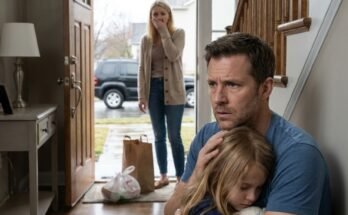
Ninety-One Thousand Five Hundred Pennies
The Buckets
Dale Heckert tipped the last bucket at four o’clock on a Friday.
I heard it before I saw it. A sound like hail on a tin roof, except it didn’t stop. It went on and on, a rushing, rattling roar, and then a heavy slithering thud as the last of it slid out of the bucket and spread across my driveway.
I was standing in the kitchen doorway with a dish towel in my hand. I’d come home early to make supper before the kids’ Friday cartoons.
I walked out onto the porch.
Ninety-one thousand five hundred pennies lay on my gravel.
A copper mountain. Three feet high in the middle, spreading out in a wide fan toward the mailbox. They shone in the late September sun like something out of a fairy tale.
Except they were slick. Every single one of them. Coated in black, sticky motor oil. The smell hit me from the porch. Burnt, heavy, the smell of the bottom of a drain pan.
Dale stood beside his pickup with an empty five-gallon bucket in each hand.
He was sixty-one, built like a fire hydrant, with a gray crew cut and forearms covered in faded Navy tattoos. He wore the same thing he wore every day. Dickies work pants, a gray T-shirt with Heckert Auto & Diesel across the back, and steel-toed boots with the laces knotted where they’d broken.
Behind him, in the bed of his truck, were seven more empty buckets.
My son, Noah, came out on the step behind me. He was eight. He’d been watching cartoons in his socks. His little sister, Lily, came out behind him, holding her stuffed rabbit by one ear. She was five.
They stood on the step and didn’t say a word.
Dale set down the empty buckets. He reached into his back pocket and pulled out a folded piece of paper.
It was a pay stub. My final paycheck. I could see the Heckert Auto logo at the top.
He took a roll of shop tape out of his other pocket, the silver kind we used on radiator hoses. He tore off a piece. He taped the pay stub to the side of one empty bucket.
Then he set the bucket on top of the copper mountain.
“Paid in full,” he said.
He looked at me. His eyes were flat and gray.
“Count it,” he said.
Then he climbed into his truck. He backed out of my driveway. He drove away down County Road K without looking back.
Six Years
My name is Becky Lindahl. I’m thirty-four years old.
I live in a little yellow house on five acres outside Merrill, Wisconsin, about thirty miles north of Wausau. Pine trees on three sides. A big garden. A swing set my husband built from a kit that took him a whole weekend and most of his patience.
For six years, I ran the parts counter at Heckert Auto & Diesel.
Heckert’s sits on Highway 64 on the east side of town, in a long gray steel building with four service bays and a gravel lot full of pickups and semis waiting to be fixed. Dale’s father opened it in 1968. Dale took it over in 1991.
It’s the kind of shop where farmers come in at seven in the morning for coffee and stay until nine arguing about deer season. Where the calendar on the wall is from a tire company and the coffee is strong enough to strip paint.
I started there when Lily was a baby.
I needed a job close to home with hours that worked around day care. Dale needed somebody to answer phones and order parts. He hired me after a five-minute interview in which he asked me exactly one question.
“Can you read a parts catalog?”
“I can learn,” I said.
He looked at me for a long time. Then he said, “Monday. Seven sharp.”
I learned.
By the end of the first year, I knew every part number in that shop. I could tell you the difference between a Freightliner brake chamber and a Kenworth one by looking at the bolt pattern. I could find a water pump for a 1994 Ford diesel faster than any computer.
The mechanics stopped going to the catalog. They came to me.
“Becky, I need a fuel filter for the Peterbilt.”
“Becky, what’s the torque spec on that head bolt?”
“Becky, where’s the left-hand tie rod end?”
Dale didn’t say much.
He wasn’t a talker. He’d grunt when he was satisfied and bark when he wasn’t. He didn’t believe in compliments, breaks, or air conditioning. He paid on time, every other Friday, and never once gave anyone a raise without being asked twice.
He wasn’t kind. But he wasn’t cruel either. Not until the end.
Two Weeks’ Notice
In August, a job opened at the Lincoln County Farmers Co-op.
Parts and inventory manager. Monday through Friday, eight to four-thirty. Same pay as Heckert’s, roughly.
But it had health insurance. Real health insurance. For me and both kids.
Dale didn’t offer insurance. He said it cost too much for a shop his size.
For six years, my husband, Jake, had carried the kids on the plan from his trucking company. Jake hauls logs for a mill in Tomahawk. But in July, the company switched insurance providers. The new plan cost three hundred dollars more a month for family coverage, and the deductible doubled.
Noah has asthma. He uses an inhaler every day and goes to a specialist in Wausau every three months. Lily had already broken her arm once, falling off the monkey bars.
We couldn’t afford to gamble.
I got the job at the co-op.
I gave Dale two weeks’ notice on a Monday morning. I typed it up on a sheet of paper because I didn’t trust myself to say it right out loud.
I set it on his desk in the back office. Next to his coffee mug and a stack of invoices.
He read it.
He set it down.
He looked at me.
“The co-op,” he said.
“Yes.”
“For insurance.”
“For my kids,” I said. “Noah’s asthma. Lily’s arm. We can’t—”
He held up his hand. I stopped.
He looked at the letter for a long time. Then he picked up an invoice and started reading it, like I wasn’t there.
He didn’t speak to me again.
Not for two weeks.
He’d walk past the parts counter without looking at me. If he needed something, he’d ask one of the mechanics to ask me. When I said good morning, he’d keep walking.
The mechanics were embarrassed. One of them, an older man named Carl who’d worked there for twenty years, took me aside on the second day.
“Don’t take it personal, Beck,” he said. “He’s like that when people leave.”
“How many people have left?” I asked.
Carl thought about it.
“Everybody,” he said. “Eventually.”
On my last day, a Friday, I cleaned out my drawer at the parts counter. I took my coffee mug and the photo of the kids I kept taped to the register.
I left a binder on the counter. Thirty pages. Every supplier’s phone number. Every part number I’d memorized. Every shortcut I’d figured out in six years. A sticky note on the front said For whoever comes next.
I said goodbye to the mechanics. Carl hugged me.
Dale was in his office with the door closed.
I didn’t knock.
My final paycheck was supposed to be direct-deposited that Friday. Eighty hours, plus my unused vacation days. Nine hundred and fifteen dollars, after taxes.
At three o’clock, I checked my bank account. Nothing.
At four o’clock, Dale’s truck pulled into my driveway.
Nobody to Call
That night, after the kids were in bed, I sat on the porch steps looking at the pile.
The moon had come up over the pines. The pennies glinted dully under the porch light, black and oily. The smell of motor oil drifted up on the cool September air.
I called Jake.
He was in a motel in Tomahawk. He hauled logs four days a week, three hundred miles a day, and slept in the cab or a motel when he couldn’t make it home.
I told him what happened.
He was quiet on the phone for a long time. Then he said something I won’t repeat.
“I’ll be home tomorrow night,” he said. “I’ll borrow my brother’s dump trailer. We’ll shovel the whole thing up and drive it back to his lot. Dump it right in front of his bay doors.”
“No,” I said.
“Beck—”
“No,” I said again. “That’s what he wants. He wants us to be as angry as he is.”
I’d already looked it up. Sitting on the porch steps with my phone.
Pennies are legal tender. There’s no federal law requiring anyone to accept them for a private debt, but there’s no law against paying with them either. Dale owed me nine hundred and fifteen dollars, and he’d paid me nine hundred and fifteen dollars.
Every cent.
There was nobody in Wisconsin to call about a man being cruel.
“Then take them to the bank,” Jake said. “Let them deal with it.”
“The bank won’t take them loose,” I said. “They have to be rolled.”
“Then the coin machine at the grocery store.”
The coin machine at County Market takes almost twelve percent. That’s more than a hundred dollars off the top.
And it would choke on the oil anyway. I could already picture it. Black sludge jamming the gears. A teenage manager glaring at me.
“So what are you going to do?” Jake asked.
I looked at the pile for a long time.
“I’m going to wash them,” I said.
Jake laughed. Then he stopped laughing.
“Beck,” he said. “That’s ninety-one thousand pennies.”
“Ninety-one thousand five hundred,” I said.
“That’ll take you weeks.”
“Probably,” I said.
The Dish Tub
The next morning, Saturday, I got out the dish tub.
It was blue plastic, the big rectangular kind. I filled it with hot water from the kitchen and a long squirt of blue dish soap. The kind that’s supposed to get oil off baby ducks.
I carried it out to the driveway. I set it on a folding card table I’d set up next to the pile.
Noah came out first. He was still in his pajamas, a pair of flannel pants with dinosaurs on them.
“What are you doing, Mom?”
“Washing pennies,” I said.
He looked at the pile. At the tub. At me.
“Can I help?” he asked.
I almost said no. I didn’t want my children touching motor oil. I didn’t want them to have any part of this.
But he was already rolling up his sleeves.
“Get your boots on,” I said. “And your old jeans. And put on gloves.”
Lily came out ten minutes later in her pink rain boots and a sweatshirt with a unicorn on it.
“I want to help too,” she said.
I spread an old wool blanket on the grass next to the card table. It was the one we used for picnics, red and black plaid, with a burn hole in one corner from a bonfire in 2019.
I set a smaller tub on the blanket. Hot water. Dish soap. Two old toothbrushes.
“Scrub them like you’re brushing their teeth,” I told Lily.
She took it very seriously.
That’s how we did it.
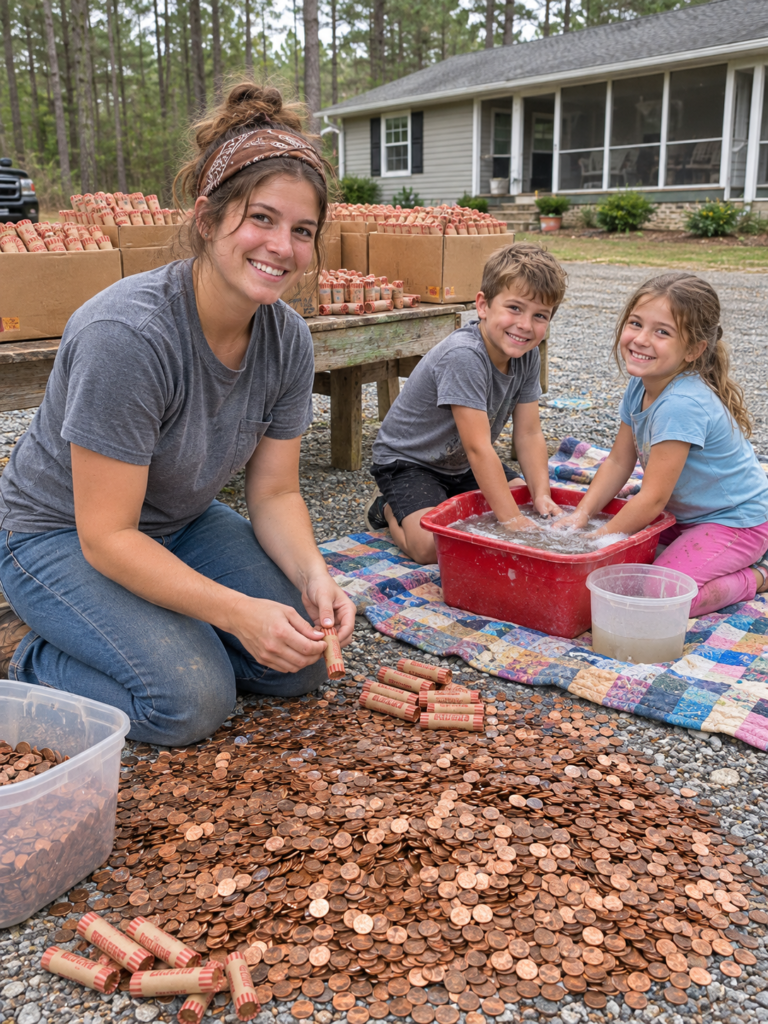
I shoveled pennies from the pile into a colander. I rinsed the worst of the oil off with the garden hose. Then I dumped them into the dish tubs.
Noah and Lily sat on the blanket and scrubbed. Hot water. Dish soap. Two sets of small hands in yellow rubber gloves that were too big for them.
When a batch was clean, they laid the pennies out on old towels to dry. Rows and rows of them, copper and shining in the sun.
I knelt in the gravel in my bandana and rolled.
I’d bought penny wrappers at the bank Saturday morning. The bank teller, a young woman named Kayla, looked at me strangely when I asked for two thousand of them.
“Two thousand?” she said.
“I have a lot of pennies,” I said.
Fifty pennies to a roll.
One thousand eight hundred thirty rolls.
You learn a rhythm. Stack ten. Stack ten. Stack ten. Stack ten. Stack ten. Slide them into the paper. Fold the ends.
Noah figured out that if you stacked them in groups of five on a strip of masking tape, you could count faster. Lily figured out that if you hummed while you scrubbed, it went quicker.
She hummed the same song for three hours. A song from a cartoon about a dog who drives a fire truck.
The shoeboxes on the card table filled one row at a time.
I’d gotten them from the shoe store in town. Twenty-five rolls fit in each box, lined up like little copper soldiers.
By Saturday night, we had eleven boxes.
The Cheese Sandwich
Saturday night, after supper, Noah asked me something.
We were sitting on the porch steps. The pile was smaller now, though not by much. The kids’ hands were red and wrinkled from the water. Mine were raw. My knees were scraped and bruised from kneeling in the gravel.
Noah was quiet for a long time. Then he said, “Mom, what happens when your lunch money runs out?”
I looked at him.
“What do you mean, honey?”
“At school,” he said. “When your lunch account runs out. What happens?”
I thought about it. I’d paid Noah’s lunch account on time every month since kindergarten. I’d never really thought about what happened when it ran out.
“I’m not sure,” I said. “Why?”
He looked down at his hands.
“There’s a kid in my class,” he said. “Mason. He got the cheese sandwich this week. Three times.”
“What’s the cheese sandwich?”
“It’s what they give you when you don’t have money,” Noah said. “It’s just bread and one piece of cheese. In a plastic bag. And a carton of milk.”
He picked at a scab on his knee.
“Everybody can see it,” he said. “Because it’s on a different tray. A white one. Everybody else gets the green trays.”
I didn’t say anything for a while.
“How does Mason feel about that?” I asked finally.
Noah shrugged.
“He doesn’t eat it,” he said. “He just sits there. And Tyler Beckman calls him Cheese Boy.”
I closed my eyes.
“Did you say anything to Tyler?” I asked.
Noah shook his head.
“I didn’t know what to say,” he said quietly.
He looked at the pile of pennies in the driveway. Shining in the porch light. Half of them clean now.
“Mom,” he said. “Can some of the pennies go to lunch?”
What the Money Was For
I looked at that pile for a long time.
That nine hundred and fifteen dollars was supposed to be our cushion. My first co-op paycheck wouldn’t come for two more weeks. Jake’s check covered the mortgage and the truck payment and not much else.
That money was supposed to buy groceries. Gas. Noah’s next inhaler refill, which our insurance didn’t fully cover yet because my new plan hadn’t started.
I’d done the math in my head a dozen times that weekend.
But I kept thinking about something else.
I kept thinking about Dale’s face when he taped that pay stub to the bucket. Paid in full. Count it.
I kept thinking about my children on their knees on a picnic blanket, scrubbing motor oil off pennies with toothbrushes.
I kept thinking that I didn’t want to buy groceries with money a man had thrown at me.
“Noah,” I said. “How many kids in your class do you think get the cheese sandwich?”
He thought about it.
“Mason,” he said. “And Riley. And sometimes Kaden. And the twins, the Larsons.”
He thought harder.
“I don’t know about other classes,” he said. “But probably more.”
Lily had been listening from inside the screen door. She came out in her nightgown with her stuffed rabbit.
“Can the pennies buy pizza?” she asked. “For the cheese kids?”
I laughed. I couldn’t help it.
“Maybe,” I said. “Let me make a phone call on Monday.”
Mrs. Fogle
Monday morning, before work at the co-op, I called the school.
Merrill has one elementary school, Washington Elementary, a long brick building on the north side of town. I asked the secretary who handled lunch accounts.
“That’d be Mrs. Fogle,” she said. “In the cafeteria. Let me transfer you.”
Mrs. Fogle had been the lunch lady at Washington Elementary for thirty-one years.
I’d met her once, at a kindergarten open house. She was short and round, with silver hair in a bun and glasses on a beaded chain. She called every child “honey” and remembered every one of their names.
She picked up on the fourth ring.
“Cafeteria, this is Edna.”
I told her who I was. I told her I wanted to pay off some lunch accounts.
She was quiet for a second.
“That’s very kind of you, honey,” she said. “But I can’t give you names. Privacy rules.”
“I understand,” I said. “Can you tell me how much is owed? For second grade?”
I heard her typing.
“Second grade,” she said. “Let’s see. Twenty-three students with negative balances.”
“Twenty-three?” I said.
There are only seventy kids in the whole second grade.
“Times are hard, honey,” Mrs. Fogle said quietly. “Fuel prices. The paper mill cut a shift in the spring. A lot of families are behind.”
She typed some more.
“The total for second grade is nine hundred eight dollars and forty cents,” she said.
I stood in my kitchen holding the phone.
Nine hundred eight dollars and forty cents.
Out of nine hundred fifteen.
“Mrs. Fogle,” I said. “I’d like to pay all of it.”
She was quiet for a long moment.
“All of it?” she said. “Honey, that’s a lot of money.”
“I know,” I said. “But there’s something you should know first. About how I’ll be paying.”
I told her.
The buckets. The motor oil. The driveway. The dish tub. Noah and Lily on the blanket. Eighteen hundred thirty rolls.
When I finished, she didn’t say anything for a long time.
Then she said, “Oh, honey.”
That was all. Just Oh, honey. But the way she said it made me sit down at my kitchen table.
Five Days
It took us five more days.
I worked at the co-op from eight to four-thirty. I came home and changed into old jeans and my bandana. I knelt in the gravel and rolled until the sun went down. Then I rolled under the porch light until my eyes wouldn’t focus anymore.
The kids scrubbed after school. They’d change out of their school clothes, put on their old jeans and the yellow gloves, and sit on the plaid blanket with their toothbrushes.
My knees went raw.
By Wednesday, I couldn’t kneel anymore. I put a couch cushion under them. By Thursday, the cushion was black with oil and gravel dust.
My fingertips cracked from the paper wrappers and the dish soap. Jake bought me a tube of bag balm at the farm store, the stuff they use on cow udders. I slathered it on every night before bed.
Jake came home Thursday night.
He pulled into the driveway in his pickup at nine o’clock. He sat in the truck for a long time, looking at the card table under the porch light. At the shoeboxes stacked three high. At the dish tubs. At me on my couch cushion.
Then he got out, took off his jacket, and knelt down beside me in the gravel.
“Show me how,” he said.
He rolled until midnight. His big trucker hands were clumsy with the paper wrappers. He tore three of them. He swore at every one.
Around eleven, he stopped and looked at me.
“Beck,” he said. “You know you could’ve let me dump them back on his lot.”
“I know,” I said.
“Why didn’t you?”
I thought about it.
“Because then he’d have made the kids watch me be angry,” I said. “This way they watched me do something better.”
Lily fell asleep on the blanket twice.
Once on Wednesday, curled up with her stuffed rabbit and a toothbrush still in her hand. Once on Thursday, with her head on Noah’s lap.
Noah didn’t move either time. He kept scrubbing with one hand so he wouldn’t wake her.
On Tuesday, Lily rolled the last one herself.
It was after supper. We were down to the last few hundred pennies. She’d been watching me roll for five days, and she asked if she could try.
I counted out fifty pennies for her. She stacked them on the card table, ten at a time, her tongue sticking out of the corner of her mouth in concentration.
She slid them into the paper wrapper. She folded the ends. She held it up.
It was lopsided. The paper was crumpled. And it had her sticky fingerprints all over it, little brown smudges where she’d been eating a peanut butter sandwich.
“Is it good?” she asked.
“It’s perfect,” I said.
Noah took it from her. He looked at it for a long time.
“Can I be the one to give this one?” he asked. “At school?”
“Yes,” I said.
Wednesday Morning
Wednesday morning, we carried every box into the school office.
Seventy-four shoeboxes. Eighteen hundred thirty rolls. Five hundred pounds of pennies.
Jake borrowed his brother’s pickup and a hand truck. We loaded the boxes into the truck bed at six in the morning. Lily wanted to ride in the back with them. I said absolutely not.
We pulled up in front of Washington Elementary at seven-fifteen.
Mrs. Fogle was waiting at the front door in her white apron and hairnet. Beside her was the principal, a tall man named Mr. Okonkwo, and the school secretary, Mrs. Jaeger.
They looked at the truck bed. They looked at the seventy-four shoeboxes.
Mr. Okonkwo let out a long, low whistle.
Jake loaded the hand truck. He wheeled the boxes into the office four at a time. It took nineteen trips. Mrs. Jaeger cleared off a whole table in the back. By the time we were done, the boxes were stacked against the wall like a copper brick wall.
Kids were starting to arrive for breakfast. They stopped in the hallway and stared through the office window.
Noah held on to that last roll.
The lopsided one. With Lily’s sticky fingerprints.
He’d carried it in his coat pocket all morning. He’d checked it six times in the truck to make sure it was still there.
When the last box was stacked, he took it out.
He walked up to the counter. Mrs. Fogle was standing on the other side.
He held the roll out to her with both hands. The way you’d hand somebody something important. Something that might break.
“This is the last one,” Noah said. “My sister rolled it. It’s for the cheese sandwich kids.”
Mrs. Fogle looked at the roll.
She looked at Noah. At Lily, holding my hand, in her pink rain boots.
She took the roll from him. She held it in both her hands.
Then she had to sit down.
She sat in Mrs. Jaeger’s office chair behind the counter, holding the lopsided roll of pennies. Her shoulders started to shake.
“Thirty-one years,” she said. “Thirty-one years, I’ve been handing out cheese sandwiches. I’ve had to take trays away from children. I’ve had to tell six-year-olds their lunch account is empty.”
She took off her glasses and wiped her eyes.
“I’ve paid some of them myself,” she said. “Out of my own purse. When I couldn’t stand it. But I can’t pay all of them. I can’t.”
She looked at the wall of shoeboxes.
“Nine hundred eight dollars and forty cents,” she said. “Every second grader. Every one.”
She looked at Noah.
“Honey,” she said, “nobody in second grade gets a cheese sandwich today.”
The Post
That morning, the school’s Facebook page posted a thank-you.
Mr. Okonkwo wrote it himself. He showed it to me before he posted it, to make sure I was okay with it.
Washington Elementary would like to extend our deepest thanks to a local mom and her two children, who this morning paid off every negative lunch balance in our second grade.
They did it with 91,500 pennies, which they spent eight days washing and rolling by hand at their kitchen table and in their driveway.
Because of them, 23 children will eat a hot lunch today.
Kindness counts. Every penny of it.
It didn’t say my name.
It didn’t say who had paid me those pennies. Or how. Or why they’d needed washing.
It didn’t have to.
Merrill is a small town. Ten thousand people. Everyone knows everyone. Everyone knows whose kid is whose and whose truck is in whose driveway.
And Carl, the mechanic from Heckert’s, had told his wife about the buckets. And his wife had told her sister. And her sister worked at the County Market deli counter.
By noon, the whole town knew whose pennies they were.
The post had four hundred shares by lunchtime. Two thousand by supper. People commented by the hundreds.
Is this the Heckert thing? I heard he dumped them in her yard covered in oil.
Dale Heckert did this to a single mom of two? Never taking my truck there again.
She’s not single, her husband drives for the mill. But still.
Those poor kids scrubbing motor oil off pennies. I’m sick.
And she gave it ALL to lunch debt?? This town doesn’t deserve her.
I didn’t comment. I didn’t share it. I didn’t say anything about Dale to anyone.
I went to work at the co-op. I came home. I made supper. I hosed the last of the oil off my driveway gravel. It left a dark stain shaped like a fan that I knew would be there for years.
Dale didn’t say a thing.
Not that day.
7:40 a.m.
At 7:40 the next morning, my phone rang.
I was standing in the kitchen in my bathrobe, packing Noah’s lunch. A turkey sandwich, an apple, and a little bag of pretzels. Lily was at the table eating cereal. Noah was upstairs looking for his other shoe.
I looked at the screen. Washington Elementary.
It was Mrs. Fogle.
Her voice was low. Almost a whisper.
“Becky,” she said. “You’d better come down here.”
My heart dropped. “Is something wrong? Is it the pennies? Did the bank—”
“No, no,” she said. “Nothing like that.”
She paused.
“Dale Heckert is standing in my office,” she said. “And he’s asking for you.”
I stood in my kitchen with a turkey sandwich in one hand and a roll of plastic wrap in the other.
“What does he want?” I asked.
“I don’t know, honey,” Mrs. Fogle said. “He won’t say. He just keeps saying he needs to talk to you.”
She lowered her voice even further.
“Becky,” she said. “He’s crying.”
The Office
I dropped the kids at the front door at eight. Lily went to kindergarten. Noah went to second grade. I told Noah to go straight to class and not stop at the office.
He looked at me. He knew something was going on.
“Is it about the pennies?” he asked.
“I don’t know yet, honey,” I said. “Go to class.”
I walked into the office.
The seventy-four shoeboxes were still stacked against the back wall. The armored car from the bank wasn’t coming until Friday.
Mrs. Jaeger was at her desk, very carefully not looking at anyone. Mr. Okonkwo was standing in the doorway of his office with his arms crossed.
And Dale Heckert was sitting in one of the little plastic chairs by the front counter.
He looked smaller than I’d ever seen him.
He was wearing his Dickies and his gray Heckert Auto T-shirt and his steel-toed boots with the knotted laces. But his shoulders were hunched. His crew cut looked like he hadn’t combed it. His face was red and blotchy.
He was holding something in his lap. A coffee can. An old red Folgers can with a dented lid.
When he saw me, he stood up so fast the plastic chair tipped over.
“Becky,” he said.
His voice was hoarse.
I didn’t say anything. I stood just inside the office door with my purse over my shoulder.
Mrs. Fogle came out of the cafeteria in her apron and hairnet. She stood beside the counter, between us, with her arms crossed.
“I’m not here to cause trouble,” Dale said. “I just—I need to say something. And I need to give you something.”
He held out the coffee can.
“I don’t want anything from you, Dale,” I said.
“It’s not for you,” he said. “It’s for the kids. The lunch kids.”
I didn’t move.
He set the can on the counter. He took off the lid.
It was full of money. Not pennies. Bills. Twenties and fifties and hundreds, rolled up tight with rubber bands.
“Four thousand three hundred dollars,” Dale said. “Mrs. Fogle says that’s what’s left. Every grade. Kindergarten through fifth. I asked her yesterday afternoon.”
I looked at Mrs. Fogle. She nodded slowly.
“He called at three o’clock,” she said. “Asked how much was owed in the whole school. I told him. He hung up.”
She looked at the coffee can.
“He was waiting in the parking lot at six-thirty this morning,” she said.
Cheese
“Why?” I asked.
Dale didn’t answer right away. He looked at the coffee can. Then he looked at Mrs. Fogle.
“You tell her, Edna,” he said quietly. “I can’t.”
Mrs. Fogle uncrossed her arms.
“Becky,” she said. “Do you know how long I’ve worked here?”
“Thirty-one years,” I said.
“Do you know who worked here before me?”
I shook my head.
“My mother,” Mrs. Fogle said. “Irene Bauer. She was the lunch lady at Washington Elementary from 1962 to 1993.”
She looked at Dale.
“Dale was in her lunch line,” she said. “Every day. From first grade through sixth.”
Dale was staring at the floor.
“My dad drank,” he said. His voice was flat. “He ran the shop. Made decent money. Spent most of it at the Rusty Nail on Main Street. Some weeks there wasn’t any money for groceries. There sure as heck wasn’t any for lunch.”
He swallowed.
“I got the cheese sandwich,” he said. “Second grade. Third grade. Fourth. Every day for three years. White tray. One slice of cheese on white bread in a plastic bag. A carton of milk.”
The office was very quiet.
“They called me Cheese,” Dale said. “Through high school. Even after the shop started doing better. Even after I joined the Navy and came back. Guys I went to school with still call me Cheese at the Rusty Nail. Forty-five years later.”
He laughed. It wasn’t a happy sound.
“I’ve never told anybody that bothered me,” he said. “I just got meaner. Figured if I was mean enough, nobody’d notice I was the cheese sandwich kid.”
“In fifth grade,” Mrs. Fogle said quietly, “his account was eighty-four dollars in the hole. That was a lot of money in 1975. The school was going to send a letter home. To his father.”
She looked at Dale.
“My mother paid it,” she said. “Out of her own purse. Out of her grocery money. She never told him. She never told anybody. She just started putting a hot lunch on his tray one day and never said why.”
Dale’s face crumpled.
“I didn’t know,” he said. “I didn’t know until 2009. At Irene’s funeral. Edna told me afterward, in the church basement.”
He wiped his eyes with the back of his hand. His knuckles were scarred and greasy.
“She paid my lunch for two years,” he said. “And I never even said thank you. Because I didn’t know.”
What He Saw
“When I saw that post,” Dale said. “Yesterday. About the pennies.”
He looked at the wall of shoeboxes.
“Twenty-three kids,” he said. “Twenty-three kids who won’t get the cheese sandwich.”
His voice cracked.
“I paid you in pennies to make a point,” he said. “To make you feel small. Because you were leaving. Because everybody always leaves. My wife. My son. Every good mechanic I ever had. You.”
He looked at me.
“You were the best parts person I ever had,” he said. “Better than my dad. Better than me. And when you put that letter on my desk, I didn’t know what to do. So I did what my dad would’ve done.”
“I wanted you to kneel in the gravel,” he said quietly. “I wanted you to count every one of them and think about me while you did it. I wanted you to be angry.”
He looked at the floor.
“And you turned every one of them into lunch for the cheese sandwich kids,” he said.
He looked up at me. His eyes were red.
“I sat in my truck in the shop lot for three hours last night,” he said. “Reading that post over and over. Reading the comments. Every single person in this town thinks I’m a monster.”
He swallowed.
“They’re right,” he said.
I didn’t say anything for a long time.
I looked at Dale Heckert. Sixty-one years old, standing in an elementary school office in his work clothes, holding a Folgers can full of money, crying in front of the lunch lady.
I thought about the pennies. About my children’s hands in yellow rubber gloves. About my raw knees and cracked fingertips. About Lily’s lopsided roll with her sticky fingerprints.
“Dale,” I said. “Why did you ask for me?”
He looked at me.
“Because I owe you an apology,” he said. “First. Before anybody else. Before I give the school a dime.”
He took a breath.
“I’m sorry, Becky,” he said. “For the pennies. For the oil. For making your kids scrub them. For not speaking to you for two weeks. For six years of never saying thank you.”
He looked at the wall of shoeboxes.
“I’m sorry,” he said again.
Noah
I didn’t hear the office door open behind me.
I didn’t know Noah was there until he spoke.
“Mr. Heckert?”
Everybody turned around.
Noah was standing in the doorway in his school clothes. He was holding his backpack by one strap. He’d come from class. I found out later he’d asked his teacher if he could go to the bathroom and came straight to the office instead.
He looked at Dale.
Dale looked at him. His face went very still.
“Hi, Noah,” he said quietly. “Your mom brought you to the shop sometimes. When you were little.”
“I remember,” Noah said. “You gave me a lollipop from the jar.”
“That’s right,” Dale said.
Noah walked into the office. He stopped in front of Dale. He looked at the Folgers can on the counter.
“Is that for the cheese sandwich kids?” he asked.
Dale nodded.
“The whole school,” he said. “Every grade.”
Noah thought about that for a long moment. The way he thinks about everything, slowly and seriously.
Then he said something none of us expected.
“Did you ever get the cheese sandwich?” he asked. “When you were little?”
Dale stared at him.
Nobody had told Noah anything. He’d been standing in the doorway. I don’t know how much he heard.
“Yes,” Dale said finally. His voice was barely a whisper. “Every day. For three years.”
Noah nodded slowly.
“Mason gets it,” he said. “In my class. Tyler calls him Cheese Boy.”
Dale closed his eyes.
“I didn’t say anything to Tyler,” Noah said. “I didn’t know what to say.”
He looked up at Dale.
“Did anybody say anything?” he asked. “When they called you that?”
Dale shook his head.
“No,” he said. “Nobody ever did.”
Noah was quiet for a long time.
Then he reached into his coat pocket.
He pulled out a penny.
It was shiny and clean. One of ours. I found out later he’d kept it. Slipped it into his pocket on the last day of rolling, when I wasn’t looking. He said he wanted one to remember.
He held it out to Dale.
“This is one of yours,” he said. “We washed it. It was really dirty.”
Dale looked at the penny in Noah’s palm.
He didn’t take it right away.
“Why are you giving me this?” he asked.
Noah thought about it.
“Because you said sorry to my mom,” he said. “And because nobody said anything when they called you Cheese.”
He held it out a little further.
“So I’m saying something,” Noah said. “I’m sorry they called you that.”
Dale Heckert took the penny.
He held it in his big scarred palm. He looked at it for a long time.
Then he sat back down in the little plastic chair and put his face in his hands.
Penny Saturday
The bank’s armored car came on Friday. They counted the pennies. Nine hundred fifteen dollars, every cent.
Mrs. Fogle applied nine hundred eight dollars and forty cents to the second-grade accounts. The leftover six dollars and sixty cents went into a jar on the cafeteria counter labeled For Whoever Needs It.
Dale’s coffee can paid off the rest of the school.
Every grade. Kindergarten through fifth. Nobody at Washington Elementary had a negative lunch balance for the first time in eleven years.
But that’s not the end of it.
The next week, Dale called me.
I almost didn’t answer. But I did.
“Becky,” he said. “I’ve got a question.”
“Okay.”
“There’s a jar,” he said. “At the shop. Under the counter. It’s been there since my dad opened the place. Every time somebody pays in cash, the change goes in the jar. Pennies, mostly.”
“How many pennies?” I asked.
He was quiet for a second.
“I had one of the guys weigh it,” he said. “About forty pounds. Maybe twelve thousand pennies. Fifty-seven years of them.”
“Dale,” I said. “What are you asking me?”
“I’m asking,” he said slowly, “if you and your kids would teach me how to roll them.”
I didn’t answer right away.
“Mrs. Fogle says the middle school has lunch debt too,” he said. “And the high school. And I was thinking. If people saw how it worked. If they saw us doing it. Maybe they’d bring their pennies too.”
He cleared his throat.
“I’ll wash them first,” he said. “Myself. No oil. I promise.”
Two Saturdays later, we set up folding tables in the Merrill Fire Hall.
Dale brought his jar. Twelve thousand pennies, washed in his own shop sink, shining like new.
I brought my blue dish tub and the plaid blanket with the burn hole. Noah brought the masking tape trick. Lily brought her stuffed rabbit and the fire truck dog song.
We put a sign on the door.
PENNY SATURDAY. Bring your change. Help roll. Every roll feeds a kid.
We thought maybe ten people would come.
Two hundred and forty showed up.
They came with coffee cans and mason jars and plastic bags and pickle jars full of change. Old men with fifty years of pennies in a shoebox. Kids with piggy banks. A woman from the nursing home who brought a quart jar of pennies she’d saved since her husband died.
Carl from the shop came with all four Heckert mechanics. The guys from the Rusty Nail came, the same ones who’d called Dale Cheese for forty-five years. They sat at a table in the back and rolled pennies for six hours.
Mrs. Fogle brought her mother’s old cafeteria apron and hung it on the wall behind the tables.
Dale sat at the head table with Noah and Lily.
He was terrible at rolling. His fingers were too big. He tore half the wrappers. Lily had to show him how to fold the ends four times.
“Like this, Mr. Dale,” she said patiently. “You tuck it. Then you push.”
“I’m tucking,” Dale said. “I’m pushing.”
“You’re squishing,” Lily said.
Noah laughed so hard he fell off his chair.
By the end of the day, we’d rolled four hundred and twelve thousand pennies.
Four thousand one hundred twenty dollars.
Enough to pay off the lunch debt at the middle school, with nine hundred left over for the high school.
The Driveway
The Monday after Penny Saturday, I came home from work and found a dump truck in my driveway.
It was from Lincoln County Aggregate. A man was spreading fresh gravel across the whole driveway. Clean, gray, crushed limestone, brand new.
Dale was standing beside the truck with his arms crossed.
“What is this?” I asked.
“The oil stain,” Dale said. “From the pennies. It’ll be there for years if you don’t replace the gravel.”
He uncrossed his arms.
“I had them dig out the top four inches,” he said. “Hauled the old stuff to the recycling yard. Put down new.”
I looked at the driveway. The dark fan-shaped stain was gone. Everything was clean and gray and smooth.
“Dale,” I said. “You didn’t have to do this.”
“Yeah,” he said. “I did.”
He reached into his shirt pocket.
He pulled out the penny Noah had given him. The shiny clean one. He’d drilled a tiny hole near the top and threaded it onto his key ring, next to his truck key and the key to the shop.
“I carry it every day now,” he said. “Every time I start the truck, I see it.”
He looked at it.
“Reminds me somebody finally said something,” he said.
One Year Later
It’s been a year now.
I still work at the co-op. Parts and inventory manager. The insurance is good. Noah’s asthma is under control. Lily hasn’t broken anything else, though not for lack of trying.
Jake still hauls logs out of Tomahawk. He says he still has nightmares about penny wrappers.
Dale still runs Heckert Auto & Diesel. Business dropped for a few months after the post. Then Penny Saturday happened, and it picked back up. People said they wanted to give the man a second chance.
He gives every new employee health insurance now. All of them. He told me it costs him almost two thousand dollars a month.
“Should’ve done it twenty years ago,” he said.
Mason, the boy in Noah’s class, eats a hot lunch every day now.
Tyler Beckman stopped calling him Cheese Boy. Noah told me why.
In October, a few weeks after Penny Saturday, Tyler said it in the lunch line. Noah stepped in front of Mason and said, loud enough for the whole cafeteria to hear, “Mr. Dale says nobody should get called that. He got called that when he was a kid, and it made him sad for forty-five years.”
Tyler didn’t say it again.
There’s a Penny Saturday every September now.
At the Merrill Fire Hall. The third Saturday of the month. Dale runs it. He bought folding tables and a commercial coin counter and a big banner that says EVERY PENNY COUNTS.
Last year, we rolled almost six hundred thousand pennies. Six thousand dollars. Enough to pay off the lunch debt for the whole school district, with a little left over to start a fund.
Dale named the fund.
It’s called the Irene Bauer Fund. Mrs. Fogle cried when he told her.
There’s a little brass plaque on the wall of the Washington Elementary cafeteria now, right next to the lunch line. Dale paid for it.
In memory of Irene Bauer, lunch lady, 1962–1993.
She paid for a boy’s lunch and never told him.
He finally found out.
No child in this school will ever eat a cheese sandwich again.
Last month, I stopped by Heckert’s to pick up a fuel filter for Jake’s truck.
The shop looked the same. Gray steel. Four bays. Coffee strong enough to strip paint. A tire-company calendar on the wall.
But there was something new on the parts counter. Right next to the register.
It was a jar.
A big glass pickle jar, half full of pennies. Clean, shining pennies.
Taped to the front was a piece of masking tape with handwriting on it. Blocky capital letters, pressed hard into the tape with a black marker.
FOR THE LUNCH KIDS. EVERY PENNY COUNTS.
And underneath, in smaller letters, a second line. I recognized the handwriting. It was a little crooked, like it had been written by somebody very carefully trying not to make a mistake.