My Niece Ruined My Son’s Birthday—Then a Letter Exposed More-olive
That sentence moved around our backyard almost immediately, repeated by one adult after another as if saying it enough times could make what had happened less deliberate.
Noah stood beside the birthday table completely frozen, staring at what remained of the three-tier superhero cake he had been talking about for weeks.
The cake wasn’t merely tipped over by accident or bumped by a child running past the table.
Emma had walked straight up to it, shoved both hands into the frosting, ripped out the plastic superhero decorations, and thrown them across the yard.
Blue frosting streaked Noah’s brand-new shirt.
Chunks of cake and crumbs covered the table and landed in the grass.
The decorations he had carefully chosen were scattered several feet away.
For a second, nobody seemed to understand what they had just watched.
Then Emma laughed.
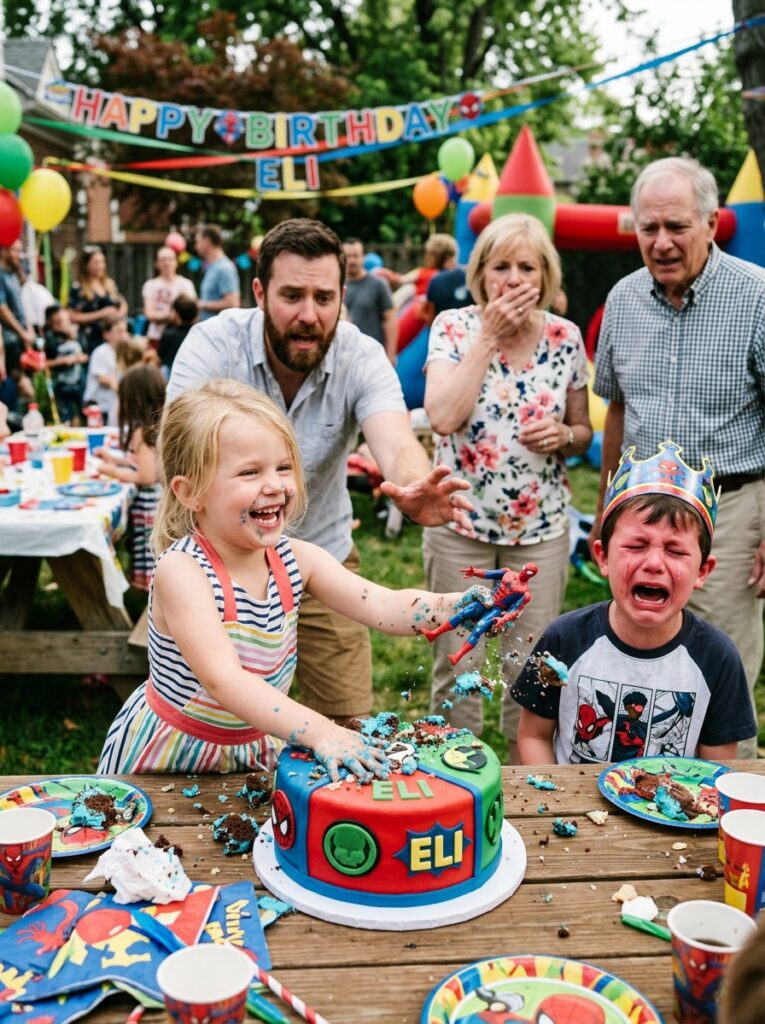
That laugh changed the entire moment for me because it wasn’t nervous or embarrassed.
It wasn’t the laugh of a child realizing too late that a joke had gotten out of control.
She sounded pleased with herself.
Noah’s face crumpled, and he started crying so hard that he couldn’t even explain what he wanted me to do.
I went straight to him, wrapped my arms around him, and tried to wipe frosting off his shirt while he pressed his face against me.
I kept waiting for someone else to step in.
There were adults all around us who had watched the same thing happen.
I expected somebody to tell Emma that she needed to apologize.
I expected my sister Ashley, Emma’s mother, to at least acknowledge that her daughter had crossed a line.
Instead, Ashley rolled her eyes.
“Oh, come on,” she said. “It’s only cake.”
Only cake.
I remember looking at her and wondering whether she genuinely believed that was the issue.
The cake mattered, but not because it was expensive or impressive.
Noah had spent weeks choosing the superhero decorations.
He had thought about the colors, pointed out the characters he wanted, and treated the whole birthday as something special he could finally look forward to.
We had saved for months because this was his first real birthday celebration after a difficult year recovering from a serious bicycle accident.
That year had already asked far more patience from a seven-year-old than I ever wanted him to need.
The party wasn’t about showing off for relatives or posting perfect pictures.
It was supposed to be a marker that something normal had returned to his life.
A backyard.
A cake.
Family around him.
Something simple to be excited about again.
Now he was standing in blue frosting while the adults around him acted as though asking Emma to apologize would somehow be more harmful than what she had done.
My parents moved toward Emma almost immediately.
“She didn’t mean it.”
“Kids get carried away.”
“Don’t turn this into something bigger.”
Each sentence landed the same way.
Nobody was asking Noah how he felt.
Nobody was telling Emma that laughing after deliberately destroying somebody else’s birthday cake wasn’t acceptable.
Everyone seemed more concerned with preventing Emma from experiencing consequences than with the fact that Noah had just been humiliated at his own party.
And there was one detail I couldn’t ignore.
Only a few minutes before the cake was destroyed, I had overheard Emma complaining that Noah was “getting all the attention.”
It had sounded childish when I first heard it.
She was nine years old at another child’s birthday party, and jealousy wasn’t exactly shocking.
I hadn’t made anything of it.
But after watching her put both hands into the cake and laugh, that earlier complaint no longer felt unrelated.
I looked at Ashley and kept my voice calm.
I told her Emma owed Noah an apology.
That was all I asked for in that moment.
Not a lecture in front of everybody.
Not some dramatic punishment.
An apology.
Ashley crossed her arms.
“If Noah can’t handle a little joke, that’s his problem.”
That sentence did something the ruined cake hadn’t done.
It made the situation perfectly clear.
This wasn’t going to be treated as a mistake.
Ashley wasn’t asking Emma to take responsibility because Ashley didn’t believe Emma should have to.
And suddenly I understood that continuing to argue about the cake would accomplish nothing.
So I stopped arguing about the cake.
I looked at my sister and said, “That’s okay. Then I won’t be paying for Emma’s ski trip or dance camp this summer.”
The conversations around us stopped.
Ashley stared at me.
“What?”
“You heard me.”
For the previous two years, I had helped Ashley financially while she tried to get back on her feet after a difficult divorce.
A significant part of that help had gone toward Emma’s activities.
Ski camp.
Dance camp.
Equipment.
Registration fees.
Altogether, I had spent nearly six thousand dollars.
I had never kept a running total to throw in Ashley’s face.
I had never reminded Emma that I was paying.
I didn’t want a child feeling indebted to an adult every time she put on dance shoes or packed for camp.
Emma was family.
Ashley was my sister.
I had believed that helping Emma continue things she loved was one practical way to help Ashley through a rough period without making her feel like she had to explain every dollar.
That was why I had never treated the money like leverage.
But there was also a difference between helping family and being told that my own child’s feelings didn’t matter while I continued funding expensive extras for the person who had deliberately hurt him.
Ashley seemed to understand immediately that I was serious.
“No,” she whispered.
“Yes.”
Dad stepped toward me.
“You can’t punish Emma over one poor choice.”
I looked at him and thought about the strange logic of that sentence.
Apparently Emma was old enough to receive thousands of dollars’ worth of camps and activities, but somehow too young for losing those privileges to count as a consequence of her behavior.
“I already have,” I said.
Ashley started yelling.
She said I was destroying her daughter’s future over “a stupid cake.”
Mom called me vindictive.
The same people who had watched Noah cry were suddenly passionate about protecting Emma from disappointment.
Emma stood beside them with blue frosting still visible on her fingers.
She watched the adults argue with the expression of someone waiting for the ending she expected.
Someone would pressure me.
Someone would tell me I was overreacting.
Someone would make me reverse the decision.
For years, that probably would have worked.
Family pressure has a way of making a reasonable boundary feel cruel when enough people object to it at once.
But I looked down at Noah and realized I didn’t want him learning that lesson from me.
I didn’t want him remembering his seventh birthday as the day everyone explained why he should accept being hurt so another child wouldn’t have to feel uncomfortable.
So I didn’t reverse anything.
I picked Noah up, carried him inside, and ended the party early.
The celebration we had saved for was over.
The relatives gradually left, but the argument followed me long after the backyard emptied.
That night my phone filled with messages.
Some came from relatives who had been standing only a few feet away when Emma destroyed the cake.
They had been quiet when Noah cried.
They were much less quiet once money was involved.
Selfish.
Cruel.
Heartless.
Those words appeared again and again.
The messages focused almost entirely on what Emma might lose.
Very few people mentioned what Noah had lost that afternoon, and none of their criticism changed the fact that Ashley had dismissed his feelings as “his problem.”
By the next morning, I was still reading those messages while making coffee.
The house felt completely different from the day before.
There were no relatives moving through the backyard, no party noise, and no reason to pretend anything had ended neatly.
Noah sat at the kitchen table in an old superhero T-shirt, picking at a piece of toast.
He was quieter than usual.
I hated seeing that more than I hated any text message on my phone.
Children don’t always give you a speech explaining exactly what hurt them.
Sometimes they just sit at a table and pull apart a piece of toast while the adults around them figure out whether they were paying attention when it mattered.
Then the doorbell rang.
I wasn’t expecting anyone.
When I opened the front door, Ashley was standing on my porch.
Emma was beside her.
Ashley was holding Emma’s brand-new iPad, still sealed in its box.
I had paid for that too.
Emma wore the same smug expression I remembered from the party.
Ashley didn’t greet me or explain why they had come.
She simply stood there while Emma took the box.
Emma lifted it over the concrete porch as though she might let it fall.
“Mom says you paid for this too,” she said. “So I guess you want it back.”
The gesture felt designed to force a reaction.
Maybe they expected me to panic about the expensive device.
Maybe Ashley wanted the morning to become another argument about whether I cared more about money than family.
Whatever the intention was, I didn’t get the chance to answer.
A mail carrier was coming up the front path with a certified envelope.
The timing was so ordinary that at first I barely thought about it.
I signed for the envelope while Ashley watched my hands.
That was when I noticed her attention shift.
She wasn’t looking at the iPad anymore.
She was looking at the envelope.
The return address was from the insurance office that had handled Noah’s bicycle accident.
The accident had already shaped most of the previous year for us, and anything connected to the insurance process was something I took seriously.
Still, I had no reason in that first second to connect a certified letter about Noah’s accident with my sister standing on my porch after a fight about a birthday cake.
I opened the envelope.
Ashley remained beside Emma.
Her fingers tightened around the iPad box.
I pulled out the first page and started reading.
The language was formal, but the important part was clear enough.
Noah’s accident file couldn’t be closed because a parental release form submitted months earlier contained conflicting information.
I read that section again.
Then again.
A copy of the disputed form was attached behind the letter.
I moved to the next page.
The form stated that no other child had been involved in Noah’s bicycle accident.
That sentence immediately raised a question I wasn’t prepared for, but it wasn’t the only thing on the page.
The form also authorized settlement funds to be deposited into a separate account.
I could hear the ordinary sounds around us, but my attention had narrowed to the paper in my hands.
A day earlier, I had been defending my son over a destroyed cake while my family accused me of making one childish act into something bigger.
Now I was holding a document connected to the most difficult year of Noah’s young life, and something about it was wrong.
Very wrong.
I kept reading downward.
At the bottom of the form was my name.
Not merely typed into a blank.
Signed.
For a moment, I stared at the handwriting because my brain kept trying to make the obvious somehow less serious.
It was supposed to be my signature.
It wasn’t.
I had never written it.
I had never authorized anyone else to write it.
And I had never knowingly signed a form saying that no other child had been involved while directing settlement money into a separate account.
The argument from the birthday party suddenly felt very far away.
I looked from the signature to Ashley.
She was already watching me.
The iPad box was still in her hands.
Emma stood beside her, but the smugness of the previous moment no longer mattered to me.
I looked back at the form.
Directly beneath the signature that pretended to be mine was a witness line.
Someone had signed that line too.
I didn’t need to study the handwriting for long.
The name was perfectly clear.
Ashley.
My sister’s signature sat directly beneath a parental signature I had never made.