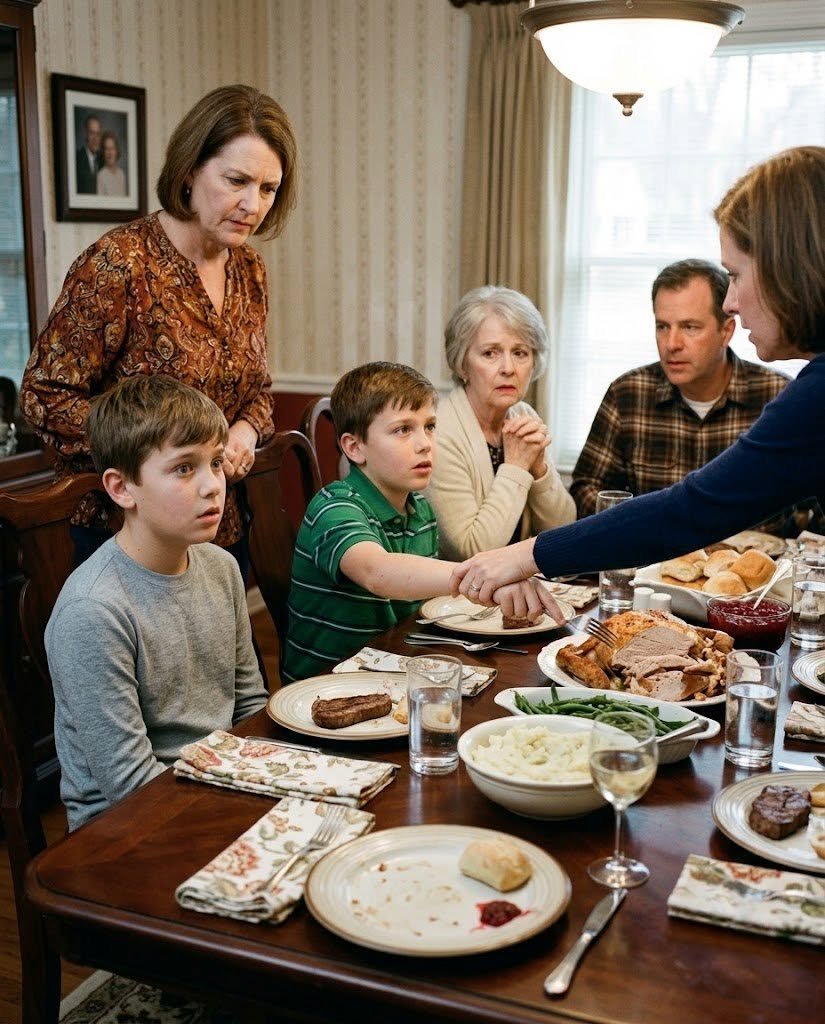
By the time the person who had cooked Ethan’s steak was asked to explain exactly how it had been prepared, my mother was no longer arguing about manners.
She was sitting very still.
That was the part I kept remembering afterward.
Not the shouting.
Not the dinner going cold.
Not even Claire knocking Tyler’s fork away before he could take a bite.
It was my mother’s silence after the doctor’s findings turned Ethan’s strange little comment into something none of us could dismiss.
The night before, she had called him difficult.
She had acted as if a 12-year-old boy refusing one piece of meat was a personal attack on Thanksgiving itself.
Now the question was no longer why Ethan would not eat the steak.
The question was what had been in it.
And who knew.
Thanksgiving had started the way most holidays with my mother started: with Margaret entering our house as if she had been hired to correct it.
She arrived early enough that Claire was still moving serving bowls between the kitchen and dining room.
My mother adjusted decorations that had already been arranged, inspected dishes without being asked, and commented on the order in which things should be served.
Tradition was one of her favorite words.
But when Margaret said it, tradition usually meant obedience.
Claire understood that better than anyone.
For years, my wife had made an effort not to turn every irritating comment into a battle.
If Margaret criticized a side dish, Claire changed the subject.
If she corrected how we handled Ethan, Claire waited until we were alone before telling me how much it bothered her.
If my mother made one of those little remarks that sounded harmless until you noticed who always received them, Claire usually gave me a look instead of giving Margaret a fight.
She did that because she loved me.
She did it because Ethan loved seeing his cousins.
And she did it because neither of us wanted every family gathering to become another story people whispered about afterward.
But Ethan had always been the point where Claire’s patience had a hard edge.
He was our son.
He was allowed to dislike a food without being humiliated for it.
He was allowed to say something felt wrong.
That Thanksgiving, he did exactly that.
He sat beside me wearing the sweater Claire had picked out for the holiday, shoulders slightly hunched as my mother watched him examine his plate.
We had made turkey for everyone who wanted the traditional meal, but we had also grilled steaks because Claire had never cared for turkey.
Nobody had treated that as strange.
At least, not until my mother put a steak in front of Ethan.
She tapped the rim of his plate with her fork.
“There. Something plain enough even you can eat.”
The sentence sounded almost playful if you did not know her.
I knew her.
So did Claire.
Ethan looked at the steak instead of answering.
Then he leaned toward me.
“Dad, it smells wrong.”
My first instinct embarrasses me now.
I nearly laughed.
I nearly told him he was smelling the seasoning or the grill.
I nearly became another adult telling a child that what he noticed could not possibly matter because the adults had already decided everything was fine.
Then I saw Claire.
She had stopped moving.
Her hand was still near her water glass, but she was looking directly at Ethan’s plate.
My mother heard him too.
“Don’t start,” Margaret said. “It is Thanksgiving dinner, not a restaurant.”
Ethan’s face tightened.
He was not throwing a tantrum.
He was not pushing the plate away dramatically.
He just looked worried.
“It smells like medicine.”
That changed the air around the table.
I leaned closer.
At first, all I noticed was what should have been there.
Butter.
Salt.
The dark grilled edges.
Then there was something else underneath it.
Something bitter.
It was faint enough that I could understand why nobody had noticed while plates were being carried through a crowded kitchen.
But once Ethan had pointed it out, I could not stop noticing it.
Before Claire or I could decide what to do next, my nephew Tyler reached across the table.
“I’ll eat it,” he said. “Ethan’s just picky.”
Tyler’s fork moved toward the steak.
Claire moved faster.
Her chair scraped hard against the floor as she stood, and she knocked Tyler’s fork away before it touched the meat.
“No,” she said. “Don’t eat that.”
The table stopped being a Thanksgiving table in that instant.
It became a room full of people trying to understand why Claire looked frightened.
My mother did not look frightened.
She looked offended.
“What exactly is wrong with you?” she demanded.
Claire did not answer the insult.
She did not defend herself.
She lifted Ethan’s plate with both hands and carried it into the kitchen.
Then she reached for her phone.
I followed her.
Behind us, I could hear Margaret complaining that Claire was making a scene.
Tyler’s mother was asking what had happened.
Someone told Tyler to sit back down.
Ethan stayed in his chair.
When I looked over my shoulder, his eyes were fixed on the doorway where Claire had disappeared.
He knew she believed him.
I think that mattered almost as much as what happened next.
Claire put the plate down where nobody could reach it casually.
“Keep everyone away from this,” she told me.
Her voice was quiet.
That scared me more than yelling would have.
“What do you think it is?” I asked.
“I don’t know.”
She looked at the steak again.
“But I’m not letting a kid eat it so we can find out.”
That was Claire.
She did not need a complete explanation before taking the safest available step.
She did not accuse anyone.
She did not announce some theory to the whole family.
She simply treated the plate as something that needed to be checked.
My mother followed us into the kitchen a moment later.
“This is ridiculous,” she said.
Claire kept working with her phone.
Margaret looked at me instead.
“Are you seriously allowing this?”
That word caught me.
Allowing.
As if Claire needed my permission to stop two children from eating food she did not trust.
As if the real problem in the room was my wife refusing to stay quiet.
I said, “Mom, Ethan said it smelled like medicine. I smelled something strange too.”
Her mouth tightened.
“He says something is wrong with everything.”
“No, he doesn’t.”
“He is difficult with food.”
“He is twelve.”
Margaret shook her head as though I had disappointed her by refusing the familiar script.
“He needs to learn that the world does not rearrange itself every time he makes a face.”
Claire finally turned around.
“He didn’t make a face.”
My mother looked at her.
“He warned us.”
Claire pointed toward the dining room.
“And your other grandson almost ate it because everyone was too busy calling Ethan picky to listen.”
Margaret started to answer.
Claire’s phone conversation ended the argument before it could build.
She had asked for help.
From that moment on, the steak stayed untouched.
The rest of dinner became irrelevant.
Nobody wanted to eat much anyway.
The turkey sat half-carved.
The mashed potatoes developed a skin.
The rolls went cold in their basket.
People moved between the dining room and kitchen speaking in low voices, trying to decide whether Claire was being cautious or whether we had all narrowly missed something serious.
Margaret continued insisting that the holiday had been ruined over nothing.
She said Claire was embarrassing her.
She said Ethan had learned that creating drama got him attention.
Every sentence pulled me a little farther away from the version of my mother I had spent years defending.
I had always told Claire that Margaret was controlling because holidays mattered to her.
That she criticized because she worried.
That she had strong opinions because she had spent decades taking care of everyone.
Those explanations suddenly sounded thin.
Because the person my mother was attacking was a child who had smelled something unusual in his own dinner.
And Claire’s only offense had been believing him.
At one point Ethan came into the kitchen.
“Am I in trouble?” he asked.
The question hit me harder than any argument with my mother had.
I crouched so we were closer to eye level.
“No.”
He looked toward the plate.
“Grandma’s mad.”
“I know.”
“Was I being difficult?”
Before I could answer, Claire stepped beside him.
“No,” she said. “You noticed something. You told us. That was the right thing to do.”
Ethan looked at her for a long second.
Then he nodded.
No speech.
No big family lesson.
He simply went back to the other room and stayed near Tyler.
That ordinary little movement made me realize how close we had come to teaching him the opposite lesson.
Eat it so Grandma does not get angry.
Ignore your own senses because an adult thinks you are inconvenient.
Stay quiet to keep the table comfortable.
The following morning, we got the information Claire had been waiting for.
A doctor reviewed what had been found and documented it in a file.
The wording stripped away every excuse we had been using the night before.
The steak contained crushed sedatives.
Not some mysterious seasoning.
Not an ingredient Ethan disliked.
Sedatives.
And according to the medical findings, the amount involved was strong enough to endanger a child.
I read that part more than once.
Then I looked at Claire.
She had already read it.
Her expression told me she was still thinking about Tyler’s fork.
One second later and he might have taken the bite Ethan refused.
One second later and the person affected might not even have been the child whose plate contained it.
That was when the entire Thanksgiving scene rearranged itself in my mind.
Margaret telling Ethan not to start.
Margaret calling him difficult.
Her insistence that he eat what was placed in front of him.
Her anger when Claire stopped Tyler.
Her repeated complaints that Claire had embarrassed her instead of any concern about why the food smelled like medicine.
None of those details proved by themselves who had done anything.
But they no longer felt harmless either.
When my mother heard what the doctor had written, she changed.
Not dramatically.
That was almost worse.
She just went pale.
For the first time since Claire had knocked away Tyler’s fork, Margaret did not have an immediate criticism ready.
She did not call Ethan picky.
She did not accuse Claire of ruining Thanksgiving.
She sat there listening.
Then came the question that made the whole thing even harder to ignore.
Who prepared Ethan’s steak?
The inquiry was simple.
The consequences were not.
People began reconstructing the dinner without the emotional noise that had filled the house the night before.
Who had been in the kitchen?
Who handled which plates?
When were the steaks cooked?
Which steak went to Ethan?
Who carried it to the table?
Nobody needed another dramatic accusation.
The plate itself had already changed the nature of the conversation.
Claire stayed close to Ethan while the adults dealt with the questions.
That was deliberate.
She refused to let him become responsible for interpreting everyone else’s behavior just because he had been the first one to notice the problem.
He had done his part.
He smelled something wrong.
He spoke.
The adults were supposed to handle the rest.
Tyler, meanwhile, had become unusually quiet.
He kept returning to the moment Claire hit his fork away.
“I really was going to eat it,” he said once.
His mother pulled him closer.
Claire answered him gently.
“I know.”
“You knew it was bad?”
“No,” she said. “I knew we didn’t know if it was safe.”
That distinction stayed with me.
Claire had not needed certainty to prevent harm.
My mother, on the other hand, had demanded certainty before she was willing to respect Ethan’s discomfort.
That difference had nearly mattered in the worst possible way.
As the questions continued, Margaret tried once to return to the subject of Ethan’s eating habits.
It went nowhere.
Nobody at the table was interested in debating whether a 12-year-old was sufficiently adventurous with food after a doctor had documented crushed sedatives in his dinner.
The old argument had collapsed under the weight of an actual fact.
Margaret noticed.
For years, family disagreements with her had followed the same pattern.
She would define the problem first.
Someone was rude.
Someone was ungrateful.
Someone was too sensitive.
Someone was difficult.
Once she chose the label, everyone else ended up defending themselves inside her version of events.
That Thanksgiving, the steak broke that pattern.
For once, the question was not whether Margaret approved of someone’s behavior.
The question was what happened to the food placed in front of a child.
And that question could not be answered by calling Claire dramatic.
It could not be answered by criticizing Ethan.
It could not be answered by saying the family holiday had been spoiled.
A medical file did not care who had hosted the most Thanksgivings.
It did not care who considered themselves the keeper of tradition.
It recorded what had been found.
Claire sat beside me later with Ethan’s untouched sweater folded over the arm of the couch where he had left it.
The house was finally quiet.
She looked exhausted.
“I keep seeing Tyler’s fork,” she said.
“So do I.”
“I didn’t even think. I just moved.”
“I’m glad you did.”
She looked toward the hallway where Ethan had gone.
“He thought he was going to be punished for saying his food smelled wrong.”
That hurt more than I wanted to admit.
Because some part of that fear had come from the way I had handled my mother over the years.
I had kept telling myself I was maintaining peace.
Sometimes what I had actually been maintaining was Margaret’s ability to make everyone else uncomfortable without facing much resistance.
Claire never said that to me.
She did not need to.
I could see it now.
The most important thing we did after Thanksgiving was not argue louder.
It was listen differently.
When Ethan said something felt wrong, we stopped treating his discomfort like a problem to manage.
When Claire set a boundary, I stopped automatically asking whether there might be a softer version that would upset my mother less.
And when Margaret tried to turn the focus back toward respect, manners, or family tradition, the steak remained the fact none of us could talk around.
Ethan had been ordered to eat it.
He had refused.
Tyler had nearly taken his place.
Claire had stopped him.
The doctor’s file confirmed why that mattered.
By the time the person responsible for preparing that steak had to answer questions about what happened in the kitchen, my mother’s confidence was gone.
I watched her listen to each question without interrupting.
The woman who had controlled the room the moment she arrived on Thanksgiving morning no longer controlled the meaning of what had happened there.
The facts did.
And for the first time in years, nobody rushed to rescue her from the discomfort of that.