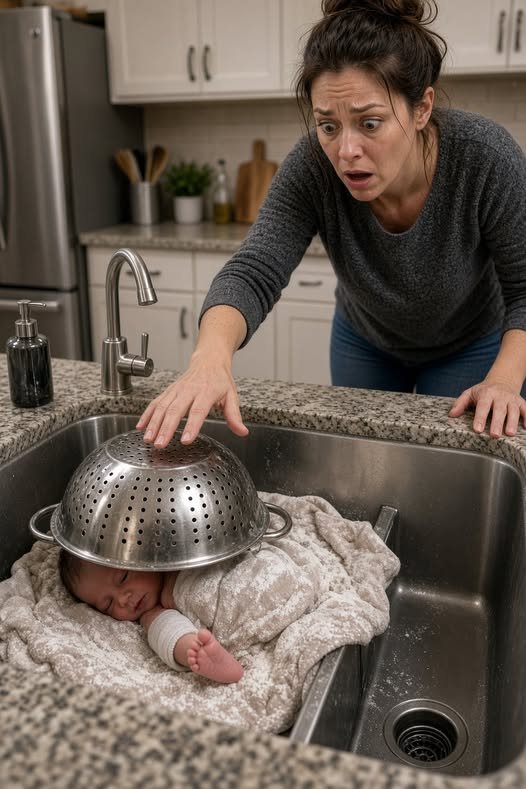
The second wristband was not his. The printed name identified a different newborn.
I stayed crouched beside the cabinet with that tiny sock in one hand and the loose hospital band wrapped around it, while behind me the baby kept crying against his foster father’s chest.
For a few seconds, everything else in the kitchen seemed to rearrange itself around that one object.
The metal colander in the sink.
The flour scattered across the blanket and floor.
The red pressure ring around the baby’s ankle.
The yellow rubber glove.
The swelling under my eye.
And now a second hospital band that had no reason to be hidden underneath the sink.
I stood slowly.
His foster father looked at my hand.
“What is that?”
I held it out without answering.
He shifted the newborn carefully against his shoulder and leaned close enough to read the band.
His face changed.
Not dramatically. He did not shout or throw anything.
His eyes simply stopped moving.
Then he looked down at the baby in his arms and checked the band that was still with him.
Different name.
Different identifying information.
There was no easy explanation for the one in my hand.
“Where did you get that?” he asked.
“Under the sink. It was wrapped around his missing sock.”
He stared toward the open cabinet.
The baby gave another sharp cry, and the sound pulled both of us back to the immediate problem.
Whatever the second band meant, the newborn in front of us needed help first.
I set the sock and wristband on the cleanest section of counter I could find and did not touch them again.
Then I moved toward the baby.
“Let me see his ankle.”
His foster father nodded.
We loosened the flour-dusted blanket without pulling against the baby’s foot.
The pressure ring was still visible around the ankle, red and unnaturally even.
I had seen ordinary blanket creases before.
This was not one.
Something had held fabric tight around that part of his leg.
I could not tell what, and after everything that had happened, I was no longer willing to guess.
“We need someone to examine him,” I said.
“I know.”
He was already reaching for his phone.
His wife was outside the house by then.
I could hear movement beyond the door but could not see exactly what she was doing, and I had no intention of leaving the baby to find out.
My cheek was beginning to swell enough that blinking hurt.
His brow was marked where the mortar had struck him earlier—no, not him. Her. I had to keep forcing myself to separate each moment because the kitchen had become a blur of hands, screaming, flour, metal, and panic.
I had hit her.
That fact mattered.
So did the fact that she had slammed my face into the cabinet first.
So did the fact that she had moved toward me again while the baby screamed behind her.
I told his foster father exactly what had happened, from the moment I entered the kitchen to the moment he came through the door.
I did not soften my part.
“I picked up the mortar,” I said. “I swung once.”
He looked at the heavy stone object on the counter.
Then at my eye.
Then at the sink.
“You thought she was going to attack you again?”
“Yes.”
“And the baby was still in the sink?”
“Yes.”
He closed his eyes for half a second.
When he opened them, he did not ask me to protect him, his wife, or the household from embarrassment.
He asked me to protect the baby.
“Tell everything exactly the way it happened.”
“I will.”
That mattered more than I realized at the time.
In frightening situations, people often start rewriting events almost immediately because the truth feels too ugly to say out loud.
He did the opposite.
He kept the baby against his chest, kept the doorway between himself and his wife, and made the call.
While he spoke, I looked around the kitchen without touching anything.
The flour was not spread evenly.
Most of it was concentrated around the sink and blanket, with smaller streaks on the cabinet edge and floor where the blanket had shaken loose during the struggle.
One yellow glove was still visible.
The colander sat crooked in the sink where I had lifted it from the newborn.
The second hospital band remained beside the missing sock.
Ordinary objects.
Together, they were unbearable.
The baby’s foster father gave the address and described the newborn’s condition first.
Only after that did he explain that there had been a physical confrontation.
Only after that did he mention the second band.
I noticed the order because it showed me where his mind was.
Baby first.
Everything else second.
When help arrived, I stepped away and let the newborn be examined without crowding him.
I answered questions from where I stood.
What had I seen when I entered?
The newborn lying in the sink beneath a metal colander.
What was on him?
A blanket dusted with flour.
Was anything missing?
One sock.
What did I notice after lifting the colander?
A red pressure ring around his ankle and blanket fabric that appeared to have been held tightly.
What happened next?
His foster mother attacked me from behind and drove my cheek into the cabinet.
What did I do?
I grabbed the stone mortar when she came toward me again and struck once.
What did she do after that?
She took the newborn from the sink, held him against her chest, and moved away while I repeatedly told her to put him down safely.
Then her husband entered and took the child from her.
I gave the account in plain sentences because anything more dramatic would have made it less clear.
The strangest part was that the kitchen did not need dramatic language.
The objects were dramatic enough.
Someone carefully placed the second hospital band and the sock where they would not be disturbed.
The foster father kept glancing toward them.
Finally he said, “I don’t recognize that name.”
I looked at him.
“You’ve never seen it before?”
“No.”
His answer was immediate.
He did not reach for the band again.
He did not try to explain it.
That became the next dividing line in the story.
Until then, I had been trying to understand one terrible scene.
Now we had a question reaching beyond that kitchen.
Who was the other newborn?
The answer could not safely come from imagination.
It had to come from records and people who could verify them.
So that was what happened next.
The name and identifying details on the band were documented, and the people responsible for reviewing the foster placement were notified.
No one in the kitchen was allowed to decide what the second band meant simply because we were frightened by it.
That restraint turned out to be important.
A hospital band can prove that an infant was registered somewhere.
By itself, it cannot explain how the band ended up wrapped around a sock beneath somebody else’s kitchen sink.
The baby was taken for a proper medical assessment.
I went too because the swelling beneath my eye had become darker and more painful.
His foster father stayed with the newborn.
The three of us left the kitchen separately from his wife.
I remember looking back once before the door closed.
The flour on the floor looked almost absurdly ordinary.
Like someone had been baking and made a mess.
If I had walked in five minutes later, maybe the sink would have been empty.
Maybe the blanket would have been shaken out.
Maybe the sock and the second band would still have been hidden under the cabinet.
That thought bothered me more than the bruise on my face.
At the medical facility, the baby’s crying eventually softened.
The sound changed from alarm to exhausted fussing, and everyone around him seemed to lower their voice without being asked.
His ankle was examined.
The pressure mark was documented.
So were the circumstances in which I had found him.
No one treated the colander or flour as funny once they understood that a newborn had been underneath the metal bowl.
No one treated my strike with the mortar as invisible either.
I was asked about it again.
I gave the same answer again.
She hit me first.
She moved toward me again.
I believed another attack was about to happen.
I grabbed what was within reach and swung once.
Then I stopped.
Consistency mattered because the facts were already chaotic enough.
Later, when the foster father and I were briefly in the same hallway, he sat with his elbows on his knees and stared at the floor.
“I should have seen something,” he said.
I did not tell him yes.
I did not tell him no.
I had been thinking the same thing about myself.
I had cared for that baby.
I knew the weight of him when he was sleepy.
I knew the small restless kick he made when a sock twisted around his toes.
I knew the difference between an irritated cry and the thin, rising scream I had heard in that kitchen.
And still, before that day, I had never imagined I would find him in a sink beneath a colander.
The foster father rubbed both hands over his face.
“What does the other band mean?”
“I don’t know.”
It was the only answer I trusted.
Then I added, “But somebody will.”
That part proved true.
The band could be traced through the ordinary records connected to it.
The name belonged to an infant who had previously passed through the same caregiving system surrounding the household.
That fact did not automatically prove that the other newborn had been harmed.
It proved something narrower and, in its own way, just as troubling: the foster mother had retained an identifying hospital item connected to another infant, and her husband said he had never known it was in their home.
The discovery widened the review.
People began comparing dates, placements, household notes, and prior concerns instead of treating what happened in the kitchen as an isolated argument between adults.
That distinction mattered.
I had worried that the bruise on my face and the mortar strike would swallow the entire story.
They did not.
The newborn remained at the center of every serious conversation.
Why had he been in the sink?
Why had the blanket been held tightly enough to leave a ring?
Why was his sock hidden beneath the cabinet?
Why was another infant’s hospital band wrapped around it?
And why had the foster mother’s first reaction to me lifting the colander been to attack me rather than check the baby?
Those questions were not answered in one dramatic confession.
Real life rarely works that way.
There was no single speech that made everyone gasp.
There were statements.
Photographs.
Medical observations.
The objects collected from the kitchen.
The foster father’s account of entering and seeing his wife holding the screaming newborn while I stood injured nearby.
My account of what happened before he arrived.
And one small hospital band that should not have been there.
The foster mother denied that the kitchen scene meant what it appeared to mean.
She offered explanations for individual objects.
The flour had an ordinary household purpose.
The colander was kitchen equipment.
The blanket could crease skin.
The sock could have fallen.
Each statement sounded less alarming when separated from the others.
But they had not been separated when I walked in.
The baby had been beneath the colander.
The flour had been on his blanket.
His ankle had carried the pressure ring.
His sock had been missing.
And the sock had been found with another newborn’s hospital band.
Context was the thing she could not remove.
Her husband understood that before I did.
When he was asked whether he wanted to change any part of his statement after hearing her explanations, he said no.
He did not add an accusation.
He did not exaggerate.
He simply refused to erase what he had seen.
That decision cost him.
Whatever their marriage had been before that afternoon, he was now choosing the baby’s immediate safety over protecting his wife from scrutiny.
There was no triumphant moment in it.
He looked exhausted.
He looked sick.
But he kept showing up.
The newborn was moved out of the situation while the adults responsible for the placement reviewed what had happened.
His foster mother no longer had unsupervised access to him during that process.
I was relieved, but relief did not feel clean.
I kept seeing his bare foot sticking out from beneath the colander.
I kept remembering how light the metal had felt when I lifted it.
That detail stayed with me because the object itself was not frightening.
It was an ordinary colander.
That was the horror of it.
Anything ordinary can become frightening when it is used around someone too small to protect himself.
Weeks later, the bruise beneath my eye had changed from deep purple to a dull yellow and then faded.
The story did not fade with it.
I was asked more than once whether I regretted swinging the mortar.
I regretted that the moment ever existed.
I regretted walking into a room where a newborn was in danger and where another adult chose violence before explanation.
But I did not regret stopping after one strike.
I did not chase her.
I did not try to punish her.
The instant the baby came between us, I opened my hands and changed what I was doing.
That choice became important to me afterward.
Not because it made me heroic.
Because it reminded me that protecting someone vulnerable is not the same thing as winning a fight.
Sometimes protection means reaching.
Sometimes it means stopping yourself from reaching because the person you are trying to save could be hurt in the struggle.
Sometimes it means telling the truth even when part of that truth makes you uncomfortable.
The foster father eventually returned to the house with other people present to collect necessary belongings.
He told me later that he could not look at the kitchen sink the same way.
The colander was gone from where it had been that day.
So was the flour.
The cabinet had been cleaned.
Ordinary life had tried to reclaim the room.
But the missing sock remained preserved with the other items connected to the review.
That felt right.
The smallest object in the kitchen had become the one that prevented the story from shrinking into a private dispute.
Without it, someone might have argued that the afternoon was a single inexplicable breakdown.
With the second band, there was a reason to look backward as well as forward.
The review of the earlier infant’s records did not turn into the dramatic nightmare people feared when they first saw the name.
There was no evidence presented to me that the other newborn had suffered the same kitchen scene.
That limitation mattered, and I refused to pretend otherwise.
But the band still raised a legitimate question about boundaries, record handling, and what had been kept from a prior placement.
It also showed how dangerous assumptions can be.
When I first read the unfamiliar name, my mind wanted to race ahead.
I wanted the object to explain everything.
It did not.
It explained one thing.
There had been another infant connected to that household history, and an identifying item from that infant had been hidden with the current baby’s missing sock.
The rest had to be proved separately.
That became the quiet rule I carried away from the entire experience.
Do not make the evidence smaller than it is.
Do not make it bigger either.
The current newborn’s situation was serious enough without invention.
He had been found in a sink beneath a metal colander.
He had a pressure ring around his ankle.
An adult had attacked the person who uncovered him.
He had been grabbed and held during the confrontation.
And another newborn’s hospital band had been discovered with his missing sock.
Those facts stood on their own.
Eventually, I saw the baby again in a safer setting.
There was no flour on his blanket.
Nothing covered him except what was supposed to cover him.
Both socks were on his feet.
I noticed that immediately.
Of course I did.
One of them had started to slide down his heel.
I reached for it, then stopped for half a second because the memory hit me so hard that my hand actually trembled.
Then I adjusted the sock gently.
No tight fabric.
No pressure around the ankle.
No hidden object.
Just a baby kicking because he did not want to keep his sock on.
I laughed once, quietly, before I could help it.
Not because anything about the kitchen was funny.
Because for the first time since that afternoon, a missing sock was allowed to mean something ordinary again.
The newborn kicked his foot free a second time.
I picked up the little sock from the blanket and placed it beside him where everyone could see it.