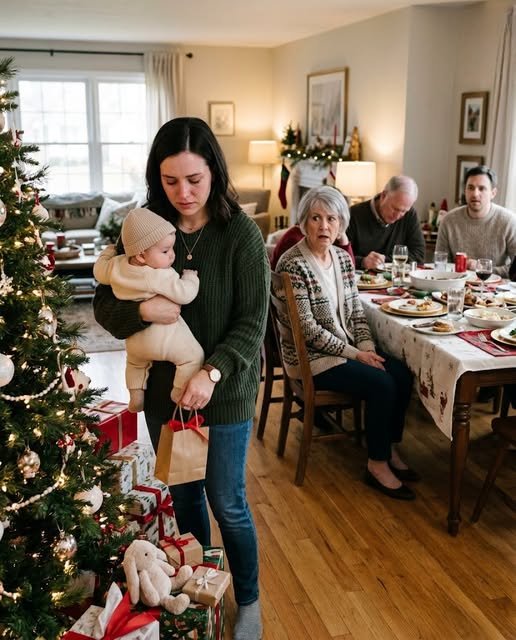
My mother finally drew the paper from her cardigan, but she kept it pinched between two fingers as if letting go of it would cost her something.
She glanced from my sister to me, then down at my daughter asleep against my shoulder.
Only then did she say she had hoped I would never learn the truth under circumstances like these.
The sentence landed harder than the insult at dinner.
A few minutes earlier, I had been leaving because my mother had called my eight-month-old daughter abnormal in front of the entire Christmas table.
Now I was standing in the hallway with a diaper bag cutting into my shoulder, four small presents pressed beneath one arm, and an envelope that apparently contained a secret my sister already knew.
I held out my hand.
“Give it to me.”
My mother did not move.
My sister did.
She stepped between us and said, “Mom.”
That was all.
My mother released the envelope.
It was old enough that the fold lines had gone soft.
My name was written across the front.
Not my married name.
Not the last name I had used during the seven years before my divorce.
My childhood name.
And I recognized the handwriting before I even opened it.
My father’s.
I had not seen his handwriting since I was eleven years old.
According to the story I had grown up with, my father had left because family life became too much for him.
My mother never said he was a monster.
That would have been easier to question.
Instead, she told the story quietly.
He was restless.
He was unreliable.
He loved me, probably, but not enough to stay.
When I was little, I waited for birthday cards that never arrived.
By middle school, I had stopped asking.
By college, whenever somebody brought up my dad, I used the same sentence my mother used.
“He wasn’t really interested in being a father.”
It became a fact because I repeated it enough times.
The letter in my hand was dated seventeen years earlier.
I unfolded it against the hallway table.
The first line made me sit down.
My father wrote that he had come to the house twice that month and had been told not to return.
The second time, he said, my mother met him outside before I knew he was there.
He wrote that he had called, mailed cards, and asked whether he could see me somewhere neutral if she did not want him inside the house.
Then came the line I read three times.
“If she ever asks whether I tried, please do not tell her I disappeared.”
I looked up.
My mother stared at the carpet.
My sister had started crying.
I was not.
Not yet.
I kept reading.
My father admitted that their marriage had been miserable near the end.
He admitted he had made mistakes.
He said he understood why my mother wanted distance from him.
But he begged her not to turn their marriage into my relationship with him.
He asked for phone calls.
Visits.
Anything consistent.
Near the bottom, he wrote that he would keep trying unless I personally told him I did not want him in my life.
I folded the paper once.
Then I opened it again because my hands needed something to do.
“When did you get this?” I asked.
My mother answered so softly that I almost missed it.
“Years ago.”
My sister shook her head.
“No. Tell her the rest.”
My mother’s eyes snapped toward her.
For one second, the old family arrangement came back into focus perfectly.
My mother expected obedience.
My sister expected punishment for breaking it.
And I was expected to make everyone comfortable.
My daughter shifted against my chest.
That tiny movement broke the pattern.
I looked at my sister.
“What rest?”
She wiped her cheek with the heel of her hand.
“I found it in October.”
The envelope suddenly felt heavier.
My sister explained that she had been helping our mother clear boxes from a closet when she found a bundle tied with an old ribbon.
There had not been one letter.
There had been eleven.
Birthday cards too.
A Christmas card with my name on it.
Two unopened envelopes addressed directly to me after I turned eighteen.
My sister had confronted our mother that afternoon.
Mom told her the letters were complicated and that dragging up the past would only hurt me.
My sister believed her for about a week.
Then she went back and read enough of them to understand there was nothing complicated about the part that mattered.
My father had tried to contact me.
My mother had prevented it.
“Where are the others?” I asked.
My mother finally looked at me.
“Put the baby down first.”
It was such a small sentence.
Such an ordinary command.
But after what she had said at dinner, something inside me refused automatically.
“No.”
Her mouth tightened.
“You’re upset.”
“I’m holding my daughter.”
“You’re shaking.”
“I’m still holding my daughter.”
My sister reached for the gifts instead.
I handed her the book, the bunny, and the two crooked boxes.
Then I asked again.
“Where are the other letters?”
My mother said they were upstairs.
I told my sister to get them.
Mom stood immediately.
“No.”
That one word told me more than another explanation could have.
My aunt appeared in the dining room doorway behind us.
She had heard enough to understand what we were talking about.
When my mother looked toward her for support, my aunt said, “Give her the letters.”
My mother stared at her.
My aunt did not look away.
Then my cousin came to the doorway too.
Nobody was eating anymore.
The beautiful Christmas table my mother had spent two days arranging sat behind them with half-filled glasses, cooling turkey, folded napkins, and candles burning lower by the minute.
For once, presentation could not rescue her.
My sister went upstairs.
My mother followed her two steps, then stopped when I said, “If you take those from her, I leave and I never ask you for an explanation again.”
She turned.
“You already said this was your daughter’s last Christmas here.”
“It is.”
My voice surprised me because it was steady now.
“This is separate.”
That distinction mattered.
The letters were about me.
The boundary was about my child.
My mother could tell me a hundred reasons for what she had done seventeen years ago and none of them would erase what she had done ten minutes ago.
She had looked at a baby who trusted every adult in that room and used her as a target because cruelty had always worked in this family when nobody challenged it.
I was done letting those two issues blur together.
My sister returned carrying a small cardboard box.
She set it on the hallway table.
Inside were envelopes with different stamps, different dates, and the same handwriting.
My father had written on birthdays.
Christmases.
The year I graduated high school.
The summer I left for college.
One envelope had my dorm address crossed out and my mother’s address written beneath it.
I picked that one up.
“Why did this come here?”
My mother closed her eyes.
“He contacted me first.”
My stomach dropped.
“When?”
“After you graduated.”
I remembered that year.
I remembered sitting at our kitchen counter while my mother told me my father had probably forgotten what year I finished school.
I had laughed because pretending not to care was easier.
All that time, there had been an envelope somewhere in the same house.
My aunt pulled out a chair from the hallway writing desk and sat down heavily.
My mother began explaining.
She said my father had hurt her deeply.
She said their arguments had become constant.
She said every time he contacted the family, she felt dragged backward into a period of her life she wanted finished.
She told herself she was protecting me from disappointment.
At first, I listened.
Some of what she said might even have been true.
A person can be genuinely hurt and still hurt someone else.
A frightened person can become controlling.
A betrayed person can make selfish decisions while believing they are defensive ones.
But then my mother said something that made the entire pattern visible.
“I knew what was best for you.”
The same certainty she used when criticizing my clothes.
The same certainty she used when telling me my job was going nowhere.
The same certainty she used after my divorce when she inspected my apartment and told me I should move somewhere more respectable before my daughter got old enough to notice.
And the same certainty she had used at dinner while examining an eight-month-old baby as though she were entitled to announce whether my child looked normal enough for the family table.
My daughter made a soft sleepy sound against my neck.
I looked down at her red onesie and the little fist still curled into my sweater.
Suddenly I understood why leaving mattered even more than the letters.
I could spend years untangling what my mother had done to me.
My daughter did not need to inherit the knot.
I placed my father’s first letter back inside the box.
“I’m taking these.”
My mother immediately said, “Some of those were written to me.”
“Then keep yours.”
I separated the envelopes bearing my name.
There were seven.
My sister quietly pushed another birthday card toward me.
Eight.
I put them into the diaper bag beside wipes, a bottle, two spare onesies, and the ridiculous number of things new mothers carry because babies can turn a ten-minute errand into an emergency without warning.
The ordinariness of that bag steadied me.
My life was not in those letters.
My life was the weight on my shoulder.
My mother looked at the bag and said, “You’re really going to walk out over this?”
“No.”
I adjusted my daughter higher against my hip.
“I was already walking out.”
My sister looked down so my mother would not see her reaction.
Mom heard the difference anyway.
She stepped closer.
“I said something badly.”
“You said it twice.”
“I was concerned.”
“You were humiliating her.”
“She’s a baby. She doesn’t know what I said.”
That was the moment the last piece clicked into place.
My mother believed harm only counted when the person being harmed could argue back.
A child who did not understand the words could be insulted.
A daughter who did understand them could be told she was too sensitive.
A father who was not in the room could be turned into a story.
Every version depended on the same thing.
My mother controlled the meaning afterward.
Not anymore.
“She will understand someday,” I said. “And before she does, I want her to know what happens when somebody talks about her like that.”
My mother crossed her arms.
“And what happens?”
“We leave.”
I picked up the presents from my sister.
This time, nobody tried to stop me.
My sister followed me outside carrying the cardboard box.
The cold hit my face hard enough to make my eyes water.
I buckled my daughter into her car seat while my sister stood beside the open rear door, hugging the box against her coat.
“I should have told you in October,” she said.
“Yes.”
She flinched.
I hated that she flinched, but I did not take it back.
Then I said, “But you told me tonight.”
She nodded.
It was not forgiveness wrapped neatly with a ribbon.
It was simply the first honest thing between us.
She handed me the box.
Before closing the door, she touched the bunny sitting on top of my daughter’s gifts.
“Can I come by tomorrow?”
I looked toward the house.
Through the dining room window, I could see my mother standing alone near the table.
Everybody else had moved away from their chairs.
She was no longer the center of the room.
“I don’t know about tomorrow,” I said. “Call me.”
My sister nodded again.
Then she stepped back and let me leave.
At home, I did not read the letters.
That surprised me.
For seventeen years, I had carried a question I did not know was still alive.
Now the answers were sitting inside a cardboard box on my kitchen counter, and I could not make myself open another envelope.
Instead, I put my daughter to bed.
I changed her diaper, warmed a bottle, and stood beside her crib until her breathing settled.
Then I carried her gifts into the living room.
My apartment really was small.
My mother had been right about that part.
The tree stood on a narrow table because there was not enough floor space for a full-size one.
The ornaments did not match.
One strand of lights blinked faster than the other.
Nothing looked like my mother’s Christmas.
I set the soft book under the tree.
Then the bunny.
Then the two boxes I had wrapped after midnight.
Four presents.
Still a small pile.
But here, nothing was tucked beneath branches to disappear.
I sat on the couch with the first envelope after midnight.
My father had died six years earlier.
There would be no reunion.
No phone call.
No dramatic drive across the country.
No chance to demand his side directly.
That fact hurt in a way I was not prepared for.
The letters could correct the story, but they could not return the years.
I read until almost three in the morning.
My father was not a perfect man in those pages.
That mattered to me.
He apologized for missing things.
He admitted anger.
He complained bitterly about my mother in one letter, then apologized for putting me in the middle in the next.
But across every envelope, one fact stayed consistent.
He had not forgotten me.
The birthday cards contained terrible jokes.
The graduation letter said he had heard from a relative that I was planning to study accounting and that he hoped I chose it because I liked it, not because somebody told me it was practical.
I laughed when I read that.
Then I cried so hard I had to put the paper down.
My mother had spent years telling me accounting was the only sensible path.
I had changed majors after one semester.
She never let me forget it.
My father, from a distance, had somehow understood the argument better than the parent sitting across from me at the kitchen table.
Around nine the next morning, my sister called.
She did not ask me to come back.
She did not defend Mom.
She asked whether the baby needed diapers because she was heading to the grocery store anyway.
That was how my family had always shown love when words became too dangerous.
I told her we were fine.
Then I changed my mind.
“Coffee,” I said. “Bring coffee.”
She arrived forty minutes later carrying two paper cups and no speech.
My daughter was on the rug trying to eat the bunny’s ear.
My sister sat beside her.
For a while, we talked about our father.
She remembered more than I did.
She was older when he left.
She remembered arguments.
She remembered him packing a duffel bag.
She remembered our mother standing in the doorway after he came back once.
“I thought he left again,” she said.
“So did I.”
She stared into her coffee.
“Maybe we were both told the same story.”
That became the real beginning of what happened after Christmas.
Not revenge.
Not a screaming confrontation.
Questions.
Dates.
Memories compared carefully instead of automatically trusting whoever spoke with the most confidence.
My aunt called two days later and admitted that she had known my father tried to stay in contact for several years.
She had not known about every letter.
She had known enough.
“Why didn’t you tell me?” I asked.
Her answer was painful because it was ordinary.
“Your mother said it would make things worse.”
There it was again.
Keeping peace.
The phrase I had used for years.
The phrase that had kept everyone quiet at Christmas until my mother aimed her cruelty at someone too small to defend herself.
I stopped using it after that.
Peace is not the same thing as silence.
My mother called repeatedly during the week after Christmas.
I did not block her number.
I also did not answer every time.
When we finally spoke, she spent the first ten minutes explaining the past.
I let her finish.
Then I told her the future had different rules.
She would not comment on my daughter’s body, development, health, appearance, personality, or worth as a way of humiliating either of us.
She would not disguise insults as concern.
If she had a genuine concern, she could speak privately and respectfully once.
If she ignored that boundary, the visit would end.
And there would be no more Christmas at her house unless I saw a lasting change long before the holiday came around again.
She called that punishment.
I called it access having conditions.
For once, I did not argue about the vocabulary.
The letters were harder.
My mother eventually admitted she had hidden them because she believed letting my father back into my life would weaken her relationship with me.
That confession hurt more than her excuses.
She had not only been protecting herself from an ex-husband.
She had been protecting her position.
I told her I needed space from that too.
She cried.
I cried after the call ended.
Neither reaction changed the boundary.
By February, my sister was visiting every other weekend.
Sometimes we talked about the past.
Mostly we did ordinary things.
We folded baby clothes on my couch.
We complained about grocery prices.
She held my daughter while I finally took a shower without listening for imaginary crying through the wall.
The bunny became my daughter’s favorite toy.
One ear was permanently bent because she dragged it everywhere.
My mother sent gifts twice.
I returned the first package because it came with a note blaming me for dividing the family.
The second package came months later with no argument attached.
Inside was a board book and a short note.
It said she was working on understanding the difference between helping and controlling.
I kept the book.
I kept the note too.
Not because everything was fixed.
It wasn’t.
Change deserves to be measured by repetition, not promises.
That year taught me that boundaries are surprisingly boring once the dramatic moment passes.
They are phone calls you do not answer during dinner.
Visits you end when the rules are broken.
Invitations you decline without writing an essay about why.
They are also doors you can open again carefully when someone shows they understand why you closed them.
The following Christmas, my daughter was twenty months old.
She could run badly, climb dangerously, and say my sister’s name in a way that sounded nothing like her actual name.
We spent Christmas morning in my apartment.
My sister came over in sweatpants carrying coffee and a lopsided breakfast casserole.
My aunt stopped by later.
There was no polished table.
No matching glassware.
No perfect centerpiece.
My daughter opened one present, ignored the toy, and played with the wrapping paper for twenty minutes.
Then she found the old bunny beneath the couch and carried it around by the bent ear.
My mother was not there.
That was still painful.
It was also still necessary.
We had begun meeting occasionally in neutral places for short visits, and some went well.
Others ended early.
I no longer treated either outcome as a verdict on whether I was a good daughter.
My job was different now.
I was somebody’s mother.
Near noon, my sister reached beneath our little tree and handed my daughter a soft rectangular package.
My daughter tore the paper open and found another book.
She immediately carried it over to me.
I lifted her into my lap.
The old bunny was trapped beneath one arm, the new book beneath the other.
My sister sat on the floor beside us while I started reading.
Halfway through the first page, I noticed something on the shelf above the tree.
The cardboard box containing my father’s letters was still there.
For most of my life, those letters had represented something taken from me.
Now they meant something else too.
They were proof that another person’s version of my life did not have to become my daughter’s inheritance.
I could not recover the Christmas cards I never opened as a child.
I could not have the conversations with my father that should have happened.
I could not force my mother to become someone different on my schedule.
But I could decide what happened in the room when somebody tried to make my daughter feel small.
That decision had started beside a Christmas table when her tiny hand curled into my sweater.
A year later, she reached up from my lap and turned the page herself.