Mom answered before Stephanie could.
“Before she died, obviously.”
The officer looked down at the page again.
“That isn’t what I asked.”
Stephanie stepped forward.
“The date is right there.”
“Yes,” he said.
Nobody spoke for a moment.
I stayed near the porch with my own folder against my side.
The officer compared Stephanie’s page with my probate documents once more.
Then he asked me:
“Were you ever notified during probate that another person claimed ownership?”
“No.”
“Did you see this document during the estate process?”
“No.”
Mom interrupted.
“Elaine changed her mind afterward.”
I finally looked at her.
“Then there should be a valid record of that.”
Stephanie gave a sharp laugh.
“You always hide behind paperwork.”
I almost smiled.
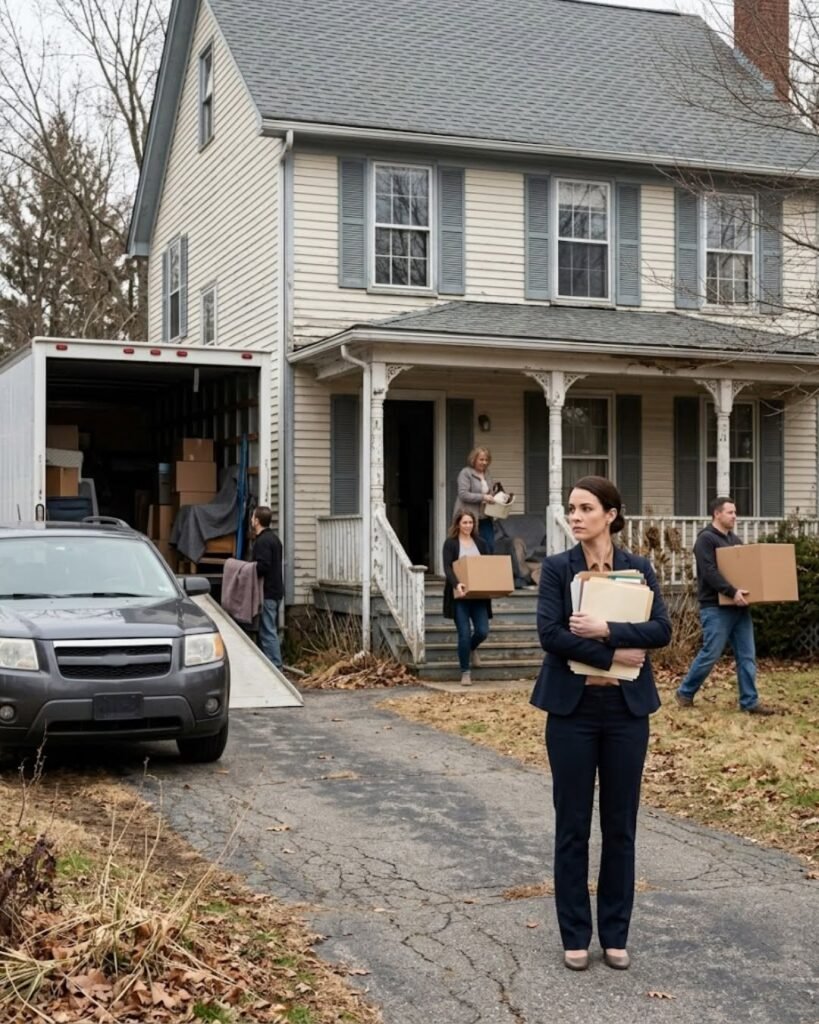
We were standing in the driveway of a house she had arrived to occupy with movers because of paperwork she claimed proved it was hers.
The officer turned the folded page over.
“Where did this come from?”
Stephanie looked at Mom.
Mom looked back at her.
That pause was tiny.
But everybody saw it.
Behind them, one of the movers quietly shut the truck’s rear door.
Mom finally said:
“We found it.”
The officer asked:
“When?”
Another pause.
That was when I understood why they had given me forty-eight hours.
Speed had been part of the plan.
Get me out.
Get Stephanie in.
Turn possession into another argument before anyone slowed down long enough to examine the date.
Grandma Elaine used to tell me that people become impatient when facts stop cooperating.
She never said it in legal language.
Grandma did not talk like that.
She usually sat at the kitchen table with tea and some stack of bills she had already paid three days early.
“Watch people when you ask them to slow down,” she once told me.
“The honest ones may get annoyed. The dishonest ones get desperate.”
I was fifteen.
I thought she was talking about a contractor who had tried to rush her into signing something for the roof.
Years later, standing in her driveway with Mom and Stephanie beside a moving truck, I finally understood why I remembered that sentence.
They had rushed everything.
Forty-eight hours.
That was the first clue.
Not:
Can we discuss Grandma’s wishes?
Not:
We found a document and need to sort out what it means.
Not even:
Stephanie believes she may have a claim.
No.
Move out.
Forty-eight hours.
The house is hers now.
They presented the conclusion before presenting evidence.
And because they were my family, they expected me to react to authority rather than ask where the authority came from.
That had worked before.
Not with houses.
With everything else.
Growing up, Stephanie always got the room she wanted.
The birthday she wanted.
The clothing item she borrowed without asking.
The apology even when the original problem started with her.
Mom had a phrase:
“Be the bigger person.”
It was almost always directed at me.
When Stephanie took my sweater and spilled something on it, I was supposed to be the bigger person.
When she read my journal and told two friends what was inside, Mom said:
“She was curious. Don’t destroy your relationship over this.”
When she backed into my car at twenty-two, Dad helped pay for the damage and then asked me not to mention it again because Stephanie was embarrassed.
I learned early that fairness in our family was flexible.
Elaine did not believe in flexible facts.
That was why I spent so much time at her house.
She did not automatically side with me.
That mattered.
If I was wrong, she said so.
If Stephanie was wrong, she said so.
She could love us both without pretending every conflict needed to end evenly.
I found that revolutionary.
The house with blue shutters became the place where I learned what consistency felt like.
Grandma had bought it with my grandfather long before I was born.
By the time I knew it, the porch boards creaked in specific places.
The kitchen drawer beside the stove always stuck.
One upstairs window needed to be lifted slightly before it would latch.
The rosebushes grew along the side yard.
Grandma complained about them every spring.
“Thorns and mildew. That’s all roses are.”
Then she spent Saturday morning pruning them.
That was Elaine.
She complained about maintenance while maintaining everything carefully.
Money too.
She taught me to keep records.
Not because she distrusted everybody.
Because memory changes.
Receipts do not.
She made me balance a checkbook when I was thirteen.
I complained that it was pointless.
She said:
“Then prove it by doing it correctly.”
Years later, I ended up working around Boston Housing Court.
Maybe that surprised no one more than me.
I became comfortable with documents.
Ownership records.
Notices.
Dates.
The enormous difference between what people believe should happen and what the paperwork actually says.
That did not make me a lawyer.
It made me someone who understood that shouting “mine” does not alter a deed.
When Grandma died, grief arrived before any thought of inheritance.
The house felt wrong without her.
Quiet.
Too clean.
Her sweater stayed over the back of one chair for weeks because I could not bring myself to move it.
Then probate moved forward.
There were procedures.
Records.
The will.
Clear language.
She left the house to me.
I did not celebrate.
There was nothing joyful about receiving property because someone you love is dead.
My family reacted differently.
Mom said:
“Elaine always favored you.”
That was one of the first things she said.
Not:
I’m glad the house will stay in the family.
Not:
Grandma trusted you.
Favoritism.
Competition.
Stephanie said the house should have been divided.
Dad said Elaine probably assumed I would “do the fair thing.”
I asked what fair meant.
Nobody answered directly.
Eventually, fair became obvious.
Give Stephanie some or all of what Grandma left me.
I did not.
That made me selfish.
At least according to them.
For a while, I stopped engaging.
The will was done.
The estate process was moving.
The house passed according to the documents.
That should have ended it.
It did not.
Mom kept bringing up Grandma’s “real intentions.”
Stephanie began talking about memories.
How she had always loved the porch.
How good the school district was.
How much room there would be someday.
The language changed gradually.
Grandma should have left it to both of us.
Then:
Grandma meant for family to use it.
Then:
You don’t really need it.
Then finally:
The house belongs to Stephanie.
That last leap arrived in a phone call while I was leaving work.
“You have forty-eight hours to clear out your things.”
I remember stopping near the courthouse exit.
People moved around me.
Someone hurried toward an elevator.
Someone else was arguing quietly into a phone.
I almost laughed because the sentence sounded absurdly familiar.
Not the words.
The confidence.
I had heard people speak like that in housing disputes.
They assumed declaring a deadline created legal force.
“Forty-eight hours.”
“Why?”
“That house is Stephanie’s now.”
“According to what?”
“You know what this is about.”
I did not.
Not specifically.
Mom hated when questions required specific answers.
“You have until Sunday.”
“Okay.”
Silence.
She expected anger.
“You understand?”
“I heard you.”
Then I hung up.
That night, I opened the file box.
Everything Elaine taught me came back.
Do not argue first.
Check first.
Will.
Probate.
Deed.
Taxes.
Insurance.
Chronology.
Nothing in my records showed what Mom claimed.
That did not mean a new document could not exist.
It meant I had not seen one.
Important distinction.
Anger likes certainty.
Documentation requires patience.
I called a colleague familiar with estate disputes.
I did not ask her to declare my family wrong.
I showed her what I had.
Then explained what Mom said.
Her advice was practical.
“Do not let them inside while this is unresolved.”
That sentence guided the weekend.
Saturday morning, I went to Elaine’s house.
Before anything else, I packed the irreplaceable things.
Photo albums.
Letters.
Recipe cards written in her handwriting.
Jewelry.
A few personal items.
Then the picture.
Grandma and me on the porch.
Blue paint.
I was maybe twelve.
We had decided to repaint one shutter ourselves.
An hour later, we had blue on our shirts, arms, hands, and one streak across Grandma’s cheek.
I took a picture because she looked ridiculous.
She made me get into the frame too.
We laughed so hard the neighbor came over to check on us.
That photograph mattered more than the house.
If something went badly, walls could be repaired.
Documents could be replaced.
Grandma’s handwriting and photographs could not.
After that, I secured the property.
I changed what needed changing.
Set up cameras.
Made notifications where appropriate.
I was careful not to create drama where none was necessary.
No social-media posts.
No family-group warning.
No:
Try me.
Silence.
That bothered Stephanie far more.
Her first text:
When can I come measure for curtains?
Not:
Can we talk?
Curtains.
She had already moved mentally into the house.
I saved the message.
Did not answer.
Dad emailed.
Long paragraph about family unity.
Grandma would want peace.
Stephanie has been struggling.
You’ve always been independent.
That last one irritated me.
Independent was our family’s favorite excuse for giving me less consideration.
You can handle it.
Stephanie needs more.
I read the email.
Saved it.
No response.
Mom’s voicemails became more emotional.
First:
You’re making this difficult.
Then:
Stephanie has already made arrangements.
Then:
People are depending on you to be reasonable.
Arrangements.
That word caught my attention.
What arrangements?
I still did not respond.
Sunday morning, the camera alert arrived.
Vehicle.
Then another.
I went to the window.
Mom’s SUV.
Moving truck.
My body went cold.
Not because I was surprised they came.
Because of the truck.
They had not come to discuss ownership.
They had come to occupy.
Stephanie got out holding keys.
Old keys.
She walked up to the house with the confidence of someone who expected the door to accept her version of reality.
Key in.
Turn.
Nothing.
Again.
Harder.
I watched from behind the blinds.
Mom stepped closer.
Stephanie said something I could not hear.
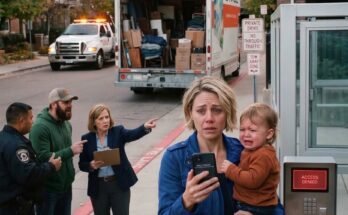
Then the police cruiser arrived.
Calmly.
No siren.
No dramatic lights.
Two officers got out.
The movers noticed immediately.
Their posture changed.
One stepped away from the truck.
That was when I opened the door.
Folder under my arm.
Mom saw me.
Her face transformed.
Public voice.
“Oh, good.”
Bright.
Reasonable.
“Now we can sort this out.”
Of course.
In front of witnesses, everything became a misunderstanding.
I looked at the officer.
He asked:
“Are you the property owner?”
“Yes.”
I provided documents.
No speech.
No:
My sister has always been spoiled.
No:
My mother hates me.
None of that mattered to the immediate issue.
Deed.
Probate.
Will.
The officer reviewed enough to understand why I was inside the house with the door locked.
Then Stephanie laughed.
“Owner? Please.”
That laugh remains one of the clearest sounds in my memory.
Confidence untested by questions.
“Grandma fixed this before she passed.”
She pulled out the folded page.
I had never seen it.
The officer looked at mine.
Then hers.
Then the date.
“When, exactly, are you saying Elaine signed this?”
Mom answered.
“Before she passed.”
He looked up.
“I need the date.”
Stephanie jumped in.
“It says it.”
The officer looked again.
“Yes.”
That one word changed everything.
Not because he declared the document false.
He did not.
Not because he announced a final legal conclusion.
He could not resolve an estate dispute on the driveway.
But the date created a question.
And Mom had not expected questions.
The officer asked me whether the document had appeared during probate.
Not to my knowledge.
Whether I had seen it.
No.
Mom claimed Elaine changed her mind later.
Maybe she believed that.
Maybe Stephanie believed it.
Maybe their page had some explanation I did not understand yet.
I refused to leap beyond what I knew.
But one thing was obvious.
If a document was going to override or complicate the existing ownership trail, it would need more than Mom saying:
“It’s right there.”
The officer asked where it came from.
Mom:
“We found it.”
Stephanie:
“Mom found it.”
Different answers.
Small difference.
Potentially innocent.
Still worth noting.
“When?”
They hesitated.
Again.
The movers had heard enough.
One of them closed the rear truck door.
That action made Stephanie angry.
“We’re still moving in.”
The driver looked toward the officers.
Then toward me.
Then back to Stephanie.
Nobody moved a box.
Good.
The immediate goal had been achieved.
No forced possession.
No unloading furniture while everyone shouted about paperwork.
The officer explained the obvious.
If they had a legitimate competing claim, it could be addressed through the appropriate legal process.
That did not give them permission to force entry that morning.
Mom hated that.
She turned to me.
“You really called police on your own family?”
I looked at the moving truck.
“You brought movers to a house I occupy.”
“That is not the same thing.”
“No.”
I nodded.
“It isn’t.”
Stephanie stepped toward the porch.
“Grandma wanted me here.”
“You can establish that through the proper process.”
“You sound like a robot.”
Maybe.
I had heard that before.
People often call calm people cold when calm removes their ability to control the argument.
Mom tried another angle.
“Can we go inside and talk?”
“No.”
Her face changed.
“Excuse me?”
“No.”
My colleague’s warning stayed clear.
Do not let them inside.
Mom looked at the officer as though he might overrule me.
He did not.
Stephanie laughed.
“This is Mom’s mother’s house.”
I corrected her.
“It was Grandma’s house.”
Then:
“The current records say it is mine.”
That distinction mattered.
Not emotion.
Record.
Stephanie waved the folded page.
“This says otherwise.”
“Then have it reviewed.”
She looked at Mom.
Again.
That glance kept happening.
Checking.
Confirming.
I did not need to accuse them of anything to see that their plan depended on agreement between them.
Dad was not there.
Interesting.
He had sent the family email.
But he did not come with the truck.
Maybe he knew more.
Maybe less.
Maybe he simply wanted no part of the confrontation.
I could not know.
So I did not invent a reason.
Mom eventually said:
“Your grandmother would be ashamed.”
That hurt.
She knew it would.
The old instinct came back immediately.
Explain myself.
Defend love.
Prove Grandma would understand.
Then I pictured Elaine at the kitchen table.
Receipts arranged.
Glasses low on her nose.
Paper remembers.
I looked at Mom.
“Grandma taught me to read what I sign.”
She had no answer.
The officer returned the documents.
No final ruling.
No dramatic declaration that one page was fraudulent.
Just practical limits.
Nobody was forcing entry.
Nobody was unloading furniture.
Any ownership dispute would need proper review.
That was enough for Sunday morning.
The movers approached Stephanie.
Quiet conversation.
She became visibly frustrated.
The truck was leaving.
She had arrived with keys.
Left without entering the house.
Mom stood beside the SUV.
“You’ve humiliated us.”
That sentence almost made me laugh.
They had arrived with a moving truck.
Still, somehow, I had humiliated them by being home.
“You gave me forty-eight hours.”
Mom folded her arms.
“You knew what we meant.”
“No.”
I looked directly at her.
“I knew what you said.”
That was different.
They drove away.
The cruiser left after them.
The moving truck went first.
Then the SUV.
I stood on the porch until the street became quiet again.
No applause.
No victorious music.
Just rosebushes.
Blue shutters.
A house.
Elaine’s house.
Mine according to every completed record I possessed.
Inside, everything felt exactly as it had before.
That surprised me.
The hallway smelled faintly like old wood.
The clock still ticked.
The kitchen drawer still stuck.
I sat at the dining table.
Opened my folder.
Then documented the morning.
Times.
Vehicles.
Who arrived.
What was said.
Stephanie’s key.
The folded document.
The officer’s question about the date.
Mom’s statement about where it came from.
Stephanie’s statement.
No conclusion I could not prove.
That discipline mattered.
Working around legal conflict had taught me how easily people destroy their own credibility by making claims bigger than the evidence.
I would not do that.
I did not know what Stephanie’s page ultimately was.
I knew it raised questions.
I did not know whether Mom had intentionally misrepresented anything.
I knew she tried to make me leave before showing me the document.
I did not know how the dispute would end.
I knew they did not enter the house that morning.
Facts.
That was enough.
My phone started buzzing.
Mom.
Stephanie.
Dad.
I ignored the first two.
Dad left a message.
Can you call me and explain what happened?
I listened once.
Then put the phone down.
For most of my life, I had been the person expected to explain.
Explain why Stephanie was upset.
Explain why Mom’s wording hurt.
Explain why I needed boundaries.
Explain why Grandma’s will should be respected.
That morning, I was done translating everybody else’s choices.
Dad could ask Mom why she arrived with movers.
He could ask Stephanie why she brought a key.
He could ask both of them where the competing document came from.
Those were better questions.
In the afternoon, I went outside with pruning shears.
The roses needed attention.
Of course they did.
I could hear Grandma complaining in my head.
“Ugly things. All thorns.”
Then she would have told me exactly where to cut.
I trimmed one branch.
Then another.
The house stood behind me.
I thought about the forty-eight-hour deadline.
Why forty-eight?
Because urgency creates obedience.
If I had panicked, I might have left.
If I had treated Mom’s certainty as legal authority, Stephanie might have entered.
Once someone occupies a space, conflict becomes messier.
That was what my colleague had warned about.
Slow down.
Secure facts.
Do not let momentum make decisions for you.
The date on Stephanie’s paper might eventually have an explanation.
Maybe not.
That question belonged to a formal review.
But the family tactic had already exposed itself.
They needed me to move before questions started.
They expected my old role.
Flexible.
Independent.
Bigger person.
I disappointed them.
Not by screaming.
By staying.
That evening, I placed Grandma’s blue-paint photograph on the mantel.
We looked ridiculous.
Her hair messy.
My shirt ruined.
Both of us laughing.
I thought about the lesson hidden inside that picture.
Grandma never cared whether things looked perfect while they were being built.
Paint could splatter.
Rosebushes could grow wild.
What mattered was whether the structure underneath was sound.
The family story about the house was not sound.
It depended on pressure.
Mine depended on records.
That did not guarantee I would win every future argument.
Life is not that neat.
But it meant I did not have to surrender before the argument was even properly examined.
Mom had called and said:
“That house is Stephanie’s now.”
Forty-eight hours later, Stephanie arrived with movers, an old key, and one folded page.
I was still inside.
My documents were still intact.
The police were there before anyone crossed the threshold.
And the first serious question anyone asked was not whether Stephanie deserved the house more.
It was about the date.
That was the moment their certainty collapsed.
Not because the whole dispute was solved.
Because for the first time, they had to stop telling me what was true and start proving it.